
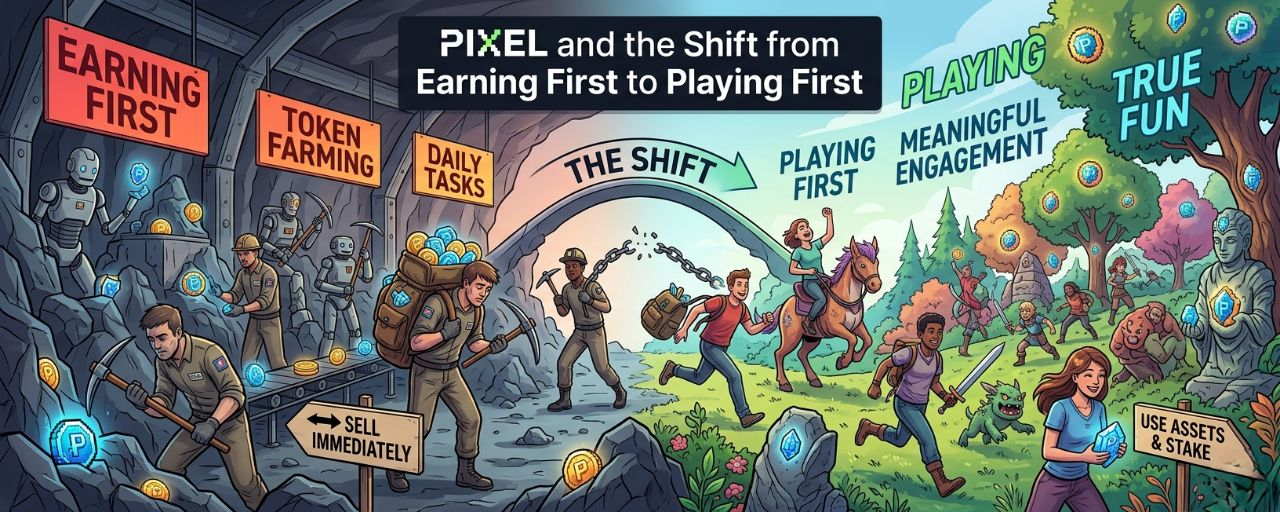

I started noticing something simple over time. Most games do not fail because they lack rewards. They fail when playing begins to feel like a job.
I have seen players log in every day with no excitement. They follow routines. They complete tasks. They chase tokens. Then one day they disappear. Not because rewards ended. But because the reason to stay was never strong enough.
This is where I began to question the foundation of play to earn.
I understand how the traditional system works. The loop is clear.
Play leads to earning.
Earning leads to selling.
At the beginning it feels powerful. Incentives attract attention. Activity grows fast. Economies expand quickly.
But I have also seen what happens next.
Earning stops being a bonus. It becomes an expectation. When that shift happens the system starts breaking from within.
Players stop playing for enjoyment. They start optimizing for returns. Games stop focusing on experience. They start focusing on distribution. What once felt like a world slowly turns into a system.
This is why I believe the direction is changing.
I am seeing a growing focus on what I would call a fun first approach. A game should stand on its own even if no tokens exist. Rewards should support engagement not replace it.
In this model value is not locked into a single environment. Assets can move across experiences. They gain meaning through use not just ownership.
Control also evolves differently. It does not shift instantly. It moves step by step from developers toward the community. This gradual decentralization builds trust instead of forcing it.
I also find the new staking design interesting because it changes how value flows.
Instead of validators being abstract entities games themselves become the core of the system. When I stake I am not just locking tokens. I am choosing which games deserve support. My decision influences how rewards are distributed.
This creates a different kind of pressure.
Games are no longer competing for attention alone. They compete for belief. They need to retain players. They need to create real engagement. They need to prove that players are willing to spend time and value inside their world.
This aligns incentives in a way I have not seen before.
There is also a shift in how rewards are handled. A system where rewards can be used without immediate selling reduces pressure on the ecosystem. It encourages participation instead of extraction.
I keep coming back to one pattern.
When money becomes the main reason players join they slowly become farmers. When systems are built around extraction games begin to feel like economies before they feel like experiences.
This creates difficult trade offs.
If I push earnings higher I often reduce long term engagement.
If I keep control centralized I delay true decentralization.
So I ask myself a different question now.
Would I still play if there were no rewards at all.
Right now I see many projects struggling with the same issue. Early growth looks strong but retention fades. Incentives bring users in but they do not keep them there.
At the same time I notice a quiet shift. More builders are returning to game first thinking. They are focusing on creating experiences that people genuinely enjoy. Rewards are becoming secondary again.
To me this does not feel like a new trend. It feels like a correction.
I believe sustainable ecosystems are not built on constant rewards. They are built on meaningful engagement. They are built on players who choose to stay.
And from my perspective the future of GameFi depends on one simple idea.
If the game is not worth playing without earning then no system can save it.
