
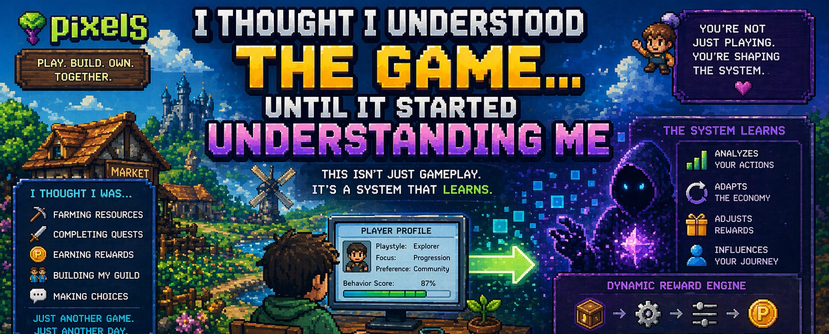
Something about these games doesn’t sit right with me, and I can’t always explain why. It’s not that they’re broken, they work, technically. You click, you earn, you progress. But after a while, it starts to feel like the system understands you better than you understand it. Or maybe worse like you’re trying to understand the system faster than you’re actually enjoying it. That quiet shift from playing to figuring things out always comes earlier than it should.
At first, I thought @Pixels was just another version of that loop. Farming, crafting, repeat. A token layered on top to give everything a sense of value. I’ve seen enough of these systems to know how they usually unfold. You start by playing, then slowly transition into optimizing. The game fades into the background, and what remains is a process you’re trying to run more efficiently than everyone else.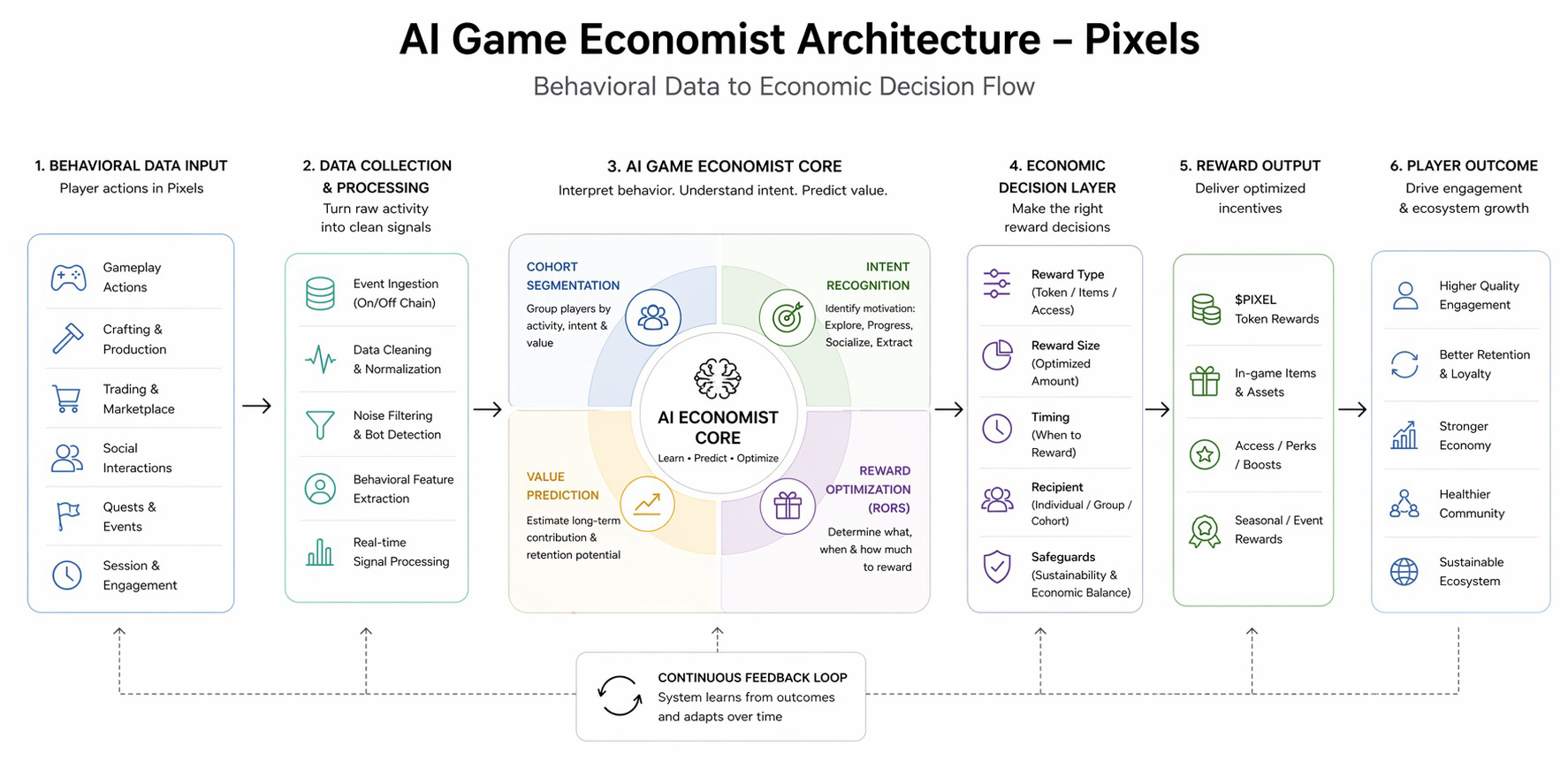
But something didn’t fully match that expectation. I couldn’t point to a single mechanic, but the outcomes didn’t feel entirely predictable. Two players doing similar things weren’t always ending up in the place. At first I thought it was randomness, or maybe just uneven design. But the more I stayed, the more it felt intentional like the system was looking at something deeper than just surface level activity. I think this is where their RORS system is actually operating, quietly in the background.
That’s when I started thinking less about the game itself and more about what might be happening underneath it. Most Web3 games treat players as a single category, But here, it felt like players were being grouped quietly, almost invisibly. Not by what they did once, but by how they behaved over time. Patterns started to matter more than actions.
It made me realize that the real shift here isn’t just about rewards, it’s about interpretation. Instead of distributing tokens evenly, the system seems to be deciding who should receive what, based on context. Not in a rigid way, but in a way that adapts. Almost like an economist embedded inside the game, constantly observing, adjusting, recalibrating. Not perfect, but not static either.
That changes the dynamic more than it seems. Because once rewards are tied to behavior patterns instead of raw output, the game stops being something you can fully optimize in a simple way. It becomes harder to “solve.” And maybe that’s the point. It doesn’t feel like the system is trying to give more, just trying to give better. Instead of rewarding speed or repetition, it leans toward consistency, intent, and engagement over time, things that are harder to fake.
I still find myself questioning whether that actually holds up under pressure. Because financial incentives have a way of bending behavior no matter how well you design around them. Players will always look for edges. If there’s a system, someone will try to map it. And once enough people figure it out, the same patterns tend to reappear. Efficiency creeps back in.
The token layer makes that tension real. $PIXEL isn’t abstract, it has a market, liquidity, expectations. And like most GameFi tokens, it exists in that fragile space between usage and extraction. If too many players treat it as something to exit, the system feels it. So the question becomes whether this kind of adaptive reward logic can actually slow that cycle down, or just delay it.
If I zoom out, the structure starts to look less like a fixed economy and more like a learning system. Players act, the system observes, rewards adjust, and behavior shifts again. It’s not a one time design, it’s ongoing. That’s a different kind of complexity. Not necessarily harder, but more alive. And that makes it harder to predict where it stabilizes.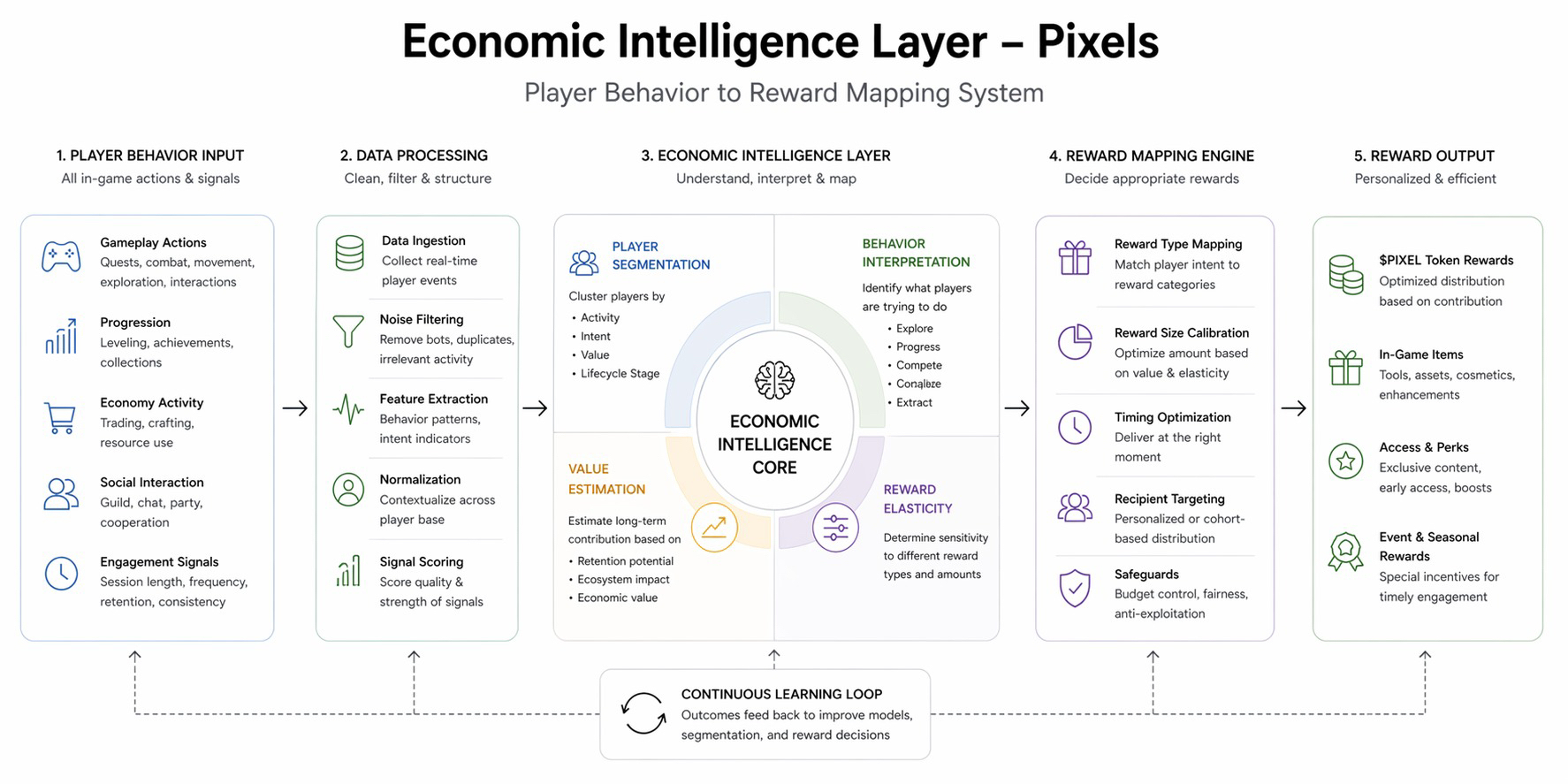
What stands out to me is how this ties back to retention. Not in a forced way, but in a structural one. If the system is constantly learning from players, then it only works if players stay. Otherwise, there’s nothing to learn from. In that sense, retention isn’t just a metric, it’s a dependency. The whole model quietly relies on it.
At the same time, systems like this don’t just work because they’re well designed. They need scale. They need enough players, enough variation, enough data for patterns to actually mean something. Early on, everything is noisy. Signals are weak, behaviors are inconsistent, and the system is still figuring itself out. That phase is always fragile.
So I don’t really see #pixel as just a game, or even just a token. It feels more like an attempt to build an adaptive layer on top of both, something that reacts to players instead of just serving them. Whether that becomes stable or just another variation of the same cycle, I’m not sure yet.
The idea makes sense. The rest depends on execution.