
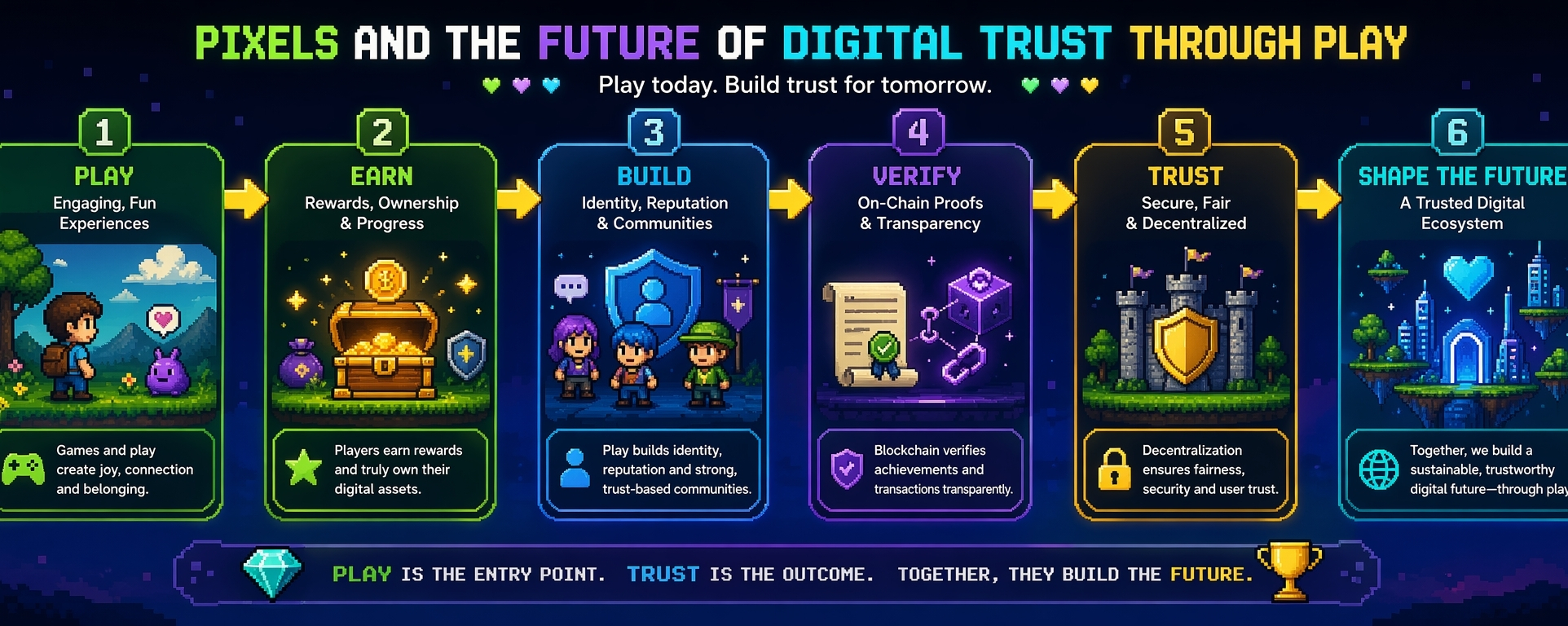
I’ve been paying attention to Pixels for some time now, and the more I observe it, the more I think people often describe it too narrowly. Most see a farming game with blockchain features attached to it. They notice the bright visuals, the social economy, the Web3 label, and then move on. But after spending time watching how it functions, I’ve started to feel that Pixels is doing something more subtle. It is using the language of games to explore how digital societies might organize themselves.
That is what makes it interesting to me.
Some technologies arrive with grand promises and heavy terminology. They announce themselves as the future of finance, governance, ownership, or the internet itself. People naturally become cautious when something introduces itself that way. But when similar ideas are placed inside a game, people approach them differently. They experiment without pressure. They learn systems by instinct. They participate before they fully understand what they are participating in.
Pixels seems built around this insight.
On the surface, players plant crops, gather materials, trade items, explore land, and interact with others. These are familiar game mechanics. Yet underneath those simple actions is a larger experiment: can time, effort, and cooperation in a digital world hold real structure beyond a closed platform?
In most traditional games, everything ultimately belongs to the company running the servers. Your progress exists because they allow it to exist. Your inventory remains yours only within their walls. If the system changes, your relationship with that world changes instantly. Pixels introduces a different framework. Because it is connected to blockchain infrastructure, records can become more durable, ownership more transparent, and exchanges less dependent on a single authority.
That shift may sound technical, but its real impact is psychological.
When people feel that their participation matters inside a system that extends beyond one company’s private database, they behave differently. They become more invested. Communities form with greater seriousness. Trade becomes less about temporary convenience and more about long-term trust. Effort starts to feel like contribution rather than consumption.
This is where Pixels becomes more than entertainment.
I keep noticing that games are often dismissed as distractions, yet they are one of the best places to study coordination. A game is a miniature society. It has incentives, scarcity, cooperation, conflict, reputation, and exchange. If the rules are weak, players expose it quickly. If the economy is unfair, people react immediately. If collaboration is rewarding, communities naturally emerge.
Pixels places these social dynamics on open rails.
That means the game is not only testing whether players enjoy farming loops or crafting systems. It is testing whether online participants can manage resources, create value, and sustain trust in a semi-open environment. That question extends far beyond gaming. It touches the future of digital work, creator economies, and online communities.
Another thing I find compelling is how casually it introduces serious concepts. Many users may enter simply to play, but along the way they learn ideas that used to belong only to technical circles: wallets, ownership, market participation, interoperable identity, transparent records. They learn these things through use rather than theory.
That method matters.
Human beings rarely adopt new systems because of whitepapers. They adopt systems because those systems become useful, enjoyable, or socially meaningful. Pixels seems to understand that adoption often begins with habit, not ideology.
I also think environments like this may become more relevant in the age of AI. As autonomous software becomes more common, we will need digital spaces where actions can be verified, assets can be managed, and interactions follow clear rules. Whether those participants are humans, bots, or AI agents, trust will need infrastructure. In many ways, blockchain game worlds quietly rehearse these future conditions.
Today it looks like players farming and trading.
Tomorrow similar mechanics could support machine-to-machine commerce, AI-managed inventories, decentralized labor networks, or programmable communities. What appears playful now may later look foundational.
Of course, no system is free from tension. Open economies can attract speculation. Incentives can distort behavior. Some participants chase extraction rather than contribution. But those challenges are valuable to witness because they reveal real design problems early. Better to discover flaws inside experimental worlds than inside critical institutions later.
What keeps returning to me is the possibility that future digital institutions may first appear in forms people underestimate. New labor systems may begin as quests. New ownership models may begin as game items. New governance habits may begin in online communities that seem small or unserious at first glance.
Pixels belongs to that category for me.
It is not important because it uses blockchain. Many projects do that. It is important because it asks whether online worlds can become places where people genuinely cooperate, build, exchange, and belong under clearer rules than the internet usually provides