
In crypto, the first thing people usually do is not read the announcement carefully. They glance at the headline, check whether the token moved, and then try to decide whether the market is “early” or already done with it. That habit says a lot. Most participants are not chasing whitepapers; they are trying to make sense of signals in an environment that changes too quickly to fully trust. One day the crowd cares about gameplay, the next day it cares about token sinks, and then suddenly the only thing anyone remembers is whether there is a clear reason to hold the asset beyond a short burst of speculation.
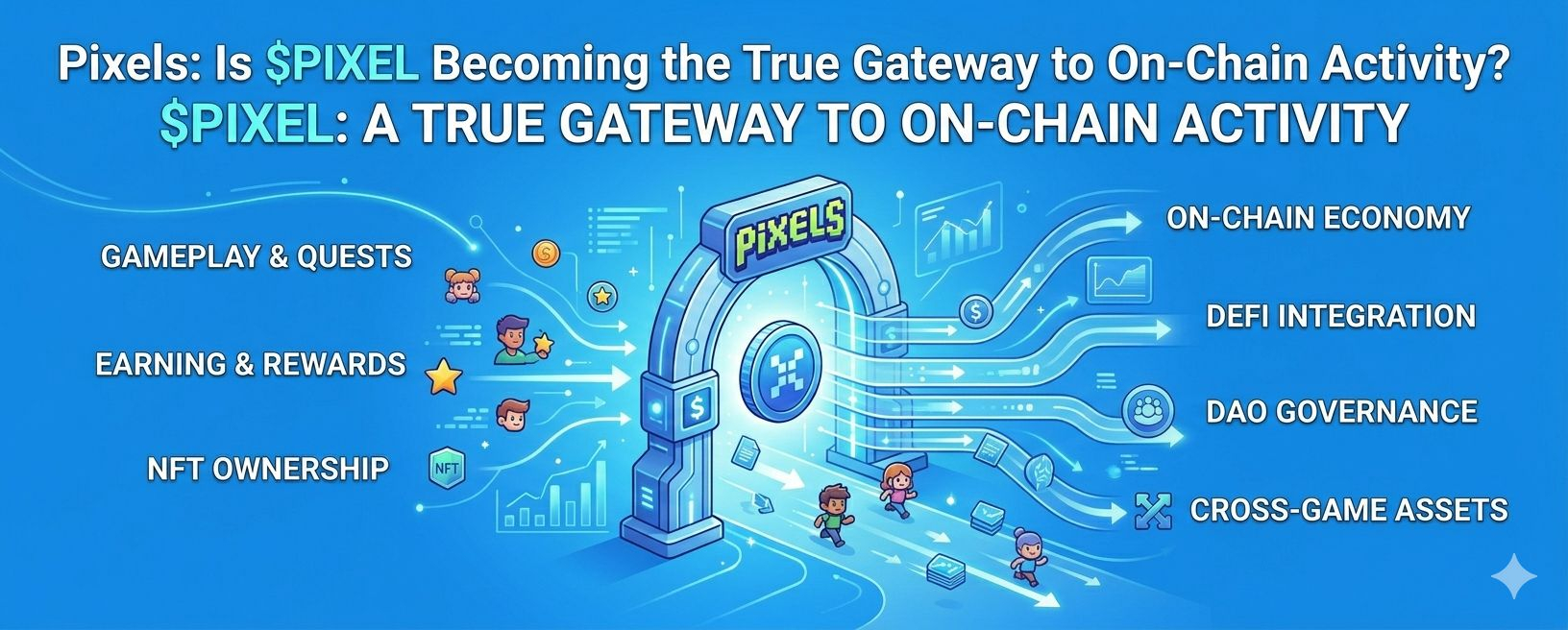
That is why the recent shift around Pixels feels interesting in a quieter, more practical way than most crypto headlines do. On the surface, “minting NFTs in $PIXEL” sounds like the kind of sentence people either overreact to or dismiss too quickly. But when you slow down and look at what it actually means, it is less about a slogan and more about a design decision. Pixels is not just adding another use case in the abstract. It is making $PIXEL the required entry point for a future set of on-chain actions. That changes the shape of user behavior, whether people notice it immediately or not.
There is a meaningful difference between a token being “used somewhere” and a token becoming the gate through which activity has to pass. In the first case, the token is optional enough that users can ignore it when conditions feel uncertain. In the second case, the token becomes part of the workflow itself. That matters because crypto users are extremely sensitive to friction, even when they say they are not. If a token sits off to the side, many will treat it as a tradable object and little more. If it becomes required to access a process, then it starts influencing how people plan, how they prepare liquidity, and how they think about participation.
From a user psychology perspective, this kind of change is subtle but powerful. People rarely say, “I am holding this token because I expect to need it for a future action.” They usually say they are watching, waiting, or staying flexible. Yet once a token becomes the gateway, flexibility gets narrower. A user who expects to participate later has to think ahead earlier. That can create a very different kind of demand than pure speculation, because the token is no longer only a bet on attention. It becomes a practical requirement for engagement.
Of course, that does not automatically make the setup strong. Crypto history is full of projects that tried to engineer utility into a token and ended up creating complexity instead of loyalty. Users may comply with a required token for a while and still feel no emotional attachment to it. They may treat it as a temporary toll rather than a belief-driven position. That distinction is important. A mandatory token can deepen engagement, but it can also turn into a source of annoyance if the value proposition is not obvious enough. People tolerate friction only when they believe the friction is doing real work.
That is where the market dynamics get more interesting. In a crowded environment, not every token needs to become a long-term cultural asset. Some tokens simply need to become infrastructural. A token that acts as a gateway can benefit from repeated functional demand even when sentiment is mixed. But this also means it becomes more exposed to behavior changes. If users begin to see the gateway as arbitrary, they look for ways around it. If they see it as necessary but fair, they accept it. If they think it is being used mainly to force token demand, they get skeptical fast. Crypto participants are surprisingly good at detecting when a design choice feels organic versus when it feels like a mechanical extraction layer.
That skepticism is part of why the Pixels move deserves to be read carefully rather than cheerfully. Making $PIXEL the required route for future NFT minting and on-chain activity is not a guarantee of anything by itself. It is a bet that the project can make the token feel like a natural part of participation instead of a separate financial object tacked onto the experience. The difference is easy to say and hard to achieve. Users do not simply ask, “Is the token needed?” They ask, often subconsciously, “Does the token add clarity or just another step?” If it adds clarity, the system feels coherent. If it adds another step without meaning, users adapt only long enough to complete the task and then mentally detach.
That is one of the reasons this kind of design can be read as a signal about a project’s priorities. It suggests the team is not only thinking about distribution or speculation, but about the economic architecture of the ecosystem. If future on-chain actions require $PIXEL, then the token is being positioned as a coordination layer. That may help align incentives around the network instead of around passive holding. But it also introduces new tradeoffs. Any token that becomes structurally important can face pressure from users who want access without exposure, and from holders who want exposure without constant utility churn. Balancing those two groups is never easy.
There is also the matter of market perception. Crypto markets often reward narratives that are easy to repeat and easy to trade, even when the underlying mechanism is less straightforward. A token becoming “the gateway” sounds clean on a slide, but in practice the outcome depends on how many users actually cross that gateway and how often they return. A requirement that is widely used can create a steady behavioral loop. A requirement that is understood but rarely activated becomes more like branding than infrastructure. The difference between those two can be large, and at the start it is often impossible to know which path a project will take.
Still, one practical consequence is already visible in how participants think about the token. Once a token is tied to future on-chain activity, it is harder to dismiss it as irrelevant metadata. Even skeptical users begin to ask different questions. How many actions will need it? Is the friction justified? Will it be easy to obtain when needed? Does this create healthier participation, or just more dependency? Those are not hype questions. They are system questions. And in crypto, system questions matter more than people admit, because the most durable projects are usually the ones whose mechanics quietly influence behavior over time.
There is an irony here that experienced users will recognize. The more crypto matures, the less convincing pure novelty becomes. Users have seen enough to know that “utility” can be vague, and “community” can be decorative. So when a project like Pixels makes a token central to future on-chain activity, the market is forced to examine whether that centrality is meaningful or merely procedural. That examination is healthy. It keeps the conversation grounded. It reduces the chance that people confuse a design change with a solved problem.
For everyday crypto participants, this is what makes the topic worth watching. Not because every required token becomes successful, and not because every gateway mechanic is wise, but because these choices reveal how a project expects users to behave under real conditions. They show whether the system is trying to create clarity or just capture attention. They also affect how much risk a user is really taking when they decide to participate later instead of now. In a market where people are constantly trying to separate signal from noise, changes like this matter because they shape both the path to entry and the quality of the decision being made. That is usually where the real story is hiding, long before the market has agreed on what it means.
