
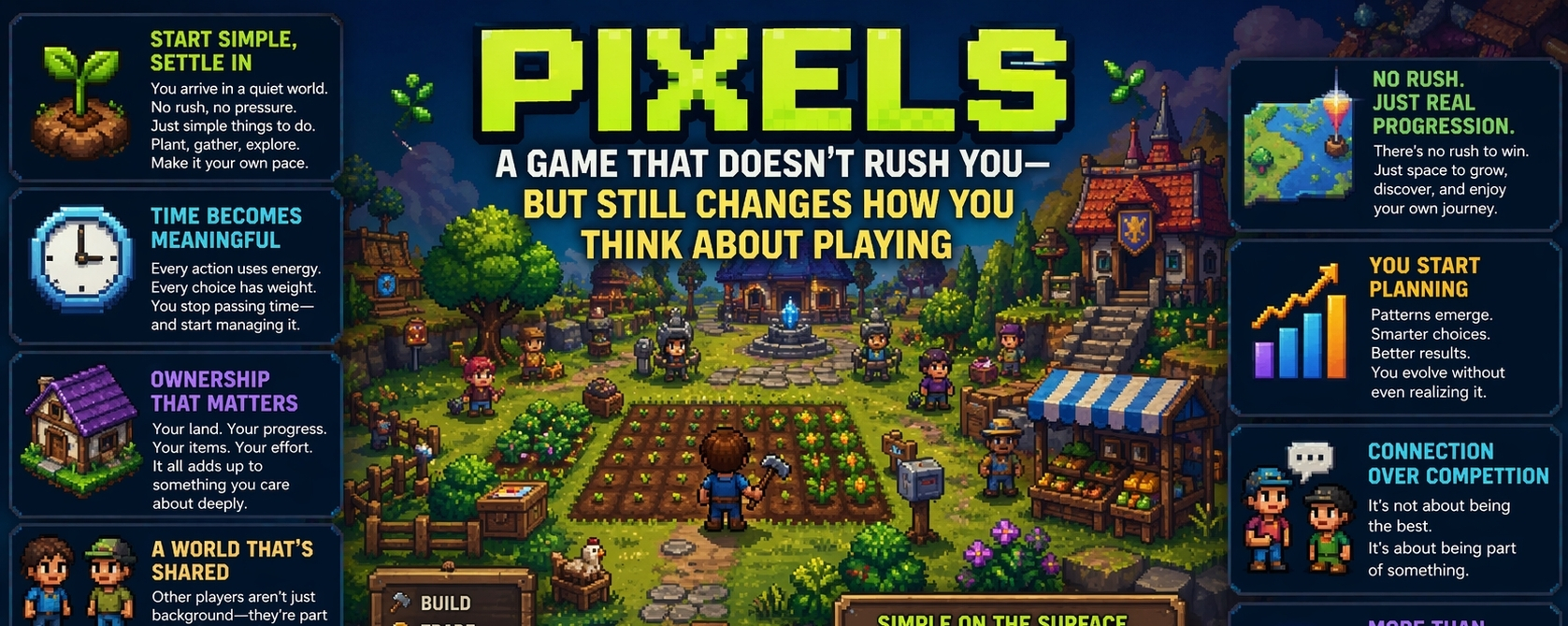
The first time you enter Pixels, nothing really stands out. You’re not thrown into action, there’s no urgency pulling you forward. You just arrive in a quiet world with a few simple things to do. You plant something, walk around, collect a couple of resources. It feels calm, almost uneventful. At that point, it’s easy to think of it as just another farming game.
That’s exactly where Pixels is different. It doesn’t try to impress you immediately. Instead, it lets you settle in. It gives you space to exist in the world without pressure. And slowly, without making a big deal out of it, it starts to change how you experience what you’re doing.
In the beginning, everything feels familiar. If you’ve played farming or simulation games before, you already understand the rhythm. You grow crops, gather materials, craft items. Nothing feels complicated. You don’t feel like you’re learning a system—you feel like you’re just passing time in a relaxed way.
But after a while, your behavior starts to shift. You stop doing things randomly. You begin to notice patterns. Some actions feel more useful, some choices feel smarter. You don’t rush, but you become more aware. Without realizing it, you start thinking about how you spend your time inside the game.
That’s where something subtle changes. Time stops feeling like something you’re just spending and starts feeling like something you’re managing. Every action costs energy. Every decision carries a small weight. You’re still playing casually, but now there’s a quiet sense of intention behind what you do.
Then comes the feeling of ownership. As you progress, the things around you start to feel like they belong to you. Your land isn’t just a place anymore—it’s something you care about. The items you collect aren’t just tools—they’re part of your progress, your effort. That sense of ownership makes the experience more personal without forcing you into it.
At the same time, other players begin to feel more relevant. Early on, they’re just part of the background. But gradually, you start to see how everyone fits into the same system. People trade, build, and contribute in ways that connect with your own progress. The world starts to feel shared, not just populated.
What’s interesting is that the game’s economy doesn’t announce itself loudly. You don’t enter Pixels thinking about value or rewards. You enter to play. But over time, you begin to understand that what you’re doing has weight. Your actions produce something that matters beyond just your own experience.
That realization brings a quiet question with it. If your time has value, and your actions carry meaning, then what exactly is this space? Is it still just a game, or is it something more structured? Pixels doesn’t force you to answer that. It lets you exist somewhere in between.
That’s probably why the experience stays with you. There’s no single moment where everything changes. Instead, it’s a gradual shift. You start planning instead of guessing. You start caring about what you build. You start noticing how others affect your journey. None of it feels dramatic, but together it creates something deeper.
Pixels doesn’t rely on intensity or spectacle. It works quietly. It gives you a simple world, then slowly adds layers of meaning to it. And by the time you realize that it’s more than just a casual game, you’re already involved in a way that feels natural.
In the end, Pixels isn’t trying to rush you into anything. It just lets you stay long enough to understand that what feels simple on the surface can slowly become something much more meaningful underneath.