
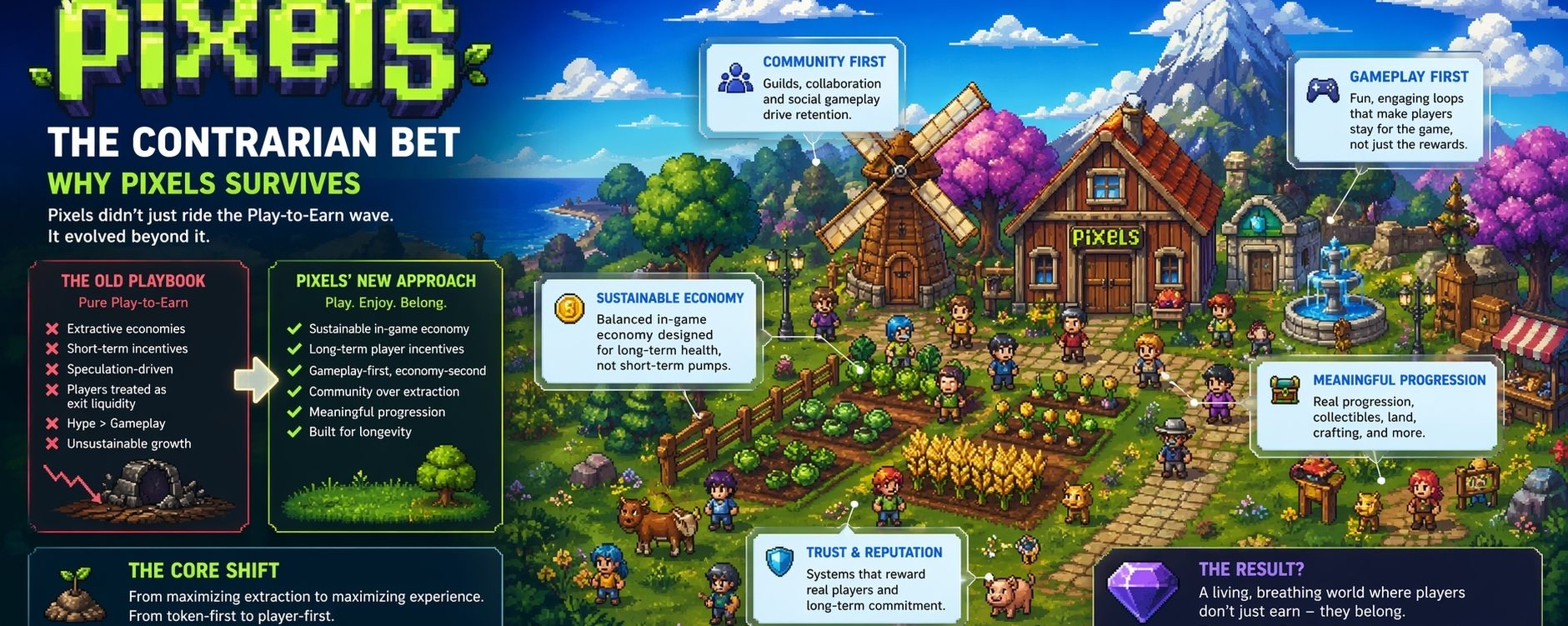
Pixels is one of those projects that says something quietly important about Web3 gaming, and it says it not through grand declarations, but through survival. That may sound like a low bar, but in this sector, it really isn’t. Too many crypto games arrived with explosive momentum, flashy token narratives, and the kind of confidence that only exists before reality has had time to interrupt. They promised players a new economic future. They promised ownership, rewards, freedom, and a world where gaming and earning would finally stop competing with each other. For a while, that vision was enough. People wanted to believe it. Honestly, a lot of people needed to believe it.
Pixels came up in that same environment. It benefited from the same excitement, the same hunger for a breakout project, the same idea that maybe this time a blockchain game could become more than a novelty. But what makes Pixels interesting now is not that it rode that wave. Plenty of projects did. What makes it interesting is that it seems to have understood, sooner than many others, that hype is not the same thing as durability, and a token economy is not the same thing as a living game.
That distinction matters. In fact, it may be the whole story.
At first glance, Pixels had all the ingredients of a classic Web3 success. It was accessible, visually friendly, easy to grasp, and built around a style that felt familiar even to people who weren’t deeply crypto-native. The farming setup helped. Farming games have a strange kind of universal appeal. They feel calm, social, and low-pressure on the surface, but underneath they are incredibly effective at creating habit. Plant, collect, upgrade, repeat. It’s simple, but simplicity is powerful when it’s done well. Pixels wrapped that loop inside a blockchain-based ecosystem and, for a while, that combination seemed to work almost perfectly.
But projects don’t reveal their true nature during the easy phase. They reveal it when pressure starts to build.
And in Web3 gaming, pressure always builds.
The trouble with the early play-to-earn idea was never just that token prices could fall. That was the obvious risk, sure, but not the deepest one. The real problem was that many of these games were designed in a way that encouraged players to think like extractors before they thought like participants. The systems rewarded activity, but not always in a healthy way. They rewarded repetition, farming, grinding, and optimization, but often without building enough emotional weight around the act of playing itself. So eventually the question changed. Instead of asking whether the game was enjoyable, people started asking whether it was still worth their time financially.
That’s where things usually begin to unravel.
Because once a game is judged mainly by yield, everything inside it starts to lose color. The world becomes secondary. The community becomes transactional. Progress turns into output. What should feel like play begins to feel like labor with better art direction. You can only stretch that illusion for so long. At some point, players sense it. They may not say it in those exact words, but they feel it. And when they do, no amount of branding can really hide the emptiness.
Pixels could have gone further down that road. In some ways, for a while, it seemed as though it might. It had the user growth, the economic attention, the kind of momentum that can tempt a project into believing its own marketing. That’s a dangerous phase for any team. If the charts are moving and the community is loud, it becomes very easy to confuse activity with health. A lot of projects never recover from that mistake. They keep feeding the system that made them popular, even when that system is quietly damaging the experience underneath.
Pixels appears to have chosen a different path.
What stands out about the project is that it didn’t keep pretending a pure play-to-earn structure was enough. It adjusted. It started acting less like a token machine with gameplay attached and more like a real live game trying to protect itself from the worst instincts of its own category. That shift may not have looked dramatic from the outside, especially to people who only pay attention when numbers spike, but it was meaningful. It suggested that the team understood something many others were slow to admit: if every part of a game is optimized for extraction, the game eventually gets hollowed out from the inside.
That’s why Pixels feels more interesting as a project now than it did at peak hype.
It feels more self-aware.
There’s something oddly mature about a Web3 project realizing that not every layer needs to be financialized. In crypto, there’s often this urge to put everything on-chain, tokenize every action, and present every mechanic as a market opportunity. It sounds ambitious. Sometimes it even sounds visionary. But in practice, it can make ordinary gameplay feel exhausting. Players don’t want every click to carry economic weight. Most of the time, they want a world that makes intuitive sense. They want progression that feels natural. They want systems that support the experience rather than constantly turning it into a negotiation with a marketplace.
Pixels seems to have moved in that direction. That matters because it changes the feeling of the project. It tells players, even if only indirectly, that the game is not supposed to be a nonstop liquidation event. It’s supposed to be a place where actions inside the world have meaning beyond immediate extraction.
That doesn’t mean rewards no longer matter. Of course they matter. This is still Web3. Ownership, value, and economic participation are part of the appeal. But the healthiest projects are the ones that know where to place those incentives and where to pull them back. There’s a big difference between using a token to enhance a game and forcing the entire game to orbit the token. One creates support. The other creates distortion.
Pixels increasingly looks like a project trying to avoid that distortion.
Another thing that makes the project more compelling is the way it seems to have become more selective, implicitly and explicitly, about what kind of player behavior it wants to encourage. That’s not always an easy conversation in crypto, because the culture often celebrates growth in the broadest possible sense. More users, more wallets, more volume, more noise. But those signals can be misleading. A game can be crowded and still be weak. It can look active while attracting the wrong kind of activity. Bots, farmers, short-term opportunists, and speculative tourists can inflate a project’s image while contributing very little to its long-term health.
A serious game eventually has to confront that.
Pixels seems to have recognized that not all participation is equally valuable. The player who invests time in understanding the systems, building connections, and staying engaged through changing conditions is not the same as the player who arrives only to drain whatever value is easiest to reach. That may sound obvious, but it’s amazing how many Web3 projects were designed as though those two users were basically interchangeable.
They aren’t.
And once a project begins designing around that fact, it becomes more than a reward surface. It becomes a managed world.
That’s where Pixels starts to feel less like a passing GameFi experiment and more like an actual project with shape and intention. The social elements matter here. The community structures matter. The sense of routine matters. People stay in games for strange reasons sometimes. Not always because the rewards are incredible. Not always because the systems are perfect. Sometimes they stay because they like the rhythm of it, or because their friends are there, or because the world has become familiar in a comforting way. Sometimes the stickiness comes from something almost embarrassingly simple: it has become part of their day.
That kind of attachment is hard to fake.
And it’s even harder to build if the project treats players primarily as economic units.
Pixels, to its credit, seems to have leaned further into the parts of the experience that give players reasons to remain present beyond pure financial logic. That is probably one of the smartest things it could have done. Because incentives can attract attention, but they rarely create affection. They rarely create identity. They rarely make players care when the speculative energy cools off.
Projects live or die on that difference.
The comedown phase is where Pixels becomes especially revealing. When the loudest hype fades, what remains? That is the question every crypto game eventually has to answer. The answer is often uncomfortable. In many cases, once the easy profitability weakens, the user base thins, the conversation goes quiet, and the project is exposed as a temporary coordination game rather than a lasting world. That doesn’t necessarily mean the team failed in every respect. It just means the core bond between player and project was never strong enough.
Pixels feels different because even after the most feverish phase, it still has something to work with. Not perfection. Not certainty. But shape. Direction. A clearer sense of what kind of product it wants to be.
And that matters more than people think.
There’s also a deeper lesson inside the project’s evolution. For years, Web3 gaming kept trying to solve the future by making games more economic. More rewards, more ownership, more tradability, more upside. But the better lesson may be the opposite one. Maybe the projects with real staying power will be the ones that learn how to make their economies less intrusive, less dominant, and less central to the emotional experience of play. Maybe the real breakthrough is not maximizing the financial layer, but knowing when to step back from it.
Pixels, in that sense, feels like a project learning the right lesson through trial and error rather than ideology.
That gives it a kind of credibility. Not the loud credibility of a project making impossible promises, but the quieter credibility of something that has been forced to adapt in public. There’s value in that. Teams reveal themselves through what they do when their first model starts showing strain. Some deny the problem. Some distract. Some keep feeding broken systems because they’re afraid of losing momentum. A project that rethinks itself, even imperfectly, is often more serious than one that insists it had everything figured out from day one.
That doesn’t mean Pixels is beyond criticism. Far from it. The project still lives inside a volatile category. It still faces the usual pressures of token attention, shifting player behavior, market cycles, content fatigue, and the constant challenge of proving that the game itself can carry enough weight. None of those issues disappear just because the design philosophy gets smarter. The risk of being pulled back into speculative framing is always there. Every time the market gets excited, there will be pressure to treat the project as a chart first and a world second.
That tension probably never fully goes away.
But even that says something important. Pixels is no longer interesting only because of what people might extract from it. It’s interesting because it seems to be trying to become more than that. It’s trying to become the kind of project that can survive the mood swings of the sector by anchoring itself in something steadier: habit, community, structure, and a version of play that doesn’t collapse the moment profitability becomes less obvious.
Honestly, that may be the most contrarian thing about it.
Not that it embraced the pure dream of play-to-earn better than everyone else, but that it gradually stopped acting as though that dream was enough.
And maybe that’s where the real future of projects like Pixels lies. Not in proving that games should become jobs, not in turning every mechanic into a market, not in pretending that players will stay loyal to a system that only values them as sources of volume. But in building worlds that are sturdy enough to hold an economy without being consumed by it.
Pixels still has to prove that over time. Survival in Web3 is never guaranteed, and gaming is merciless even without the extra baggage of crypto. But as a project, it has already done one valuable thing: it has shown that adaptation is not weakness, and that becoming more like a real game may be the smartest move a blockchain title can make.
That’s why Pixels remains worth watching.
Not because it fulfilled the loudest promises of the early GameFi era, but because it seems to have outgrown them.