
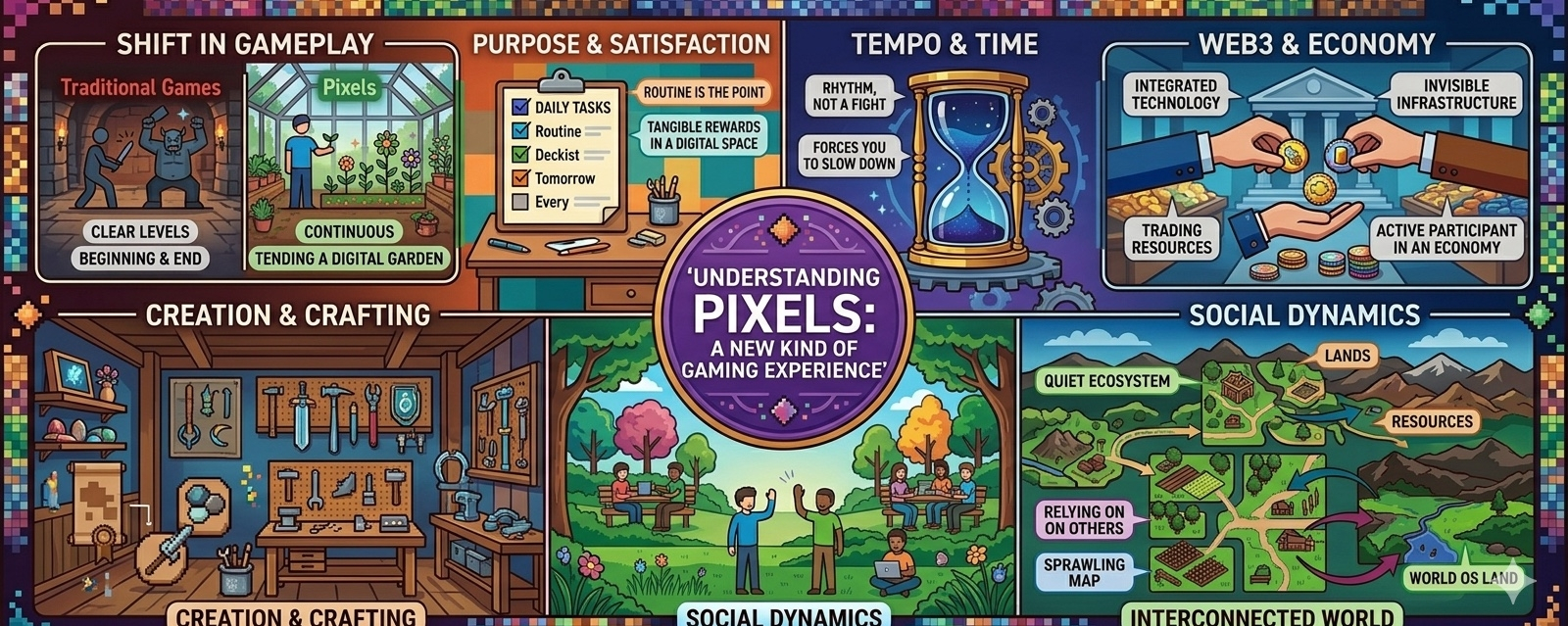
It’s strange how games have changed over the last few years. I remember when gaming was mostly about sitting down, clearing a level, and then closing the app. You had a clear beginning and an end. But lately, I’ve been looking at things like @Pixels , and it feels different. It’s not really about finishing anything. It’s more like tending to a garden that lives in a corner of the internet.
When you first land in the game, it’s… quiet. That’s probably the first thing you notice. You’re dropped into this pixelated world, and there isn’t a huge, dramatic cutscene telling you that you’re the chosen one or that the world is ending. You’re just a person on a farm. You have some seeds, some dirt, and some time. That’s about it.
You can usually tell a lot about a game by how it treats time. In a lot of games, time is a resource you’re fighting against. In Pixels, though, time seems to be a rhythm. You plant something, and then you have to wait. There’s nothing else to do while you wait, really. You can walk around, maybe talk to the other people wandering through the fields, or just watch your plants grow. It forces you to slow down. You can’t rush a digital turnip, no matter how much you might want to.
That’s where things get interesting, I think. Most of the games we’re used to are designed to keep your adrenaline high. They want you clicking as fast as you can. But here, the pace is set by the game’s own internal clock. It’s almost meditative. You find yourself walking back and forth between your plots, checking the status of your crops, and eventually, you stop thinking about "winning" and just start thinking about the cycle. It’s farming, but stripped down to its absolute simplest parts.
The @Ronin Network part of it—the technical side—is there, of course. You can feel the infrastructure underneath it if you look for it. But after a while, you stop noticing the web3 aspect of it entirely. It just becomes the way the world works. You hold your items, you trade them, you move them. It’s just how you interact with the environment. It doesn’t feel like you’re doing finance; it feels like you’re just moving items from your bag to a market stall.
I’ve noticed that people behave differently in a space like this. Since there’s no massive threat, people aren't really competing with each other in the traditional sense. You aren’t trying to kill the other player or conquer their territory. You’re both just… there. You’re both farming. You see someone standing by a fountain or working on a nearby plot, and you just nod and keep doing your own work. It feels more like a shared park than a battlefield.
It becomes obvious after a while that the game is really just a canvas. The developers built the rules—how fast things grow, how you navigate, what you can make—but the actual texture of the world comes from the people who keep showing up. If you stop logging in, your little corner of the world just sits there. It waits for you. There’s something kind of comforting about that, honestly. It doesn’t demand your attention with flashing lights or urgent notifications. It just exists.
The exploration part is where the scale starts to hit you. You start on your own little patch of land, and it feels manageable, almost small. But then you venture out. You find these wider paths, these other areas with different resources, different landscapes. It makes you realize that your farm is just one tiny piece of a much larger, sprawling map. You start to see how everything connects. You realize that you’re relying on resources that someone else had to gather, and they’re relying on something you’re producing. It’s a quiet, interconnected ecosystem.
I remember thinking at first that I’d get bored pretty quickly. I mean, how many times can you plant, water, and harvest before it gets repetitive? But the repetition is actually the point. It’s not about the novelty; it’s about the routine. There’s a strange satisfaction in having a list of chores in a digital space that actually yield something tangible, at least within the context of the game. You learn which crops are worth the time, which ones aren't, and you start to map out your own day. The question changes from "how do I beat this level?" to "how do I want to spend my hour today?"
And there’s the crafting, too. That adds another layer. You take the things you’ve grown, and you put them together to make something else. It feels like you’re actually building up a life. You’re not just a character moving across a background; you’re an active participant in an economy. Even if that economy is entirely virtual, the effort you put in feels very real. You remember that you spent three days gathering the materials for a specific tool, and that tool now has a bit of a history because of it.
I think that’s why people stick around. It isn't because the game is giving them constant, high-octane rewards. It’s because it’s a place to exist. It’s a low-pressure environment where you can just check in, do your bit, see what others are up to, and then step back out into the real world.
Sometimes, when I’m just standing there, looking at the way the pixels are arranged, I find myself thinking about the person who built that specific tree or that specific building. It’s a collaborative project, in a way. Not just by the developers, but by the players themselves. Everyone adds their own bit of energy to the collective experience.
It’s not perfect, of course. Nothing is. Sometimes the movement feels a little stiff, or you have to wait for things to load, or the path ahead feels a bit obscure. But even those little hiccups feel like part of the experience. They remind you that this is a digital space, something being built in real-time. It’s not a finished, polished, dead-end product. It’s an ongoing experiment in how we spend our leisure time.
I find myself wondering what it’ll look like in a year, or five years. Will the fields still be there? Will the people still be walking along the same paths, checking their harvests, trading their goods? It feels like the kind of place that could just keep going, indefinitely, as long as people want to be there.
There’s no pressure to be the best at it. You can’t really "win" at farming, anyway. You just farm. You do it well, or you do it poorly, or you do it just enough to get by. It’s entirely up to you. And in a world that’s constantly shouting at us to be faster, smarter, and more productive, that seems like a quiet little relief.
I suppose that’s the real takeaway. It’s just a place to be, and sometimes, that’s all you really need. You walk your character over to the next plot, click on the ground, and start again. The sun sets in the game, the colors shift, and the world keeps spinning, regardless of whether you're watching or not. And somehow, that feels perfectly fine.
