

When I first learned about Pixels, I assumed I was looking at another game centered crypto project where the token sits at the front and the deeper system stays in the background.But the more I read, the more I felt the real story was developing underneath the surface.What stood out to me was not only the visible game ecosystem, but the infrastructure being built around rewards, retention, and long term player behavior.That is exactly where the Stacked ecosystem starts to feel important to me.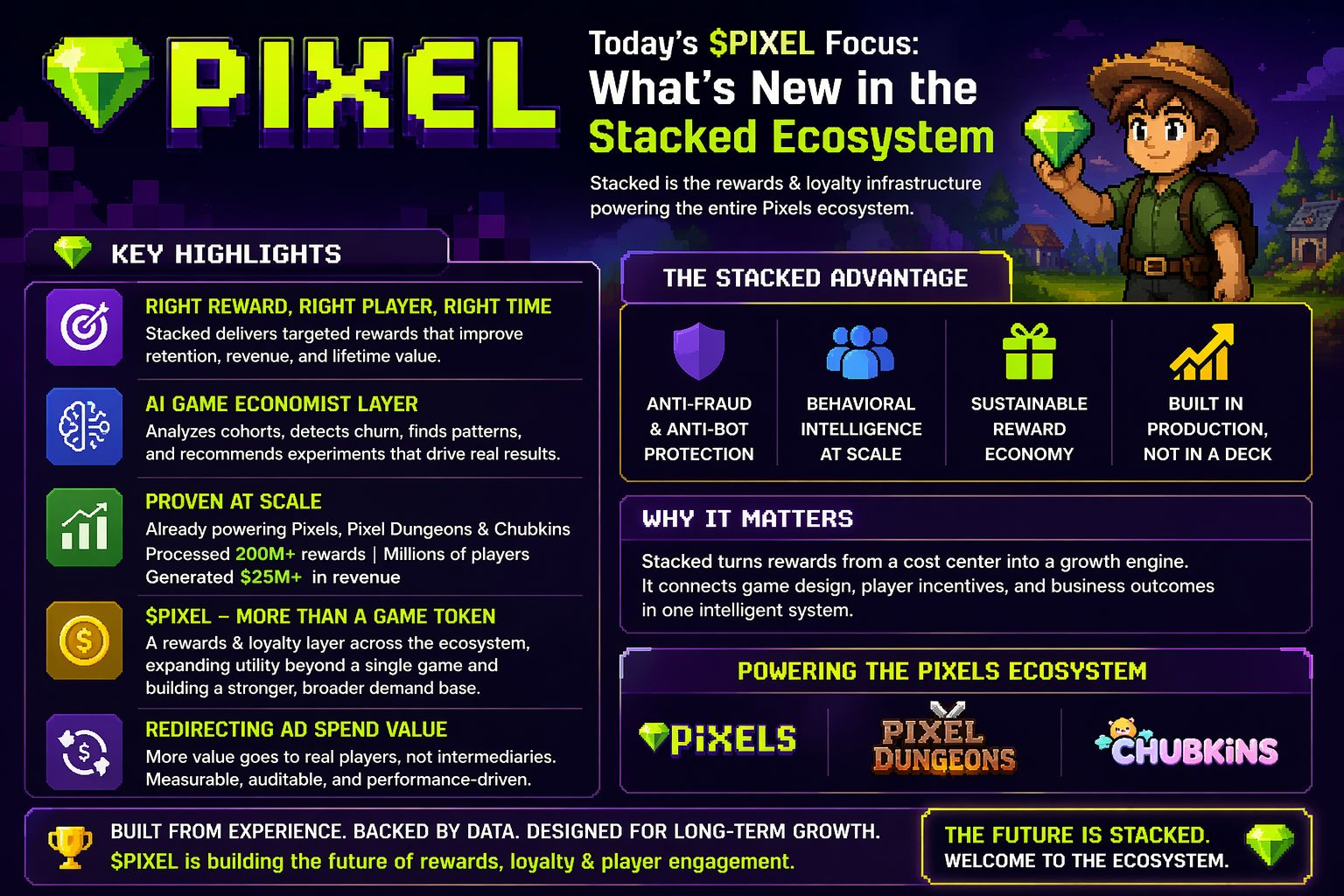
What makes this interesting is that Stacked does not come across like another generic rewards app trying to wrap old ideas in new language.In Web3 gaming, many reward systems look attractive at first, then eventually get damaged by bots, farming, poor targeting, and unsustainable incentive design.That cycle has become familiar enough that I now pay more attention to how a system was built than to how it is marketed. In the case of Pixels, the Stacked direction feels different because it appears to come from years of live testing, mistakes, adjustment, and operational learning inside real games. To me, that matters more than polished branding.
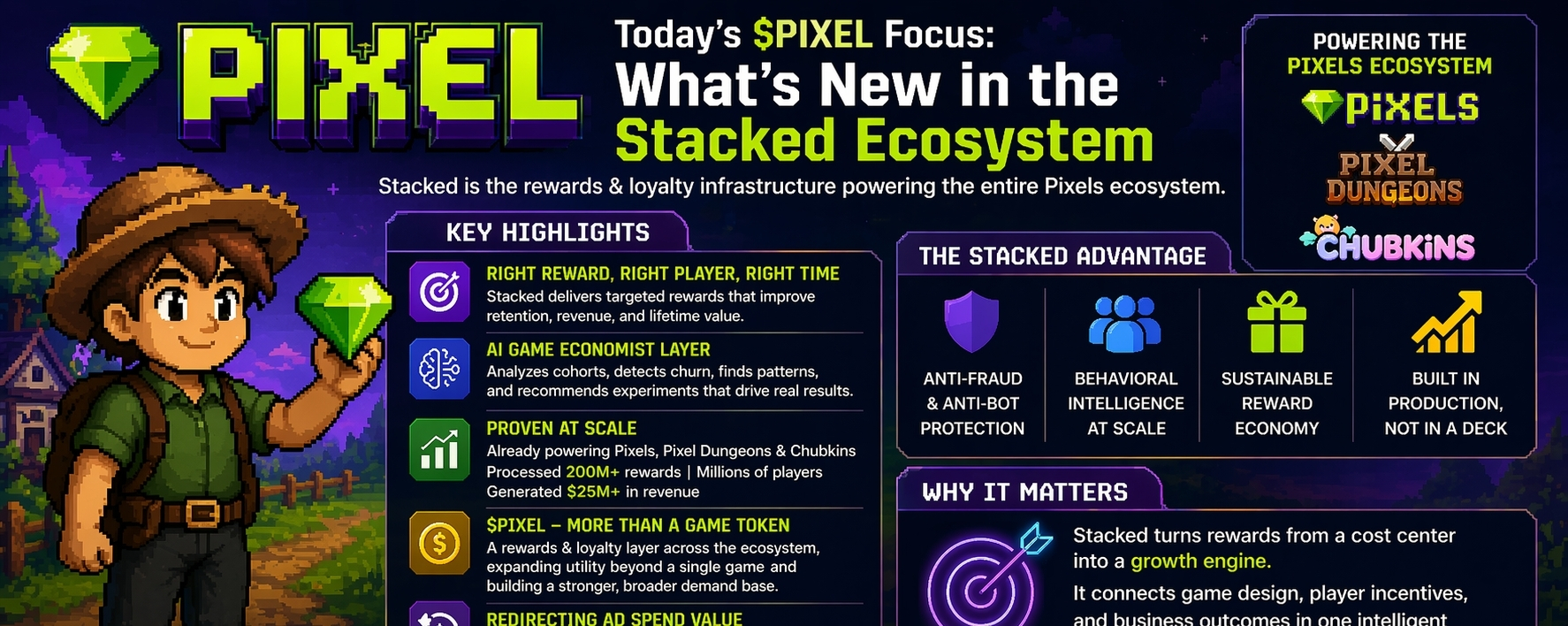
The core idea behind Stacked is also more practical than it first sounds. The goal is not simply to hand out rewards and hope activity grows. The goal is to give the right reward to the right player at the right moment, then measure whether that action actually improves retention, revenue, and lifetime value. That may sound straightforward, but it changes the way I think about game rewards. Instead of treating rewards like a broad distribution tool, Stacked frames them as a precise operating layer. That makes the system feel less like a short-term engagement feature and more like an intelligence-driven part of game economics.
This is where the AI game economist layer becomes the real differentiator for me. A lot of projects mention AI in vague terms, but here the use case feels much more grounded. Studios are not just being offered dashboards or passive analytics. They are being given a system that can analyze player cohorts, detect churn patterns, identify where value is leaking, and suggest experiments worth running next. Questions like why stronger spenders disappear between specific time windows, what loyal users do before they become long-term players, or which mechanics actually correlate with retention are not cosmetic questions. They are the questions that shape whether a game economy remains healthy or slowly weakens over time. If a studio can move from insight to action inside the same environment, that is a meaningful operational advantage.
Another reason I take this more seriously is because Stacked is not being introduced as a whitepaper-only concept. It is being framed as infrastructure that already powers real products inside the Pixels ecosystem, including Pixels, Pixel Dungeons, and Chubkins. That changes the tone immediately. I find it much easier to trust a system that has already been exposed to actual user behavior than one that only looks convincing in a document.The scale shared around Stacked also matters. A system that has processed more than 200 million rewards across millions of players and contributed to over $25 million in revenue is no longer speaking in purely theoretical terms. It is speaking from production experience. In crypto, that distinction matters a lot.
From the token perspective,I think this is also where pixel starts to look more interesting. A token tied only to one game usually carries a narrow narrative and a narrow risk profile. But when the surrounding ecosystem expands, the token’s role can become broader and more flexible. What I find notable is that PIXEL is being positioned not just as a single-game token, but as part of a wider rewards and loyalty framework across the ecosystem. That does not automatically solve every token design question, but it does create a larger demand surface and a more credible utility story. In my view, that is healthier than forcing a token to depend entirely on one title’s popularity.
One of the strongest ideas here, in my opinion, is the thesis around redirecting ad spend. Gaming studios already spend enormous amounts on user acquisition and engagement, but much of that value traditionally flows toward advertising platforms and middle layers rather than directly to players. Stacked pushes a different logic. It suggests that more of that budget can move toward users who actually matter to the game economy, while still remaining measurable and auditable for the studio. I think that is one of the more important shifts in this model. It is not only about rewarding players. It is about changing where growth value goes and making that flow more accountable.
I also think the moat around this type of system is more serious than it may seem at first glance. Many teams can build quest boards, reward menus, and campaign pages. Very few can build fraud-resistant systems, anti-bot protections, large-scale behavioral models, and sustainable reward logic that can survive adversarial usage. Those capabilities usually do not come from a single launch cycle. They come from repeated exposure to real abuse patterns and real economic pressure. That is why the phrase “built in production, not in a deck” feels especially relevant here. It captures the difference between presentation and operational durability.
What keeps my attention on pixel is that this evolution makes the ecosystem look less like a closed game economy and more like a broader infrastructure layer for live game management. That is the part I find most relevant today. The visible feature is rewards, but the deeper story is about targeted incentives, measurable outcomes, and systems that are designed to stay functional under real conditions. For me, that is what feels new in the Stacked ecosystem. It suggests that PIXEL is not just sitting inside a game economy anymore. It is gradually being tied to a wider framework for reward distribution, player loyalty, and ecosystem coordination. That makes the direction of Pixels feel more mature, more scalable, and much more interesting to watch under pixel.
