while watching reward flows hit the chain
While cross-referencing Pixel reward payouts through the Katana DEX pool on Ronin late last week, something small stopped me. Not the volume. It was the distribution shape. Rewards weren't fanning out uniformly the way bot-farmed play-to-earn ecosystems tend to look. There was texture to it — differentiation. Players receiving clearly different amounts for what looked, on the surface, like similar in-game activity.
That's when I went back to actually read what #Pixels and @PixelsOnline shipped on March 26, 2026: the Stacked platform going live on Ronin. I had mentally filed it as a feature drop. It turned out to be something a lot closer to infrastructure.
Stacked is an AI-powered reward system. The narrative is clean: play games, complete missions, build streaks, earn across multiple titles from a single app. That part everyone sees. What sits beneath it is the part that lingered for me.
The $PIXEL token on Ronin has been moving steadily for months — 22 million+ transfers logged, over 238,000 holders at last read. But transfer count tells you nothing about whether those tokens are flowing toward the right players or looping endlessly through bots and alt wallets. That distinction is precisely what Stacked is trying to solve, and it's the reason this launch still feels significant nearly four weeks after it happened.
the mechanic that stuck with me
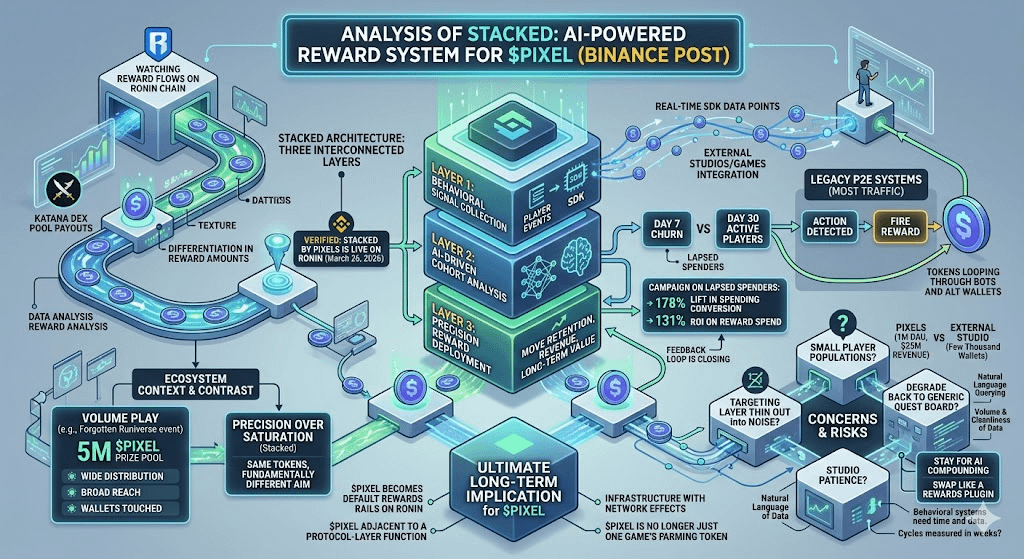
There's a framework inside how Stacked operates that I kept returning to. Three interconnected layers. The first is behavioral signal collection — granular player events tracked in real-time through an SDK studios integrate. The second is AI-driven cohort analysis: figuring out what separates a player who churns at Day 7 from one who's still active at Day 30. The third is precision reward deployment — not emitting tokens based on raw playtime, but targeting specific actions proven to move retention, revenue, or long-term value.
Most P2E systems I've tracked operate only on that third layer. They detect an action, fire a reward. Stacked starts from the first layer and works downward. That's a meaningfully different architecture.
The internal data Pixels shared was the number that made me stop scrolling. A campaign targeting lapsed spenders — players who hadn't transacted in over 30 days — produced a 178% lift in spending conversion and a 131% return on reward spend. Those aren't promotional numbers. That's a feedback loop closing cleanly. The reward wasn't random; it was a function of who the player was and where they sat in their behavioral lifecycle.
Hmm… and this is where the broader ecosystem context matters. Two things are happening simultaneously in Web3 gaming right now: a visible cohort of projects collapsing under inflated token emissions, and a quieter cohort starting to apply real behavioral science to reward design. Stacked sits in the second group — and that shapes how Pixel fits within it.
The Pixels x Forgotten Runiverse cross-game event from earlier this year — where 5 million $P$PIXEL re deployed as a prize pool across another game's ecosystem — is a useful contrast point. That was a volume play: wide distribution, broad reach, measured in wallets touched. Stacked represents a different philosophy entirely. Same tokens, fundamentally different aim. Precision over saturation.
something I'm genuinely unsure about
Actually — and I want to be fair here — the question I couldn't fully settle is how Stacked's AI economist performs when the player population is small. The system was battle-tested inside Pixels, which has reportedly reached one million daily active users and generated over $25 million in cumulative revenue. That's a large enough sample for cohort models to find real signal. But what happens when an external studio integrates Stacked with, say, a few thousand active wallets? Does the targeting layer thin out into noise? Does it degrade back into something that looks like every other generic quest board?
Natural language querying of player data is offered, which meaningfully lowers the technical barrier for smaller teams. That's genuinely useful. But the output quality of those queries still depends on the volume and cleanliness of behavioral data feeding in.
I don't have a clean answer here, and I think that's worth sitting with. This isn't a fatal flaw — it's the honest shape of any early-stage infrastructure product being extended beyond its original controlled environment. Pixels built Stacked from four years of live operation inside their own ecosystem, which is the right way to build something like this. But external studios introduce conditions they haven't controlled before, and scale assumptions don't always travel cleanly.
Acknowledging that feels important before getting too enthusiastic about the architecture.
still pondering the ripple here
The reason Stacked stayed in my head for days is what it implies for Pixel's position inside the Ronin ecosystem long-term. If Stacked becomes the default rewards rails for games building on Ronin — or beyond it — then Pixel isn't just the in-game token for one farming game anymore. It becomes adjacent to a protocol-layer function: the token powering the payout mechanism that other studios depend on.
That's a different category of utility than governance access or VIP membership perks. Those are features tied to one game. This would be infrastructure with network effects. And infrastructure, when it takes hold, tends to accumulate quietly before anyone recognizes it as load-bearing.
I've watched enough on-chain cycles to notice that quiet infrastructure often gets ignored during attention-driven phases and then suddenly becomes structural. The 22 million+ transfer events on the Pixel contract are mostly routine game actions — mundane, expected. But the ones routing through Stacked's behavioral targeting layer are something else. They're intentional, scored, and traceable back to a specific outcome the system was designed to move.
The thing I keep returning to is a simpler, more uncomfortable question: whether the studios that integrate Stacked will stay long enough for the AI layer to genuinely compound — or treat it like every other rewards plugin and swap it out the moment their weekly CAC numbers look inconvenient. Behavioral systems need time and data before they start looking intelligent. They look expensive before they look smart.
Is that kind of patience structurally available in a space that still measures cycles in weeks?