
I keep coming back to Pixels, almost absentmindedly, like revisiting a place that doesn’t seem important at first but slowly reveals a deeper structure the longer you stay. It looks simple—fields, crops, small interactions—but beneath that simplicity there’s a system quietly shaping how people behave with one another. It doesn’t announce itself as revolutionary, and maybe that’s why it’s easier to observe what’s really happening.
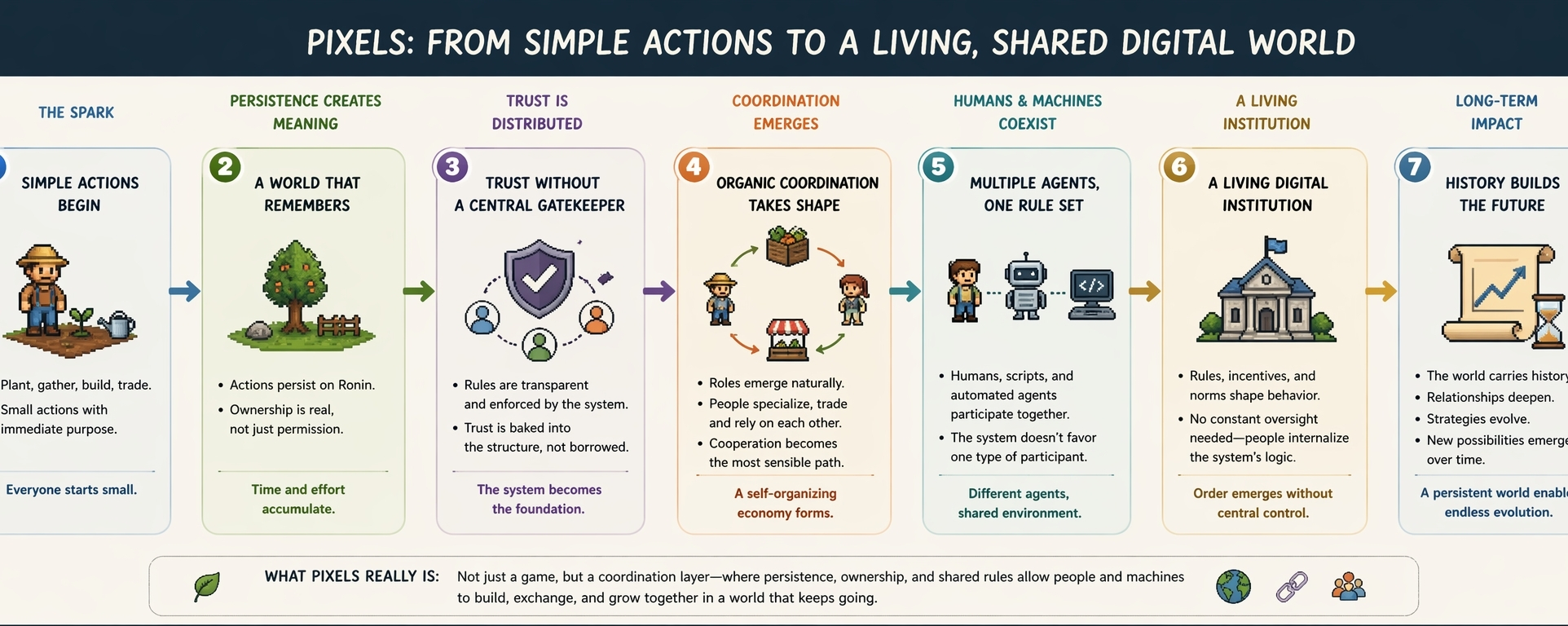
What drew me in wasn’t the gameplay loop, but the feeling that actions inside this world don’t just disappear. There’s a kind of continuity here that most digital spaces lack. When someone plants, trades, or builds, those actions settle into a larger structure that persists. Over time, that persistence begins to influence decision-making. People stop acting casually and start thinking in terms of outcomes that stretch forward, as if the environment itself has a memory they can rely on.
I’m noticing that this changes the emotional texture of participation. In many online systems, trust is borrowed from a central authority—you trust the developer, the server, the rules because they can be enforced from above. In Pixels, that trust feels quieter and more distributed. The underlying infrastructure doesn’t dominate the experience, but it anchors it. Ownership, in particular, feels less like a permission and more like a condition of the system itself. That subtle shift changes how people relate to what they have and what they do.
The longer I observe, the more it resembles a small, self-organizing economy rather than a designed game loop. People begin to specialize without being told to. Some focus on producing, others on trading, others on optimizing routines. These roles aren’t assigned; they emerge. And what’s interesting is how naturally coordination follows. There’s no explicit instruction for cooperation, yet it forms because the system makes it sensible.
I keep thinking about how this environment handles the presence of automation. In most digital spaces, automated behavior is treated as something unnatural, something to be removed. But here, it feels more like an inevitable layer of participation. Scripts, routines, even early forms of machine-driven activity begin to blend into the same framework as human effort. The system doesn’t fully reject them, nor does it fully embrace them—it simply provides a set of rules that both must navigate.
That ambiguity is where things get interesting. It suggests a future where digital spaces are not purely human arenas, but shared environments where different types of agents operate together. The question then isn’t how to exclude machines, but how to design systems where their presence doesn’t break the balance. Pixels doesn’t resolve this, but it quietly exposes the challenge.
Over time, I’ve started to see it less as a game and more as a kind of living structure—something closer to an institution than an application. It has rules, incentives, and a shared understanding among participants, but it doesn’t require constant oversight to function. People internalize its logic. They adjust their behavior not because they’re forced to, but because the system makes certain actions make sense and others less so.
What stands out is how gradual everything feels. There’s no dramatic moment where the system reveals its significance. Instead, it accumulates meaning through repetition. Small actions, repeated across many participants, begin to form patterns. Those patterns become expectations, and eventually, they resemble a kind of order that no single participant controls.
I find myself wondering what happens if systems like this continue to exist over longer periods. If they don’t reset, if they don’t disappear, they begin to carry history. That history becomes a foundation for more complex interactions. Relationships deepen, strategies evolve, and the environment starts to feel less like a temporary space and more like something ongoing—something that people return to not just for activity, but for continuity.
In that sense, Pixels feels like a subtle shift in how digital worlds are constructed. It moves away from the idea of isolated experiences and toward something more persistent and interconnected. The blockchain element plays a role in that persistence, but what matters more is how it shapes behavior. It creates a setting where actions have weight, where participation leaves traces that others can build upon.
I keep thinking that what makes this important isn’t what it claims to be, but what it quietly becomes over time. It’s not trying to redefine everything at once. Instead, it’s showing how simple systems, when given persistence and shared rules, can evolve into spaces where coordination happens naturally.
And maybe that’s the real shift I’ve been noticing. Not a dramatic leap, but a slow reorientation. A movement toward digital environments that feel less like controlled experiences and more like open systems—places where people, and eventually machines, learn to act together under a common structure that no one fully owns, yet everyone depends on.