

I didn’t really question it at first.
It just felt… sustainable.
Not in the loud, obvious way where rewards are constantly thrown at you, but in something quieter. I would log in, complete a few tasks, earn a bit, spend a bit, and log out without that usual feeling of “I need to extract more before it’s too late.” There was no urgency pressing down. No rush to optimize every second.
And that’s when it started to feel different.
Because most play-to-earn systems don’t fail loudly. They fail slowly—under the weight of their own incentives.
At a glance, @Pixels with $PIXEL looks familiar. Tasks, farming loops, resource gathering, a token tied to progression. We’ve seen this structure before. We already know how it usually ends: rewards outpace demand, players optimize extraction, and the system quietly starts bleeding value.
But here, something feels… restrained.
And that restraint might be the system.
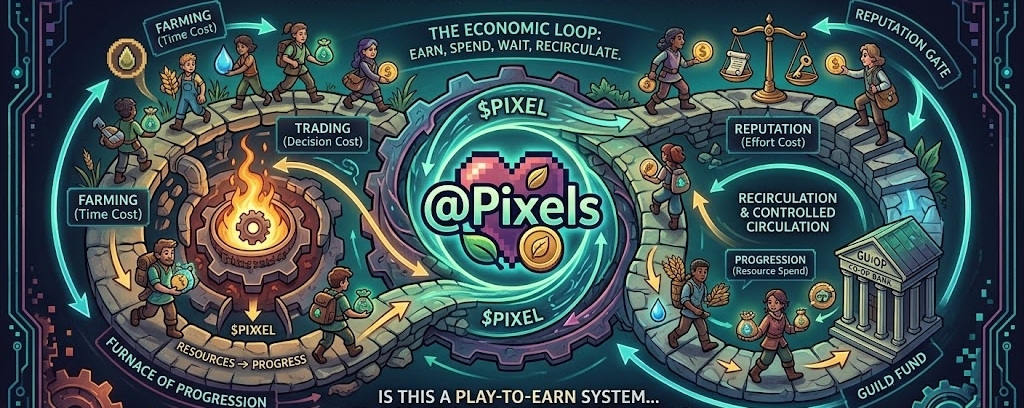
If you look beneath the surface, the economy doesn’t seem built to maximize earnings—it seems built to regulate them. Rewards exist, but they are shaped by time, effort, and friction. You don’t just “earn”; you move through a loop where earning, spending, and waiting are tightly connected.
So the question shifts.
Is this actually a play-to-earn system… or something closer to a controlled circulation model?
Because in most economies, value isn’t created by rewards alone. It’s created by movement. By how often resources change hands, how quickly they return to the system, how many decisions players are forced to make along the way.
And here, every action seems to have a shadow cost.
Time spent farming is time not spent trading. Resources used for progression are resources not sold for profit. Even task completion isn’t just a reward—it’s a filter, deciding who stays engaged long enough to participate meaningfully.
At some point, it stops feeling like a game loop and starts looking like an economic loop.
Which raises an uncomfortable question:
Are players really earning… or are they participating in a system that carefully manages how much they can earn?
That’s where player psychology quietly enters.
Because when rewards are predictable and extraction is easy, players optimize. They stop playing and start calculating. Fun disappears, replaced by efficiency. And once efficiency dominates, the system becomes fragile—because every player is now pulling value in the same direction.
But when friction exists—when time, effort, and limited opportunities shape outcomes—behavior changes. Players don’t just optimize; they adapt. Some trade, some grind, some wait, some experiment.
The system breathes.
Still, that balance is delicate.
Too much control, and players feel restricted. Too little, and the economy inflates. Stability isn’t just about reducing rewards—it’s about maintaining tension between earning and spending, between patience and urgency.
And this is where a subtle shift happens in perspective.
What if the goal of $PIXEL isn’t to let players earn freely… but to keep them circulating indefinitely?
Because a stable play-to-earn economy might not be one where everyone profits. It might be one where no one can easily break the system.
That sounds counterintuitive at first.
But think about it—if every player could consistently extract more than they put in, where would that value come from? And how long could that last?
Sustainability, then, isn’t about generosity. It’s about limits.
And @Pixels seems to understand that.
There are sinks, but they don’t feel forced. There are rewards, but they don’t feel infinite. There are loops, but they don’t collapse into a single optimal path—at least not yet.
Which leads to another question.
Is this balance intentional design… or just a temporary phase before optimization catches up?
Because players always learn. Systems always get mapped. And once they do, hidden efficiencies emerge. What feels balanced today can become exploitable tomorrow.
So the real test isn’t how the system works now.
It’s how it evolves.
Can it adjust as players adapt? Can it introduce new friction without breaking engagement? Can it keep value moving without letting it accumulate in the wrong places?
Or will it eventually face the same pressure every play-to-earn economy faces—the quiet shift from participation to extraction?
Right now, it feels like $PIXEL is walking a narrow line.
Not promising too much. Not giving too much. Not collapsing under its own incentives.
And maybe that’s the point.
Because a stable play-to-earn economy might not feel exciting at first glance. It might feel slow. Controlled. Even slightly limiting.
But maybe that’s what stability actually looks like.
Not explosive growth.
Just a system that keeps going… without needing to constantly prove that it can.
And the real question isn’t whether players can earn from it.
It’s whether they’re willing to stay inside a system where earning is never fully in their control.
Or maybe… that’s exactly why it works.