
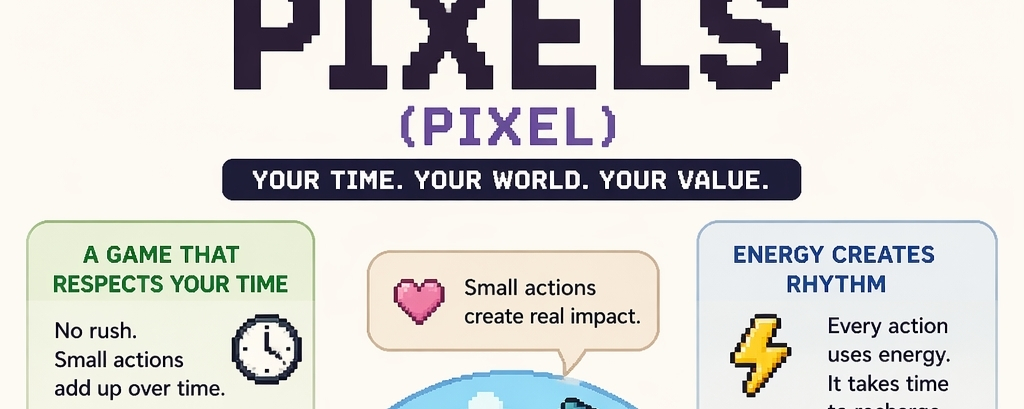
Pixels doesn’t try to impress you right away. It doesn’t rush you or overwhelm you with action. You enter the world, plant something, walk around, maybe collect a few resources. At first, it feels almost too simple, like nothing important is happening. But if you stay a little longer, that feeling begins to change. What looks empty at the surface slowly reveals itself as something much more intentional.
The game isn’t built around excitement. It’s built around presence. It doesn’t ask you to win quickly or progress aggressively. Instead, it quietly encourages you to return, to spend a little time, to engage in small actions that don’t feel significant on their own but start to matter over time. That’s where Pixels begins to separate itself from most games. It doesn’t try to control your pace — it reshapes it.
Everything you do in Pixels is tied to energy. Planting, gathering, crafting — all of it consumes something that takes time to regenerate. At first, this can feel limiting. You can’t just keep going endlessly. You have to stop, step away, come back later. But slowly, that limitation starts to feel less like a restriction and more like a rhythm. The game begins to fit into your time instead of demanding all of it.
And without realizing it, your mindset shifts. You stop thinking only about what to do next and start thinking about what actually matters. Certain resources become more valuable to you. Certain actions feel more worth your time. You begin to notice patterns, small opportunities, quiet advantages. The experience becomes less about playing casually and more about understanding the system you’re inside.
That system is where Pixels becomes something deeper. It isn’t just a farming game, even though that’s what it looks like. Beneath it is an economy, a structure where time, effort, and interaction slowly turn into value. There’s a simple in-game currency that keeps everything moving, familiar and easy to understand. But there’s also the PIXEL token, which exists beyond the game itself. You don’t have to focus on it constantly, but knowing it’s there changes how your actions feel. Your time no longer feels completely isolated. It feels connected to something outside the screen.
Then there’s land, which at first seems like just another feature but gradually reveals its importance. Owning land isn’t just about having space — it’s about having a role in the world. Activity happens around it. Resources move through it. Other players interact with it. It gives you a sense that you’re not just passing through the game, but actually shaping a small part of it. And once that idea settles in, the experience changes. You’re no longer just playing in a world. You’re part of how it functions.
At the same time, Pixels isn’t perfect, and it doesn’t pretend to be. It can feel repetitive. Some moments feel slow, even uncertain. Rewards don’t always match effort in a clear way. But that’s partly because the game isn’t fixed. It keeps evolving. Systems are adjusted, balances shift, new mechanics appear. It feels less like a finished product and more like something that’s still growing, still being shaped by both developers and players.
That ongoing change gives the game a different kind of energy. It’s not about mastering something stable. It’s about adapting, noticing, staying connected. And that connection becomes the real reason to return. Not for a single reward or achievement, but because your time starts to feel meaningful in a quiet, steady way.
In the end, Pixels doesn’t loudly declare what it is. It doesn’t try to convince you that it’s revolutionary. It simply lets you experience it at your own pace until something clicks. You begin with small actions that feel insignificant. Then those actions start to connect. Then they start to matter. And at some point, almost without noticing, you realize you’re no longer just playing a game.
You’re part of a system that responds to your time, your choices, and your presence — and that subtle shift is what stays with you.