
Most games—and, more broadly, most Web3 projects—are structured around a familiar premise: value is defined by what players earn. Tokens, rewards, and yield become the primary lens through which both design and user behavior are interpreted. However, this framing overlooks a more fundamental variable—one that ultimately determines the efficiency and sustainability of any in-game economy: how the system treats player time.
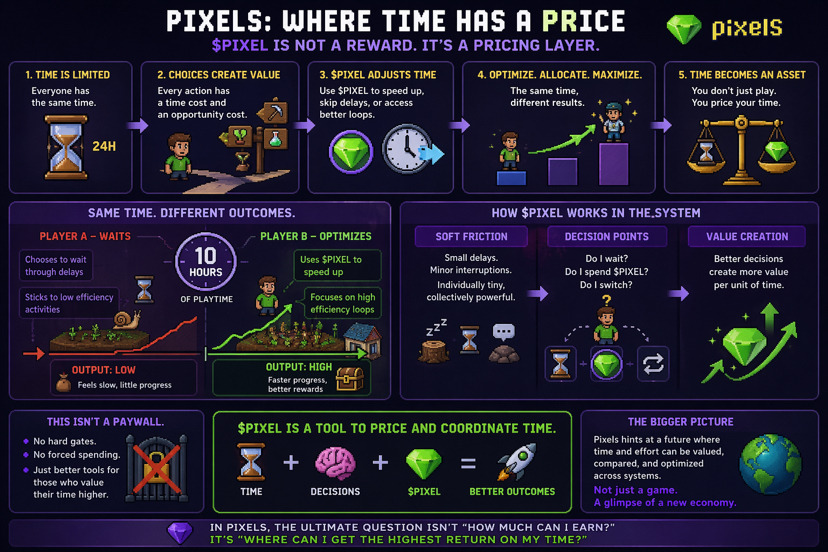
Pixels approaches this problem from a different angle. Rather than focusing on maximizing rewards, it quietly constructs an environment in which time is no longer a passive input. Instead, it becomes an active variable—something that can be measured, compared, and, most importantly, optimized. This shift is subtle and easily overlooked at first, because the surface-level gameplay remains familiar: players farm, craft, wait, and repeat. Yet beneath that loop, a more consequential dynamic begins to emerge.
As players engage more deeply, they find themselves making a continuous series of micro-decisions: whether to wait or accelerate, whether to continue a current activity or switch to a more efficient one, whether the marginal gain of speed justifies the associated cost. At this point, the core question of the game quietly transforms. It is no longer centered on progression in the traditional sense, but rather on the relative value of time across different actions within the system.
In effect, Pixels introduces the conditions for what can be described as a time-based market, without ever explicitly defining it as such. Through the careful use of delays, trade-offs, and optional acceleration mechanisms, the system encourages players to behave as if time itself carries a price. Crucially, that price is not static. It varies depending on context, strategy, and individual decision-making.
This leads to a structurally important outcome: two players can invest the same amount of time yet arrive at significantly different results. The divergence is not driven by randomness, but by how effectively each player allocates and optimizes their time. Efficiency, rather than effort alone, becomes the defining factor.
Within this framework, PIXEL takes on a role that is materially different from that of a conventional reward token. It functions as an adjustment mechanism embedded within the decision layer of the game. There is no explicit paywall, nor is there a forced monetization path. Instead, the system introduces what can be described as soft friction—minor delays and small inefficiencies that, in isolation, appear negligible but collectively create a persistent sense of opportunity cost.
Over time, this design prompts players to internalize a new set of considerations: whether waiting remains rational, whether accelerating certain processes yields a net efficiency gain, and whether their current activity represents the best possible use of their time. Importantly, these decisions are not imposed by the system; they are generated organically by the player in response to the structure presented.
This is not traditional monetization. It is a form of behavioral design, where value extraction is replaced by value alignment. The system does not compel spending; it encourages players to assign a value to their own time and act accordingly. As a result, PIXEL becomes integrated into the player’s decision-making process rather than existing as an external reward.
Once this integration occurs, the nature of the in-game economy shifts meaningfully. Progress is no longer defined by how much a player can accumulate, but by how effectively they can generate output per unit of time. In other words, the system begins to reward optimization over participation.
The implications of this design extend beyond a single game. If such a structure proves robust, it suggests a broader model in which human time and effort can be consistently evaluated and optimized across different environments. While Pixels may not fully realize this vision yet, its current design direction provides a clear indication of where such systems could evolve.
In this context, PIXEL should not be viewed as a speculative instrument tied solely to market cycles. Its significance lies in its function: a tool for pricing and coordinating time within a structured environment. This reframing fundamentally alters how one evaluates both the token and the system it operates within.
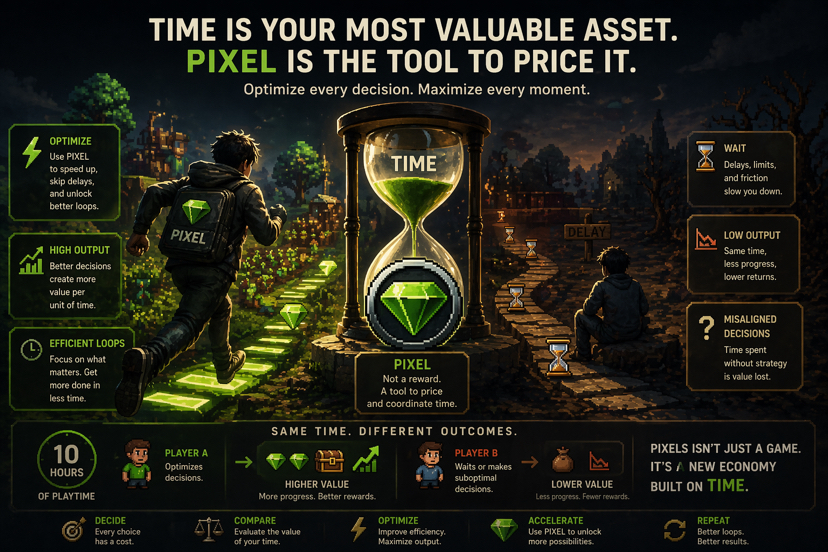
Accordingly, the most relevant question is no longer whether the token will appreciate in price, but whether the user is allocating their time efficiently within the system—and whether that time is being valued appropriately relative to the available alternatives.
