
Bitcoin’s recent drop isn’t the result of a major structural breakdown. The move was largely triggered by renewed geopolitical tension after Donald Trump signaled the possibility of continued strikes on Iran.
That was enough to shake markets.
Oil prices jumped, risk assets pulled back, and Bitcoin reacted exactly as expected. We’ve seen this pattern many times before — when macro uncertainty rises, liquidity exits first, and crypto usually gets hit the fastest because it’s one of the most reactive assets in the market.
The move from the mid-$70K range toward the mid-$60Ks isn’t some hidden mystery. It’s simply a positioning flush.
Short term, the market looks messy — and that’s normal during headline-driven volatility.
But the bigger picture remains intact.
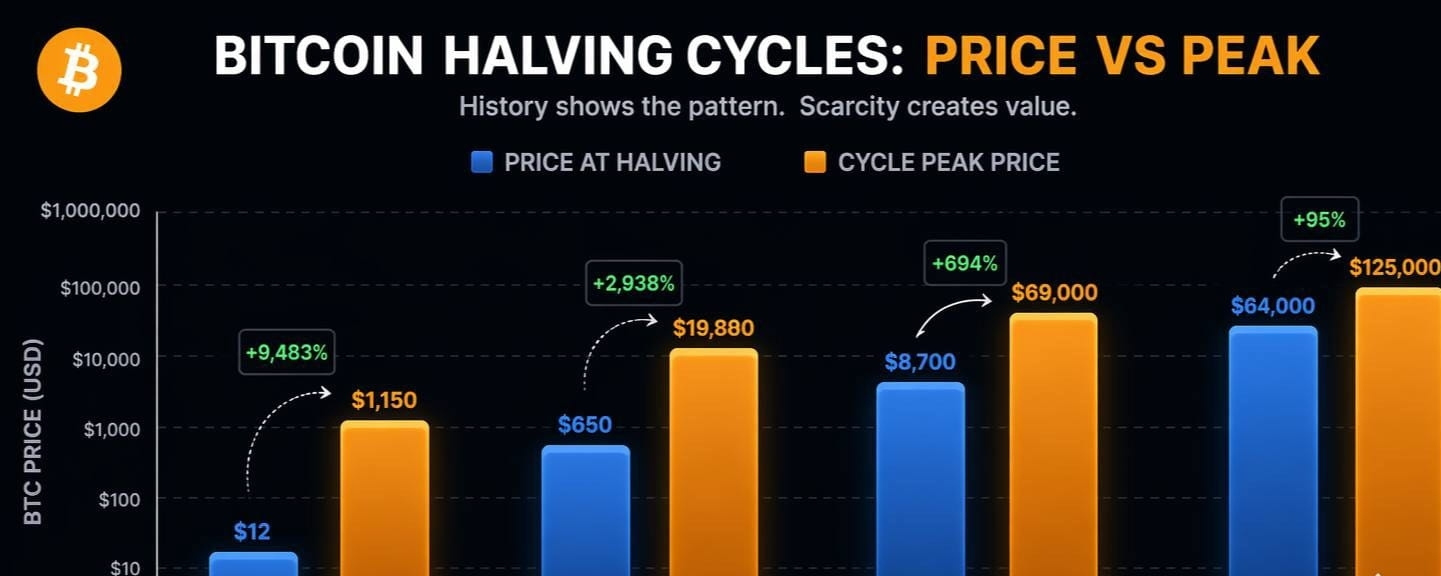
Bitcoin recently came off a cycle top near $125K following the 2024 halving, which aligns closely with historical cycle behavior. The 2012, 2016, and 2020 halvings all produced major upside moves roughly 12–18 months after supply was reduced.
That pattern has repeated for more than a decade.
The core math hasn’t changed.
Every halving reduces new supply entering the market. As long as demand remains stable — it doesn’t even need to surge — price tends to trend higher over time. That’s why long-term cycle analysis still matters.
Right now, we’re simply in the uncomfortable phase of the cycle: the correction.
A 30–40% pullback after a cycle peak is completely normal.
Previous cycles have seen even deeper drawdowns. During the 2020–21 run, Bitcoin experienced multiple corrections near 50% before eventually pushing to new highs.
Painful? Yes.
Unusual? Not at all.
This is typically where weak hands exit and stronger capital begins to accumulate.
What makes this cycle different is the presence of institutional capital.
Since 2024, spot ETFs have attracted tens of billions of dollars, something previous cycles never had. This doesn’t remove volatility, but it does create stronger demand zones and potential downside support.
So if ETF outflows appear during geopolitical stress, that should be viewed more as short-term risk management rather than a structural exit from Bitcoin.
The real question is not whether Bitcoin is dropping.
The real question is:
Is demand structurally leaving the market?
At the moment, the answer appears to be no.
What we’re seeing is macro-driven pressure — higher oil prices, war-related risk, and tighter liquidity expectations. These factors impact all risk assets, including equities and crypto.
However, if tensions begin to ease, the reverse trade becomes very likely.
Oil cools down.
Liquidity expectations improve.
Capital rotates back into high-beta assets.
And historically, Bitcoin tends to move first.
That’s the key asymmetry many traders overlook.
At this stage, the market is clearing excessive leverage, resetting funding, and flushing out weak positioning. From a broader perspective, that can actually be constructive.
Cycle returns may be smaller now than in the past — 10x moves are less common — but the absolute value continues to rise.
That’s how maturing assets behave:
less explosive, but more persistent.
This means the “this time is different” argument works both ways. Upside may be more compressed, but downside is also absorbed faster because larger institutional players are now involved.
Bitcoin is no longer a fringe asset.
It is increasingly tied to global liquidity conditions.
And this week, global liquidity is being shaped by war headlines.
Don’t confuse short-term fear with long-term structure.
The key level to watch now is the $60K–$65K zone.
That range has repeatedly attracted buyers. If it holds under sustained pressure, this likely becomes another standard shakeout. If it breaks decisively, the market may need to reprice lower.
This week is less about narratives and more about reaction.
Watch oil.
Watch ETF flows.
Watch how Bitcoin responds once bad news stops getting worse.
That’s usually where the next major move begins.