
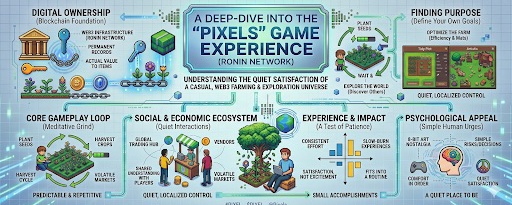
I’ve been spending some time looking at @Pixels lately. It’s one of those games that doesn’t really demand much of your attention at first, but once you start digging into the mechanics, you notice how the whole thing is built. It’s hosted on the Ronin network, which means there’s this layer of digital ownership underneath everything you do.
Usually, when you see a game like this, the first thing people talk about is the economy. They want to know if they can make money or how the tokens work. But if you actually sit down and play it, the money part feels kind of secondary, at least in the beginning. It’s mostly just farming. You plant seeds, you wait for them to grow, you harvest them, and then you do it all over again.
It’s almost meditative. You can usually tell after a few minutes whether you’re the kind of person who enjoys that cycle or if it’s going to feel like a chore. There isn’t a huge narrative pushing you forward. You aren’t saving a princess or fighting a dragon. You’re just… existing in this pixelated space.
That’s where things get interesting, I think. Because there’s no big goal, you sort of have to define your own. For some, it’s about optimizing the farm. You start looking at the math—which crops yield the most, how long they take to mature, and how to balance your energy levels. It becomes a bit like a puzzle. You’re trying to squeeze a little more efficiency out of a small patch of dirt.
Then there’s the exploration side. You walk around these different plots, and you realize that everyone is doing something different. Some people treat their space like a showroom, decorating it with little items they’ve collected or crafted. Others leave their plots completely barren, just focusing on the utility of the grind. You get a sense of who is playing, just by looking at how they treat their land. It’s like walking through a neighborhood where you can see who keeps a tidy garden and who doesn't really care.
The social aspect of it is pretty quiet, too. It’s not like a high-octane multiplayer game where everyone is screaming over voice chat. It’s mostly just people moving their characters around, maybe saying a few words in the chat box, but mostly doing their own thing. It’s a strange feeling, being in a digital space with hundreds of other people, but feeling mostly alone with your own tasks.
I’ve noticed that people gravitate toward the areas where they can trade. It’s where the human element really shows up. You see someone standing by a vendor, and you know they’re thinking about the same trade-offs you are. Even if you don’t speak to them, there’s a shared understanding. You’re both navigating the same rules, the same energy limitations, the same market fluctuations.
It becomes obvious after a while that the game is really a test of patience. You aren’t rewarded for being the fastest or the most skilled with a controller. You’re rewarded for showing up consistently. It’s a slow-burn experience. If you’re looking for a thrill, you probably won’t find it here. But if you’re looking for something that just sits in the background of your day—something you can check on every now and then while you’re doing other work—it fits into that rhythm quite well.
The connection to the blockchain is interesting, but it doesn’t change the core experience of planting seeds. It just means that when you build something, or when you earn something, it feels a bit more permanent. That adds a little weight to your decisions. If you make a bad trade or waste your resources, you feel it a bit more because there’s an actual value attached to the items.
The question changes from, “Is this fun?” to “Does this fit into my routine?”
I find myself thinking about the art style, too. It’s simple. It’s nostalgic, leaning into that 8-bit aesthetic that feels familiar to anyone who grew up playing older consoles. It doesn't try to be high-fidelity. It doesn't need to be. The simplicity makes it easier to focus on the tasks. If the graphics were too busy, I think it would actually get in the way of the farming.
Sometimes, I wonder why we’re so drawn to these repetitive tasks in games. In the real world, weeding a garden or waiting for plants to grow is work. It’s labor. But here, stripped of the sweat and the sun, it turns into a game. We find satisfaction in the progress bars filling up. We find comfort in the order of it all. The game gives you a set of inputs, and you get a reliable set of outputs. That predictability is rare in life. Maybe that’s the real appeal. You know exactly what happens when you press the button to water your crops.
There’s a freedom in it, too. You don’t have to follow a quest line. You don’t have to level up a character to survive a dungeon. You can just hang out. I’ve seen people just wander from plot to plot, looking at what others have built, just taking it in. It’s like a digital park.
Of course, the market can get volatile. You’ll see the prices of goods shift, and you’ll see the players react. That’s the part of the game that feels the most “real” in a way. It’s not just a game; it’s an economy. And because it’s an economy that people actually care about, the stakes feel real even if the assets are just digital lines of code on a network.
I don’t know if I’d call it “fun” in the traditional sense of high-energy excitement. It’s more… satisfying. Like organizing a desk or cleaning a room. It gives you a small sense of accomplishment at the end of a session. You started with an empty inventory, and now you have a pile of resources. You’ve done something, even if that something didn't matter to anyone else in the world.
It makes you reflect on what we want from our time online. We spend so much time scrolling through feeds, consuming content that someone else made, and reacting to things we can’t control. In Pixels, you’re the one in control. You choose the crop. You choose the plot. You choose the trade. It’s a very small, very localized kind of control, but it’s yours.
The more I play, the less I think about the “Web3” part of it. It’s just the plumbing. It’s how the game moves things around. Once the initial novelty of that wears off, you’re just left with the game itself. And the game is just a series of small, repetitive, quiet choices.
Maybe that’s enough. Maybe we don't always need games that take us to epic fantasy worlds or force us into intense competition. Sometimes, just having a little patch of land to manage is plenty. You can watch the screen, see the little plants grow, and think about nothing in particular. The world continues on outside, and for a few minutes, you’re just a farmer in a digital field, waiting for the harvest.
It’s peaceful, in a way. You realize that most of the noise on the internet is just that—noise. When you strip it all away, you’re left with these very simple, very human urges to create, to own, and to sustain. Pixels doesn't try to be anything more than that. It doesn't promise to change your life or lead you to some grand treasure. It just asks you to show up, plant your seeds, and see what happens next.
And for now, that seems to be enough. I keep coming back to it, not because I have to, but because it’s a quiet place to be. You learn the rhythm of the game, and eventually, the game learns the rhythm of you. You find yourself logging in just to check the status of your farm, a small digital ritual that fills a gap in the day. It doesn’t ask for much, so it’s easy to give it a little bit of your time. And in that exchange, there’s a quiet kind of satisfaction that’s harder to find in the rest of the digital world. The plots stay there, the crops continue to grow, and the game just keeps ticking forward, day after day, waiting for you to come back and do it all over again.
