
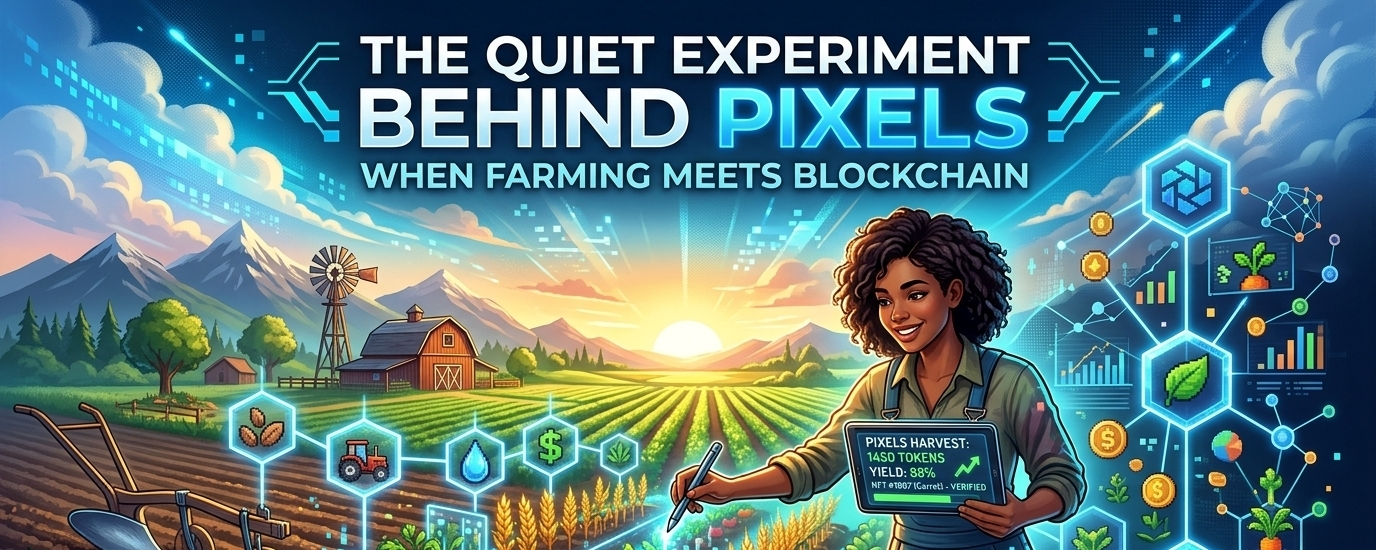

I keep wondering what it is about farming games that makes them such a persistent idea even as everything else in tech shifts so quickly. Maybe it’s the predictability or the quiet sense of ownership over something that grows slowly. That’s probably why a project like Pixels feels oddly familiar at first glance even though it’s built on something as abstract and still-evolving as the Ronin Network.
On the surface, Pixels doesn’t look like it’s trying to reinvent anything dramatic. You farm, you explore you gather resources. It leans into that soft almost nostalgic loop that games have used for years. But the moment you realize that the game world is tied to a blockchain infrastructure the tone shifts slightly. Not dramatically but enough to make you pause and ask what exactly is different here, and whether that difference matters in practice.
The idea, at least as I understand it, is that ownership becomes more literal. Items, land, progress these aren’t just entries in a centralized database controlled by a game studio. They exist as assets on a network. In theory that means players can carry value outside the game, trade more freely or even build systems on top of it. It sounds straightforward but in reality it introduces a layer of friction and complexity that traditional games never had to deal with.
What’s interesting about Pixels is that it doesn’t push this complexity to the front. You can spend a good amount of time just playing it like a normal game almost forgetting the infrastructure underneath. That feels intentional. There’s been a quiet shift in Web3 projects lately away from loudly declaring themselves as blockchain-first and toward something softer where the tech sits in the background. Whether that’s a sign of maturity or just a change in strategy is still unclear.
The choice of the Ronin Network is also worth thinking about. Ronin isn’t new to gaming it’s already been tested sometimes painfully in other ecosystems. It was designed to handle high transaction volumes with lower fees which makes sense for something like a farming game where actions can be frequent and repetitive. But even then there’s always a question of trade-offs. Speed and cost improvements often come at the expense of decentralization or security assumptions and those trade-offs don’t disappear just because they’re hidden behind a friendly interface.
There’s also something slightly paradoxical about combining slow methodical gameplay with an infrastructure that invites speculation. Farming in the traditional sense is about patience. Blockchain economies at least historically tend to attract people looking for quick movement of assets of value of opportunity. When those two mindsets meet it can create an odd tension. Are players there to enjoy the loop or to optimize returns? And does the game subtly change depending on which group dominates at any given time?
I’ve noticed that in projects like this, the social layer becomes more important than the technology itself. The moment people start trading collaborating, or even just comparing progress the blockchain aspect stops being a technical feature and starts shaping behavior. It influences how people value their time in the game how they interact with others, and even how long they stick around. But it’s unpredictable. Sometimes it creates vibrant communities; other times it reduces everything to a kind of quiet marketplace.
What Pixels seems to be experimenting with intentionally or not is whether Web3 infrastructure can coexist with a game that isn’t built around urgency. There’s no constant pressure to act no obvious you’re missing out loop baked into the core gameplay. That feels different from earlier blockchain games which often leaned heavily on incentives and rewards to keep players engaged.
Still questions linger. If the blockchain layer were removed entirely, would the game still hold attention? Or is the underlying promise of ownership doing more work than it appears? And on the flip side if the gameplay were deeper or more complex would the blockchain even matter as much?
It’s easy to get caught up in whether projects like this will succeed or fail but that framing feels a bit too narrow. What’s more interesting is how they quietly test assumptions about what players actually value. Not in theory but in practice over time in a world that keeps running whether or not anyone is paying attention.
And maybe that’s the real experiment here not whether farming on a blockchain works but whether people can forget about the blockchain long enough for it to matter in a different way.
