
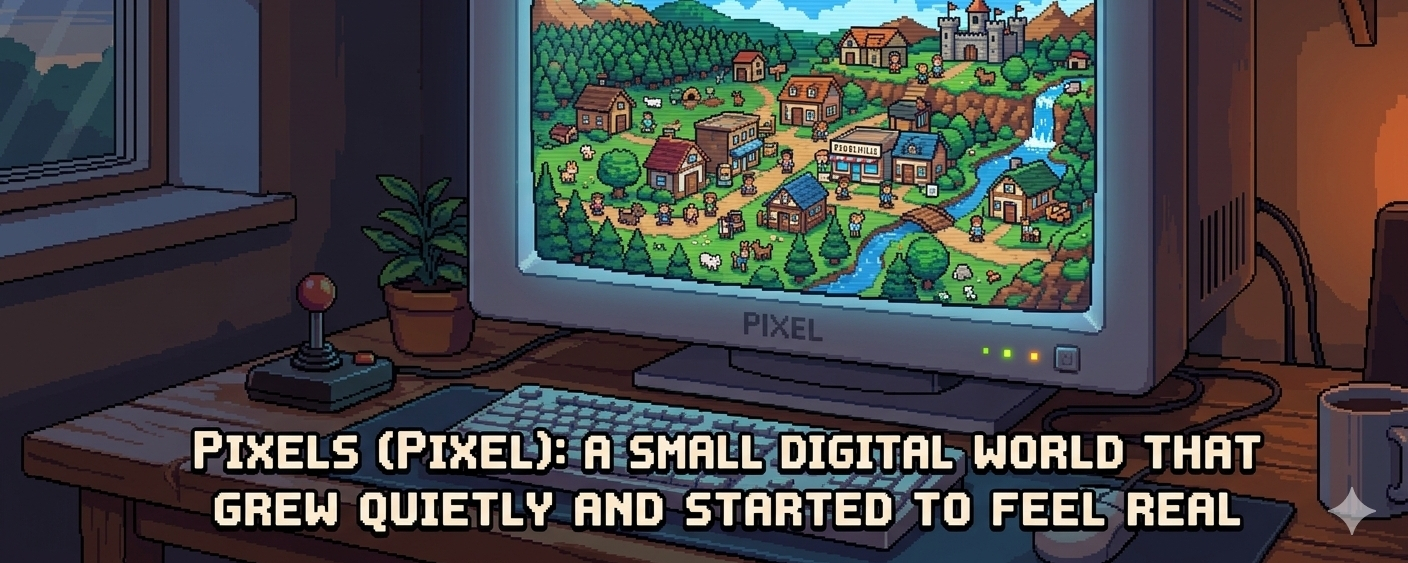
Not long ago, most Web3 games felt like they were built in a hurry, chasing attention instead of building something lasting. They were loud, fast, and focused on earning. People joined with expectations, not emotions, and when the rewards slowed down, everything else faded with them. It created a space where games stopped feeling like games and started feeling like systems you had to manage. Somewhere in that noise, Pixels appeared without trying to compete. It didn’t arrive with promises of quick wealth or complex mechanics. It simply offered a small world where you could plant crops, gather resources, and move at your own pace. At first glance, it looked almost too simple, but that simplicity carried a different kind of intention. It was not trying to impress immediately; it was trying to stay with you over time.
In its early days, Pixels felt closer to older games than modern blockchain projects. You logged in, did a few small tasks, explored a little, and left knowing you would come back again. There was no pressure to rush, no feeling that you were already behind. That approach quietly solved one of the biggest problems in Web3 gaming—access. Anyone could enter without needing to spend money or understand the technology behind it. The world welcomed you first, and only later revealed its deeper layers. When the game moved to the Ronin Network, that experience became smoother and more natural. Actions felt instant, costs disappeared into the background, and the system stopped getting in the way of the world itself. Growth followed, not as a sudden explosion, but as a steady increase of people who stayed longer than expected.
Today, Pixels feels calm in a way that stands out. You walk into a pixelated environment, plant seeds, water them, cut trees, cook food, and meet other players doing the same. Nothing feels forced. Nothing feels urgent. But the longer you stay, the more you begin to notice how everything connects. The crops you grow become resources, the resources become items, and those items move through a shared economy where players trade and progress together. Beneath that calm surface is a carefully balanced system. One part of the game handles everyday actions in a simple and familiar way, while another part connects to the PIXEL token, giving certain activities real value. These layers are separated on purpose, so the experience does not become overwhelmed by speculation. You can enjoy the world without thinking about tokens at all, or you can engage deeper if you choose to.
Ownership exists, but it does not control the experience. Land can be owned as NFTs, yet you are not required to own anything to begin. That decision changes the feeling of the game completely. It removes the barrier that once kept many players away and replaces it with curiosity. You enter because you want to see what is there, not because you feel like you need to invest. Time also plays an important role. You have energy, and it runs out gradually, encouraging you to slow down. It creates a rhythm that feels closer to real life, where progress happens step by step instead of all at once. The social side adds even more depth. Players are not just sharing a server; they are sharing a space. They trade, interact, and exist alongside each other in a way that feels natural. Different avatars, different communities, all blending into one environment that feels alive in its own quiet way.
When Pixels was listed on Binance, attention from outside the game increased quickly. Trading activity surged, and suddenly the project was being discussed on a much larger scale. But inside the world itself, nothing really changed. Crops still needed watering, resources still needed gathering, and players continued their routines. That contrast says a lot about what Pixels actually is. It is not built around moments of hype; it is built around consistency. The system behind it reflects that idea. It avoids flooding players with rewards that lose value over time and instead creates limits that keep everything balanced. Progress takes effort, and because of that, it feels meaningful. Even the choice of Ronin supports this design by removing technical friction and allowing the experience to feel smooth and uninterrupted.
Success for Pixels cannot be understood through numbers alone, even though those numbers have been strong at times. What matters more is how often players return and how long they choose to stay. The game has seen large waves of activity, but what stands out is the sense of presence within its community. People are not just logging in for rewards; they are spending time in a world that feels comfortable. That kind of engagement is difficult to create and even harder to maintain. At the same time, there are real challenges ahead. The economy must remain balanced, or it risks weakening under pressure. The gameplay must continue evolving to avoid becoming repetitive. Dependence on the Ronin ecosystem introduces its own uncertainties, and the broader skepticism around Web3 still lingers in the background. None of these risks are small, and how they are handled will shape the future of the project.
Looking forward, Pixels does not feel like it is trying to become something completely different. Instead, it feels like it is slowly expanding what it already is. The systems in place suggest the possibility of a larger world, one that could grow beyond farming into something more open and interconnected. But the real challenge will be holding onto its identity while it grows. If it moves too fast or tries to chase trends, it could lose the quiet balance that makes it special. If it continues at its current pace, however, it has a chance to become something rare in Web3—a place people return to not because they are chasing value, but because they genuinely enjoy being there.
In the end, Pixels does not try to overwhelm you. It invites you in, lets you take your time, and allows the experience to unfold naturally. There is something honest about that approach. In a space filled with urgency and noise, it offers stillness. In a system built around constant movement, it creates room to pause. And somewhere in that pause, between planting and harvesting, between effort and reward, a different kind of connection begins to form. Not just to the game, but to the idea that digital worlds can feel human again. And if that feeling continues to grow, slowly and quietly, then maybe this small world made of pixels will turn into something much bigger than it ever needed to be.
