
For a long time, Pixels looked like something easy to underestimate.
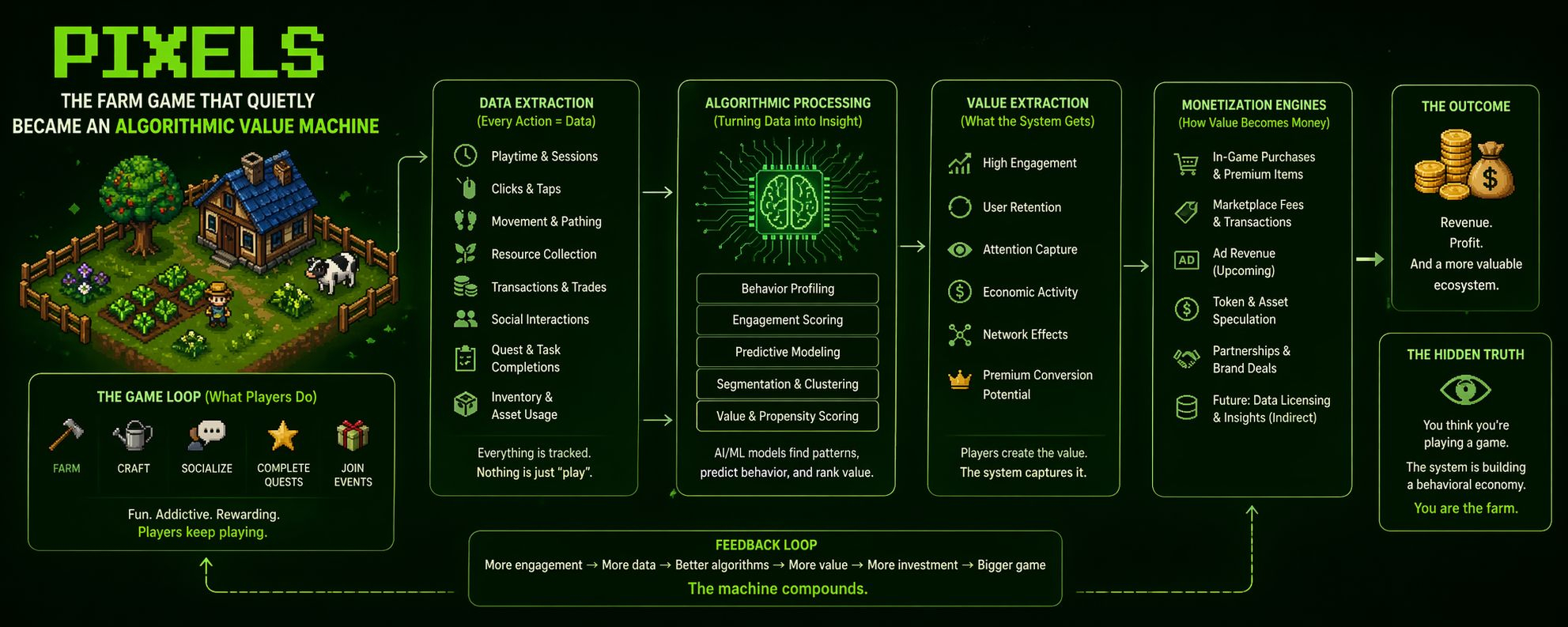
At first glance, it had the familiar skin of a casual Web3 game: farming loops, resource gathering, social progression, and the kind of light, colorful gameplay that makes people assume they already understand the project. But the more carefully you look at Pixels, the more you realize that the visible game is only one layer. Beneath the surface, there is a far more disciplined system at work — one built not just to entertain players, but to measure them, segment them, and extract value with precision.
That is what makes Pixels interesting. It is not merely a game built around farming. It is a game that seems to have turned farming itself into a data problem.
In earlier eras of GameFi, the core mistake was simple: projects handed out rewards without understanding who was really participating. Bots, multi-account farmers, script operators, and low-intent users flooded every incentive program that looked remotely profitable. The result was predictable. Rewards were drained, economies were distorted, and real users were pushed aside by automated behavior that could scale faster than any manual moderation team.
Pixels appears to have learned from that collapse.
Instead of relying only on surface-level gameplay updates or flashy marketing campaigns, it seems to have invested deeply in the invisible layer — the infrastructure that determines who gets rewarded, when they get rewarded, and how much value they are likely to return to the ecosystem over time. That shift matters. In a crowded on-chain environment, the biggest challenge is not simply attracting users. It is identifying which users are worth keeping, which ones are extracting too much, and which ones are actually contributing to long-term network health.
That is where the real sophistication begins.
A modern Web3 game does not survive because it has the prettiest interface or the loudest community thread. It survives because it can manage incentives without being exploited by them. And that is exactly why Pixels feels different from many of the projects that came before it. It does not appear to be built around blind reward distribution. It appears to be built around selective allocation — a system that continuously evaluates activity, behavior, and efficiency in order to decide where economic energy should flow.
That is a colder model, but also a more realistic one.
The romantic version of Web3 gaming says that everyone can farm, everyone can earn, and everyone can participate equally. The actual market has never worked that way. Once money enters the loop, participants split into very different categories: loyal players, opportunists, bots, grinders, speculators, and extractors. If a project cannot distinguish between those groups, it will eventually pay the price in the form of wasted emissions and broken retention.
Pixels seems to understand that distinction.
What stands out is not just that it offers rewards, but that it appears to treat rewards as a strategic weapon rather than a simple giveaway. That changes the entire logic of the ecosystem. Incentives are no longer just a way to attract volume. They become a mechanism for shaping behavior. A player who stays active, spends meaningfully, and returns consistently becomes more valuable than one who only appears when there is a payout to be claimed.
That is the quiet intelligence of a system like this.
From the outside, it may still look like a farming game. People plant, gather, craft, and interact in a world that feels intentionally simple. But simplicity can be deceptive. The most effective systems are often the ones that hide their complexity behind easy surfaces. What matters is not the aesthetics alone, but the machinery underneath: the monitoring, the segmentation, the reward logic, and the constant recalibration of who deserves economic attention.
And that is why Pixels deserves a closer reading.
It is no longer enough to ask whether a Web3 game is fun in the traditional sense. The more relevant question is whether its economy is designed to withstand reality. Can it survive bots? Can it resist exploitative farming? Can it tell the difference between genuine engagement and manufactured activity? Can it reward users in a way that preserves the ecosystem instead of draining it?
Pixels appears to have built around those questions from the beginning.
That does not mean the project is immune to criticism. In fact, there is a very real tension at the heart of systems like this. A highly optimized reward engine can preserve economic stability, but it can also create a colder user experience if the content layer fails to keep pace. Players do not stay because an algorithm is efficient. They stay because the world feels alive, the progression feels meaningful, and the game gives them a reason to care beyond the numbers.
This is the challenge Pixels still has to solve.
A strong economic engine can prevent collapse, but it cannot by itself create affection. It can optimize retention, but it cannot manufacture delight. At some point, the project still has to prove that the world itself is worth inhabiting — not just that the system behind it is smart. If the gameplay becomes repetitive, even the best-designed reward model will eventually hit a ceiling.
That is the real test.
So the correct way to think about Pixels is not as a simple farming title, and not even as a standard GameFi project. It is better understood as a live experiment in how a digital economy can be managed when every interaction is measurable and every participant is, in theory, classifiable. The game layer brings people in. The data layer decides how the system survives.
That combination is what makes it powerful.
Pixels may look casual on the outside, but its underlying structure suggests a much more serious ambition: to build a world where activity is not just recorded, but interpreted; where incentives are not just distributed, but engineered; and where value is not assumed, but calculated in real time.
That is why it stands out.
In a market full of projects that still rely on presentation slides, hype cycles, and borrowed narratives, Pixels feels like something more durable. Not because it is perfect, and not because it has solved every problem, but because it seems to understand the most important lesson in Web3 gaming: the battle is not only for users. It is for signal, for retention, and for control over the economic loop itself.
And once a project learns how to read that loop properly, it stops being just a game.
It becomes a system.
