
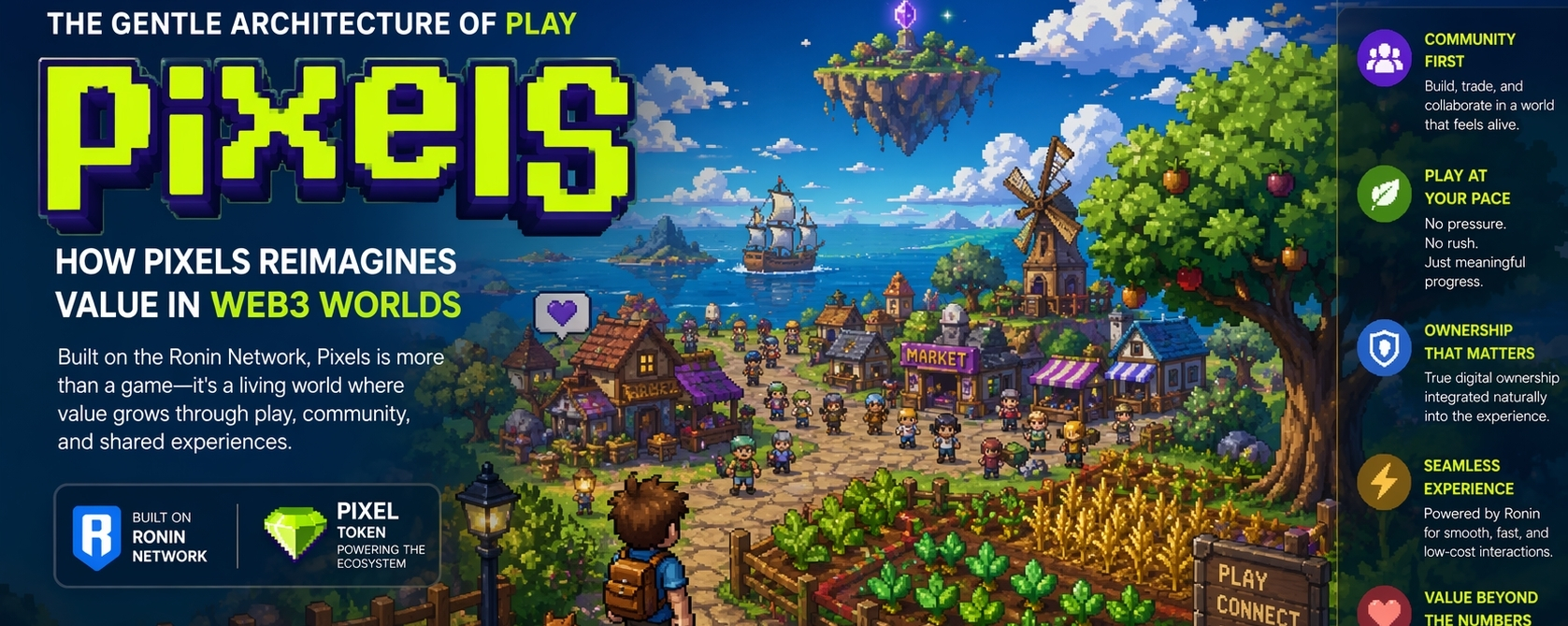
In a digital landscape often defined by noise, urgency, and speculation, Pixels arrives with a quieter intention. It does not attempt to overwhelm the user with complexity or promise instant transformation through financial mechanics alone. Instead, it offers something more subtle and enduring, an experience shaped by curiosity, routine, and shared presence. Built on the Ronin Network, Pixels positions itself not just as a game, but as a living environment where value emerges gradually through interaction rather than pressure.
At first glance, its world feels familiar. There are farms to tend, land to explore, and simple systems that guide the player forward without resistance. Yet beneath this simplicity lies a deliberate design philosophy. Pixels understands that attention is fragile, and instead of competing for it aggressively, it nurtures it through rhythm. The act of planting crops, trading resources, or walking through a pixelated landscape becomes less about progression and more about participation. This shift, though subtle, carries significant implications for how Web3 experiences are evolving.
Traditional blockchain games often lean heavily on economic incentives. They construct systems where engagement is closely tied to earning potential, and where players are encouraged to optimize rather than explore. Pixels moves in a different direction. While it still integrates tokenized elements and digital ownership, it does not make them the center of gravity. The PIXEL token exists as part of the ecosystem, but the experience itself does not feel dependent on it. This creates a softer entry point, especially for users who might otherwise feel intimidated by the financial layers of Web3.
The choice of the Ronin Network further reinforces this approach. Known for its efficiency and gaming-focused infrastructure, Ronin allows Pixels to operate with minimal friction. Transactions are smoother, interactions feel immediate, and the technical layer recedes into the background. This matters more than it might seem, because immersion in a digital world is easily broken when systems feel slow or overly complex. Pixels protects that immersion carefully, ensuring that the player remains inside the experience rather than constantly negotiating with the technology behind it.
What makes Pixels particularly compelling is its social dimension. The world is not empty, nor is it purely transactional. Players encounter each other, collaborate, and form small, organic communities. These interactions are not forced through rigid mechanics but arise naturally from shared activities. A farm becomes a point of connection. A marketplace becomes a conversation. Over time, these small moments accumulate into something that feels closer to a digital neighborhood than a competitive arena.
This emphasis on community introduces a different kind of value, one that is difficult to quantify but deeply felt. In many Web3 environments, value is measured in volatility, in charts that rise and fall with unpredictable intensity. Pixels offers an alternative perspective. Value here is embedded in time spent, relationships formed, and a sense of continuity that extends beyond individual sessions. It is less about extraction and more about presence.
There is also an aesthetic intelligence at work. The pixel art style is not merely nostalgic decoration, but a conscious choice that aligns with the game’s philosophy. It lowers the barrier to entry, invites creativity, and allows the world to feel approachable rather than intimidating. In a space where visual realism is often equated with progress, Pixels demonstrates that emotional resonance can be achieved through simplicity. The result is a world that feels warm, coherent, and quietly expressive.
From a broader industry perspective, Pixels signals a shift in how Web3 games might evolve. It suggests that the next phase will not be defined solely by technological advancement, but by the refinement of experience. Users are no longer satisfied with systems that prioritize mechanics over meaning. They are looking for spaces that feel alive, where engagement is not driven by urgency but by genuine interest. Pixels responds to this demand with a kind of quiet confidence.
There are, of course, challenges ahead. Sustaining a balanced economy, maintaining user interest over time, and navigating the unpredictable nature of crypto markets are all ongoing concerns. Yet Pixels does not appear to rely on sudden growth or speculative hype. Its strength lies in consistency, in its ability to offer a stable and inviting environment even as external conditions fluctuate.
In many ways, Pixels feels like a gentle correction to the trajectory of Web3 gaming. It does not reject the core principles of decentralization or ownership, but it reframes them within a more human context. It reminds us that technology, at its best, should serve experience rather than dominate it. By focusing on play, community, and emotional texture, Pixels creates a space where value is not imposed but discovered.
As the broader ecosystem continues to mature, projects like Pixels may become increasingly important. They offer a glimpse of what Web3 can be when it moves beyond its early obsessions and begins to prioritize depth over speed. In that sense, Pixels is not just a game. It is a quiet exploration of how digital worlds can feel, how they can grow, and how they can matter in ways that extend beyond the visible layers of code and currency.