
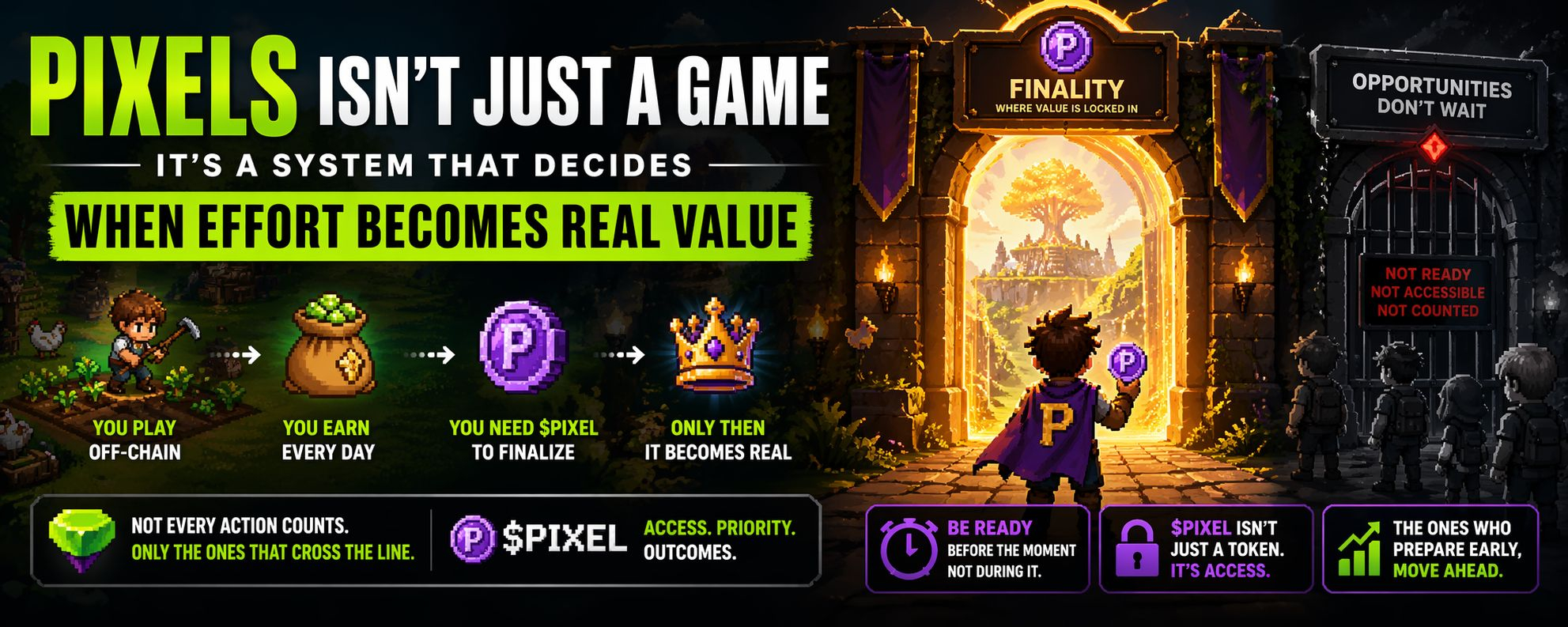
I went into Pixels expecting innovation in the usual sense. I thought I would see better mechanics, smoother loops, and a more refined way of turning effort into progress. That’s what most systems promise, and at first, Pixels delivers exactly that feeling. I stayed active, I learned the loops, and everything I was doing felt productive. The system felt open, responsive, and fair on the surface. It genuinely looked like a place where consistency alone could carry me forward.
But the longer I stayed inside it, the more I started noticing something that didn’t fully align with that belief. There were moments where my effort didn’t translate into meaningful outcomes, and it didn’t feel random. I wasn’t doing less than others, and I wasn’t missing obvious steps, yet the results didn’t match the work I was putting in. What stood out even more was that the same type of players kept appearing at the exact points where real value was being locked in. They weren’t necessarily more active in general, but they were always present when it actually mattered.
That’s when my perspective started to shift. I realized that most of the activity inside Pixels exists in a low-friction environment where actions are easy to repeat and rarely force critical decisions. Farming, crafting, and moving resources creates the feeling of progress, but it doesn’t always push you into moments that define outcomes. You can stay busy for hours and still remain in a layer where nothing truly decisive happens. Then suddenly, something changes. A limited opportunity appears, something scarce and time-sensitive, and the system tightens. In that moment, activity loses importance and readiness becomes everything.
I started to see how often hesitation was costing me. Even a small delay was enough to miss the point where effort could actually convert into value. While I was thinking or preparing in real time, someone else had already acted. Not because they were reacting faster in that moment, but because they had already positioned themselves before the opportunity even appeared. That’s when I stopped seeing $PIXEL as just a reward or a simple utility and started seeing it as access. It felt like the difference between participating in the system and actually being able to influence outcomes within it.
This made me realize that Pixels isn’t purely an effort-driven economy. It separates constant activity from selective finality and only connects them at specific moments. Most players operate in the activity layer, keeping the system alive and constantly moving, but not always reaching the points where value is finalized. A smaller group consistently operates at that boundary where actions turn into outcomes, and the difference between these groups isn’t always visible through effort alone. It comes down to positioning, timing, and the ability to act without hesitation when the system demands it.
Over time, this changes how you approach the entire game. I stopped focusing only on doing more and started focusing on being ready. I began paying attention to when the system might require a decision instead of just staying active all the time. Because Pixels doesn’t really reward the player who does the most, it rewards the player who is prepared before the moment arrives. And those moments don’t announce themselves clearly. They appear, they pass, and they favor those who were already in position.
Now when I look at Pixels, I don’t just see a game or even a standard economy. I see a system that quietly filters which actions become real value and which ones stay circulating without ever crossing that line. And if I’m being honest, the real challenge isn’t increasing effort or staying constantly active. The real challenge is making sure that when the moment finally comes, I’m not trying to catch up.