
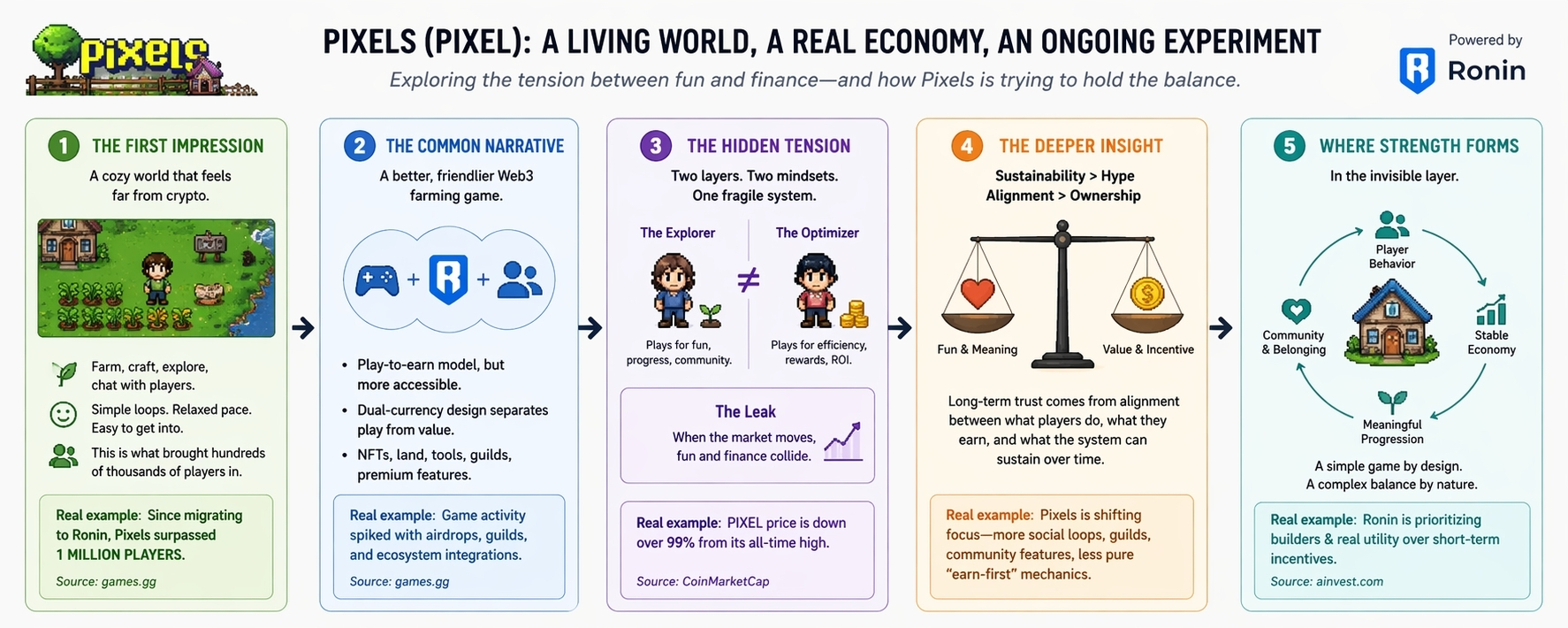
I keep coming back to this strange feeling… like I’m not really “playing a crypto game” when I open Pixels (PIXEL), I’m just… hanging out in a quiet little digital village.
You log in, plant some crops, maybe chat with someone nearby, craft a few items and for a moment, it feels almost normal. No charts, no hype, no pressure. Just a simple loop. And honestly, that’s what pulls people in.
The usual story people tell is pretty straightforward: Pixels is a Web3 farming game on the Ronin Network, where you can play, earn, and own assets. It’s smoother than older crypto games, easier to get into, and built around community. And yeah, all of that is true. The game really did grow fast after moving to Ronin, with strong player activity and a big push from things like airdrops and guild features .
But that’s just the surface.
Let me explain it the way it actually feels.
Imagine two players. One is just farming for fun logging in daily, upgrading tools, slowly building their land. The other is thinking, “How do I optimize this? How do I earn more PIXEL?” Both are playing the same game… but they’re not really in the same system.
That’s where things get interesting.
Because underneath the cozy farming vibe, there’s a real economy running. There are two currencies—one more casual, one tied to actual value. You can mint NFTs, join guilds, even access premium features using the PIXEL token . On paper, it’s smart design. It tries to separate fun from finance.
But in reality, those two layers always leak into each other.
I’ve seen this play out so many times. A game starts feeling like a world… and then suddenly, people start calculating everything. Time becomes ROI. Farming becomes strategy. Even social interaction starts to carry an economic edge.
And then the market moves.
At one point, PIXEL was trading above $1. Today it’s down massively from that level like over 99% from its peak . That’s not just a number. That shift changes how the whole game feels. The same actions—planting, grinding, trading can feel rewarding one month and pointless the next.
That’s the part most people don’t talk about.
The real challenge isn’t building a game people enjoy when things are going well. It’s building something that still makes sense when things aren’t.
And to be fair, Pixels seems aware of this. You can see it in how they’re slowly shifting focus more social features like guilds, more emphasis on community loops, less pure “earn-first” thinking. It’s like they’re trying to gently move players from extracting value to belonging in a world.
But that balance is fragile.
Too much focus on earning, and the game becomes a grind machine. Too much focus on fun, and the token loses meaning. And somewhere in the middle… that’s where the system either stabilizes or quietly breaks.
What I find interesting is that Pixels doesn’t try to solve this with complexity. It actually goes the opposite way. The gameplay is simple. The visuals are retro. The loops are slow.
At first, that looks like a limitation.
But maybe it’s intentional.
Because complex economies collapse faster. Simple ones… sometimes survive longer.
So when I think about Pixels now, I don’t see it as “the next big Web3 game” or “just another farming simulator.” It feels more like an ongoing experiment. A soft attempt to answer a hard question:
Can you build a digital world where people stay not because they’re earning, but because it still feels worth showing up?
I’m not sure yet.
But I do know this the answer won’t come from the token price… it’ll come from what people keep doing when nobody’s watching.
