
Saya perhatikan bahwa semakin kacau hidup digital kita, semakin kita menginginkan sesuatu yang lambat. Kita menghabiskan sepanjang hari menghindari email dan menggulir melalui berita yang tak ada habisnya, dan kadang-kadang, yang kita inginkan hanyalah tempat di mana satu-satunya "batas waktu" adalah menunggu tanaman virtual tumbuh. Ada kenyamanan aneh dan tenang dalam kesederhanaan yang sebagian besar telah kita hilangkan di internet modern.
Untuk waktu yang lama, game Web3 terasa seperti kebalikan dari kenyamanan itu. Mereka seringkali terlalu kompleks, terlalu mahal untuk memulai, dan lebih terasa seperti pekerjaan kedua daripada sebuah permainan. Lalu datanglah Pixels.
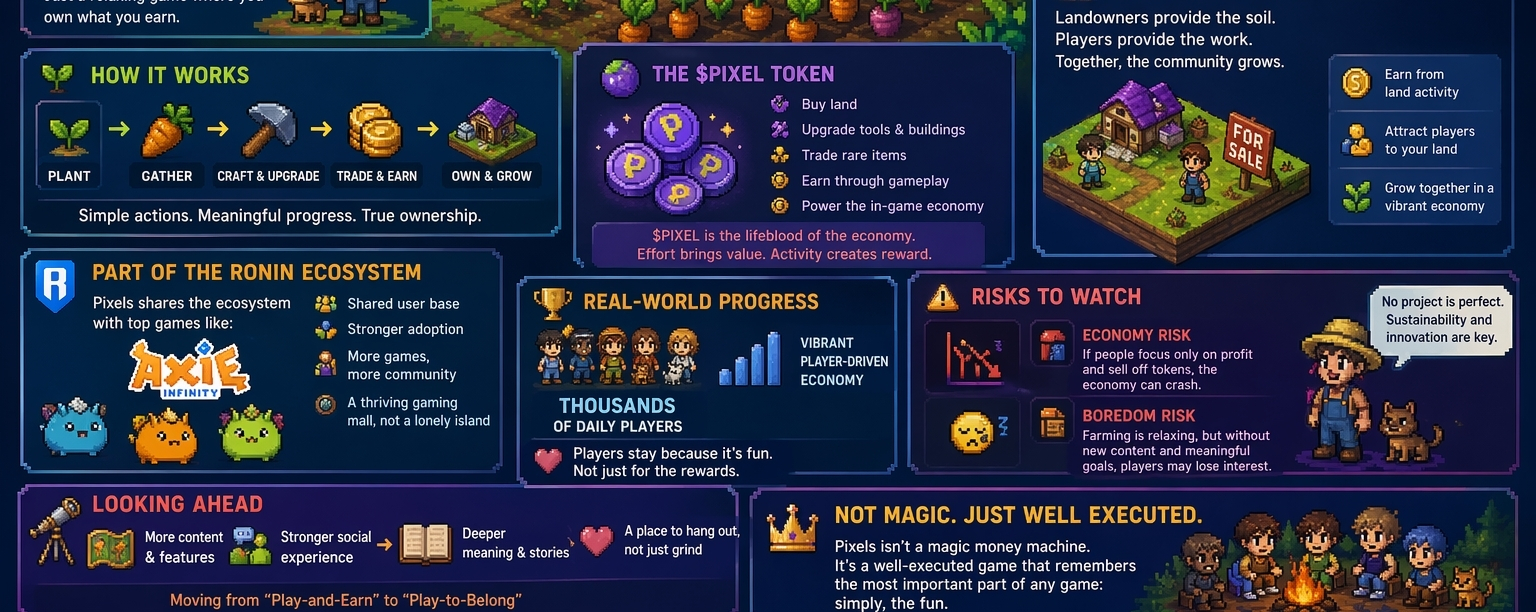
Di inti, Pixels adalah game pertanian sosial dan santai. Tapi alih-alih hanya menjadi loop tertutup di mana kemajuanmu tinggal di database satu perusahaan, ia hidup di blockchain.
Masalah inti yang diselesaikannya adalah gesekan. Kebanyakan game blockchain meminta kamu untuk menjadi ahli keuangan sebelum kamu bisa bergerak. Pixels menghilangkan itu. Ini mengambil nuansa nyaman dan nostalgia dari seni piksel lama dan menambahkan lapisan kepemilikan yang nyata.
Sekarang, mari kita bicarakan bagaimana ini sebenarnya bekerja di belakang layar. Pixels didukung oleh Jaringan Ronin. Anggaplah Ronin sebagai jalan raya khusus yang dibangun khusus untuk game.
Jika kamu mencoba menjalankan game seperti ini di jaringan utama seperti Ethereum, biaya untuk menanam satu wortel akan lebih mahal daripada wortel itu sendiri. Ronin membuat transaksi cepat dan hampir gratis.
Ini memungkinkan pemain untuk berdagang barang dan mendapatkan imbalan tanpa khawatir tentang biaya gas yang menggerogoti keuntungan mereka. Arsitekturnya dirancang untuk menangani ribuan pemain yang berinteraksi di dunia bersama tanpa sistem lag atau crash.
Kemudian ada token \u003cc-96/\u003etoken. Ini adalah nadi dari ekonomi game. Di Pixels, token bukan hanya imbalan; itu adalah alat.
Kamu menggunakannya untuk membeli tanah, meningkatkan alatmu, atau berdagang barang langka dengan pemain lain. Nilai mengalir dari usaha ke imbalan. Kamu melakukan tugas, mengumpulkan sumber daya, dan melalui aktivitas itu, kamu mendapatkan hak untuk mengakses $PIXEL.
Ada juga insentif kuat untuk kepemilikan tanah. Pemilik tanah menyediakan ruang di mana pemain bercocok tanam, menciptakan hubungan simbiotik antara mereka yang memiliki "tanah" dan mereka yang melakukan "pekerjaan."
Tapi Pixels tidak ada dalam vakum. Ini adalah bagian dari ekosistem Ronin yang lebih luas. Dengan berada di Ronin, Pixels berbagi basis pengguna dengan judul besar lainnya seperti Axie Infinity.
Ini seperti berada di pusat perbelanjaan—jika kamu datang untuk satu toko, kamu kemungkinan akan menjelajahi toko lainnya. Ini menciptakan komunitas gamer yang sudah nyaman dengan dompet dan token, membuat adopsi jauh lebih cepat.
Dalam hal kemajuan dunia nyata, game ini sudah melihat lonjakan besar pemain. Kita tidak berbicara tentang beberapa ratus penguji; kita berbicara tentang ekonomi yang hidup dan bernapas dengan ribuan pengguna aktif harian.
Orang-orang benar-benar menghabiskan waktu luang mereka di sini, bukan hanya mengejar pompa harga, tetapi karena loop gameplaynya benar-benar menenangkan.
Namun, kita harus jujur tentang risikonya. Tidak ada proyek yang sempurna. Tantangan terbesar untuk model "main-dan-dapatkan" adalah keberlanjutan.
Jika terlalu banyak orang bergabung hanya untuk menghasilkan uang dan kemudian langsung menjual token mereka, ekonomi bisa runtuh. Ada juga risiko kebosanan.
Bercocok tanam itu menenangkan, tetapi jika game tidak terus menambahkan tujuan baru atau cerita yang bermakna, pemain mungkin pada akhirnya beralih ke hal baru yang mengkilap.
Melihat ke depan, strategi untuk Pixels tampaknya bergerak menjauh dari "menghasilkan" dan bergerak menuju "bermain." Tujuannya adalah membangun pusat sosial—tempat di mana kamu pergi untuk bersantai dengan teman, bukan hanya untuk grind token.
Jika mereka bisa menjaga keseimbangan itu—menjaga permainan tetap menyenangkan sambil menjaga ekonomi stabil—Pixels bisa menjadi cetak biru untuk bagaimana game kasual memasuki ruang Web3.
Ini bukan mesin uang ajaib, dan ini bukan keajaiban. Ini hanya game yang dieksekusi dengan baik yang ingat bahwa bagian terpenting dari game apa pun adalah, sederhana, kesenangan.
\u003cm-88/\u003e\u003ct-89/\u003e\u003cc-90/\u003e