
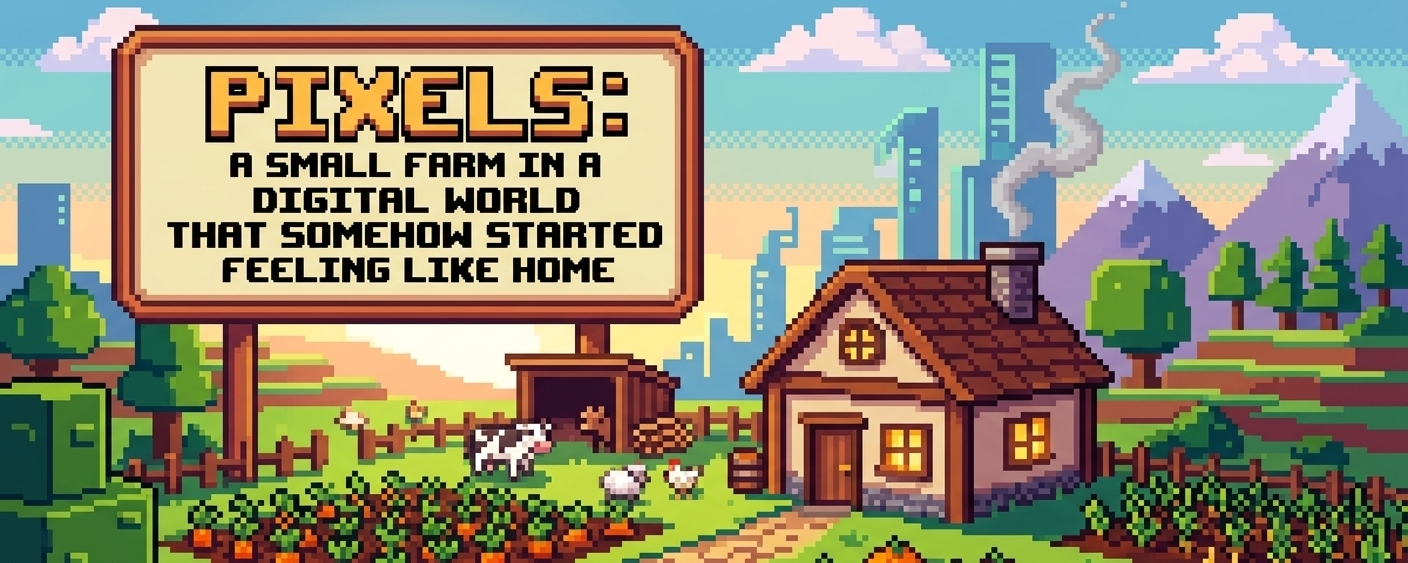
There was a time in Web3 when everything felt loud but strangely empty. New games kept appearing, each promising big rewards and a revolutionary future, but when people actually stepped inside those worlds, something was missing. You could click, earn, and leave, but there was no reason to stay. It didn’t feel like a place you belonged to. It felt temporary, like a job you knew would end soon. In that environment, Pixels didn’t try to compete with noise. It came in quietly, almost carefully, as if it understood that what the space needed was not more excitement, but more feeling. Around 2021, instead of focusing on how much players could earn, it focused on something much simpler and much harder — how to make someone come back tomorrow, even if there was nothing urgent waiting for them.
So it built a world that felt familiar. A place where you plant crops, gather resources, cook food, and walk around alongside other players who are doing the same small things. There is no pressure to rush, no overwhelming complexity in the beginning. It feels soft, almost nostalgic, like something you’ve seen before but forgot about. That feeling is not accidental. It is the foundation of the entire experience. Pixels understood early that before people trust a system, they need to feel comfortable inside it. And comfort is something most Web3 games had completely ignored.
The real shift for Pixels came when it moved to the Ronin Network. This was more than just a technical decision. It was the moment where the game finally aligned with infrastructure that matched its philosophy. Everything became smoother. Actions felt instant. The usual friction of blockchain — fees, delays, confusion — quietly disappeared into the background. You could simply play without thinking about what was happening underneath. Around the same time, the PIXEL token became available on Binance, connecting this calm digital world to a much larger financial ecosystem. Suddenly, what players were doing inside the game had a bridge to real-world value. But what made Pixels stand out was that it didn’t change its personality after this moment. It didn’t become aggressive or overly focused on profit. It stayed slow, steady, and grounded, which made people trust it even more.
Underneath its simple surface, Pixels is built with a thoughtful structure that balances two different needs. On one side, there is gameplay — fast, responsive, and easy. Farming, crafting, exploring — all of this happens smoothly because it is handled off-chain. On the other side, there is ownership — assets, land, and the PIXEL token — which live on the blockchain and carry real value. This separation is important because it allows the game to feel natural while still offering true ownership. If everything were on-chain, the experience would feel slow and heavy. If nothing were on-chain, the sense of value would disappear. Pixels sits quietly in the middle, and that balance is one of its biggest strengths.
The system also uses energy as a way to create rhythm. Every action costs something, and that something regenerates over time. At first, it feels like a limitation, but over time it starts to feel like pacing. You plant something, you wait, you return later. It mirrors real life in a subtle way. Effort, patience, reward. This rhythm turns the game into a routine rather than a grind. And routine is powerful, because it makes people come back without feeling forced. Land ownership adds another layer to this system. Owning land is not just about having an asset. It means being part of a living economy where other players interact, contribute, and create value over time. Slowly, the game begins to feel less like a product and more like a small digital society.
What makes Pixels feel different is not just its design, but its attitude. It doesn’t try to impress you constantly. It respects your time. You can log in, do a few things, and leave without feeling like you are falling behind. The visuals are simple but intentional. The pixel art is soft and easy to look at, creating a space where you can relax instead of being overwhelmed. Even the way blockchain is introduced feels gentle. You don’t need to understand everything from the beginning. You just play, and the deeper layers reveal themselves naturally. This approach makes the experience feel human, as if the game is not trying to sell you something, but simply inviting you to stay.
In terms of success, Pixels has grown into one of the most active ecosystems in Web3 gaming. A large number of players log in daily, and the activity around it has expanded significantly, especially after its integration with Ronin. The availability of the PIXEL token on Binance adds another layer of legitimacy and liquidity. But the real success is not in numbers or token price. It is in behavior. People return. They build small habits. They check their crops, complete tasks, and slowly progress. That quiet consistency is something many louder projects failed to achieve.
Still, the system is not without risks. The biggest challenge is maintaining balance. If too many players focus only on earning, the experience could shift away from being a game and turn into something purely transactional. This has happened before in other Web3 projects, and it can slowly break the system from within. There is also the question of depth. Simplicity is what makes Pixels accessible, but over time, players will expect more complexity and new layers of engagement. If the game does not evolve carefully, it could start to feel repetitive. On top of that, there is the broader skepticism around Web3. Even though Pixels hides much of the complexity, it still exists within a space that many people do not fully trust.
Looking ahead, the future of Pixels feels less like a sudden explosion and more like steady growth. There are signs that it wants to become more than just a single game. It is moving toward becoming a platform where different experiences, communities, and systems can exist together. If this vision continues, Pixels could turn into something closer to a digital world than a product. A place where players are not just participants, but contributors. Where ownership, creativity, and interaction blend into something that feels alive. The challenge will be to expand without losing the calm, human feeling that made it special in the first place.
There is something quietly meaningful about Pixels. It does not rush you. It does not demand constant attention. It simply exists, waiting for you to return. You plant something today, and tomorrow it grows. Not instantly, not aggressively, but naturally. And in a digital environment where everything moves too fast and asks for too much, that kind of patience feels rare. Maybe that is why people stay. Not because they are chasing rewards, but because they have found a place that feels steady. A place that does not try to overwhelm them, but slowly becomes part of their routine. And in that quiet rhythm, Pixels offers something that many technologies forget to give — a sense of belonging, growing gently over time like the crops inside it.
