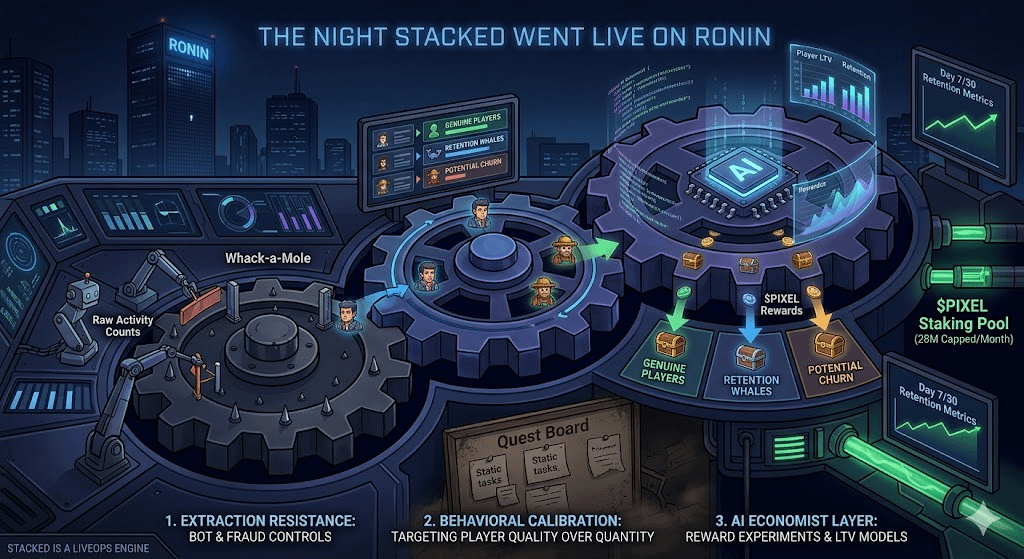
the night stacked went live on ronin
It was March 26. I had a position half-open and the Ronin blog notification dropped. I almost missed it.
The Pixels team published the Stacked launch announcement at blog.roninchain.com/p/stacked-by-pixels-is-live-on-ronin, and within twenty minutes I'd closed the tab three times thinking I'd read it wrong. This wasn't another quest board. It wasn't a points ledger with a prettier coat of paint. Stacked is a LiveOps engine — one that tracks gameplay events on-chain, segments players into behavioral cohorts, and decides who gets rewarded, for what action, and at which exact moment.
I've been watching play-to-earn reward structures for a while now. Most fail not because the teams run out of money. They fail because the reward loop was designed for the token price, not the player.
The thing that actually registered: Stacked is already live inside Pixels, Pixel Dungeons, and Chubkins — being tested in production. Not in a whitepaper. On Ronin.
three quiet gears generic apps never build
Here's the model that keeps playing in my head. Call it three gears.
The first gear is extraction resistance. Generic P2E rewards are farmed. Bots show up on day one, and the team spends the next six months playing whack-a-mole with wallet patterns. Most never win that fight. Stacked runs tight fraud controls and precision targeting — it only triggers rewards for verified behavioral signals, not raw activity counts. That's a different philosophy than issuing tokens for time-on-screen and hoping for the best.
The second gear is behavioral calibration. This is the quiet one. Most reward apps ask: how do we keep users coming back? Stacked asks something harder — what kind of user do we actually want to keep? The Pixels team quietly shifted this framing back in April 2025, when they announced the move from Daily Active Addresses to Daily Active User quality. That was the tell. They were already building toward a system that could distinguish a genuine farmer from a wallet cycling rewards. Stacked is where that thesis finally has an engine.
The third gear — and honestly the one that still makes me think — is the AI economist layer. Developers can ask the system questions like: what separates whales who retain from whales who churn by Day 30? And the system generates cohort reports and suggests reward experiments tied to real LTV outcomes. That's not a quest board. That's… something closer to a live risk model for game economies.
Hmm. That last part is where it gets interesting, and also where I get skeptical.
the part that still makes me rethink this
I want to be honest here. When I first saw the Stacked framing — the infrastructure Pixels wishes it had from day one — I sat with that for a minute.
That sentence is doing a lot of work. It's admitting, implicitly, that the original reward design had failure modes. And I respect that kind of transparency. But it also means Stacked is being stress-tested while carrying the weight of a live game economy with a staking pool currently capped at 28 million $PIXEL per month (on-chain, as of March 2026). Staked supply is locked. Staker yield depends on fees redistributed from withdrawals under the Farmer Fee model. That flywheel works when user behavior and reward precision are both tuned correctly.
What happens when the AI economist misprices a reward experiment? Who absorbs that friction?
I don't have a clean answer. I'm still watching the fee redistribution patterns against staking inflow. Early data looks stable. But this isn't a system you stress-test with fake volume — it needs real players making real decisions. That's both the strength of the design and its exposure.
There's also a second thing. The Taskboard — still the main economic driver in Pixels — hasn't been replaced. The Pixels founder said it plainly in the March AMA: the Stacked system is meant to slowly take over Taskboard, but thoroughly tested first. That sequencing matters. Two parallel incentive layers, one legacy, one next-gen, running in the same economy is genuinely hard to balance. I've seen smaller teams collapse trying exactly that.
where this actually points
Here's what I think is worth watching.
First: Stacked-as-infrastructure is a bigger play than Pixels-as-game. If other studios on Ronin start integrating it — and the framing is clearly pointed that direction — then $PIXEL's staking demand becomes tied to the health of an entire ecosystem, not a single title. That's an index-like dynamic. It's asymmetric upside if it scales. It's also asymmetric fragility if one partner game misbehaves economically.
Second: the move from raw emission schedules to behavior-triggered rewards is the correct long-term direction for any P2E system that wants to survive a full cycle. Most projects that launched in 2021-2023 never made this pivot. Pixels is mid-pivot right now, on a live chain, with real stakers watching.
Third: the AI economist layer is genuinely novel in this space. Not novel as in buzzword — novel as in no one else is running reward logic through behavioral cohort modeling with this level of granularity, on-chain, in production. If it holds up under pressure, it becomes the template.
I'm not fully convinced yet. But I'm paying attention in a way I wasn't three months ago.
What's the real test? Whether Stacked can produce measurably better Day-7 and Day-30 retention on Pixel Dungeons before the next chapter update drops — without the AI economist overcorrecting and flattening what makes the game actually fun to play. That's the hard part. And honestly, has any reward system in crypto gaming ever threaded that needle cleanly?