
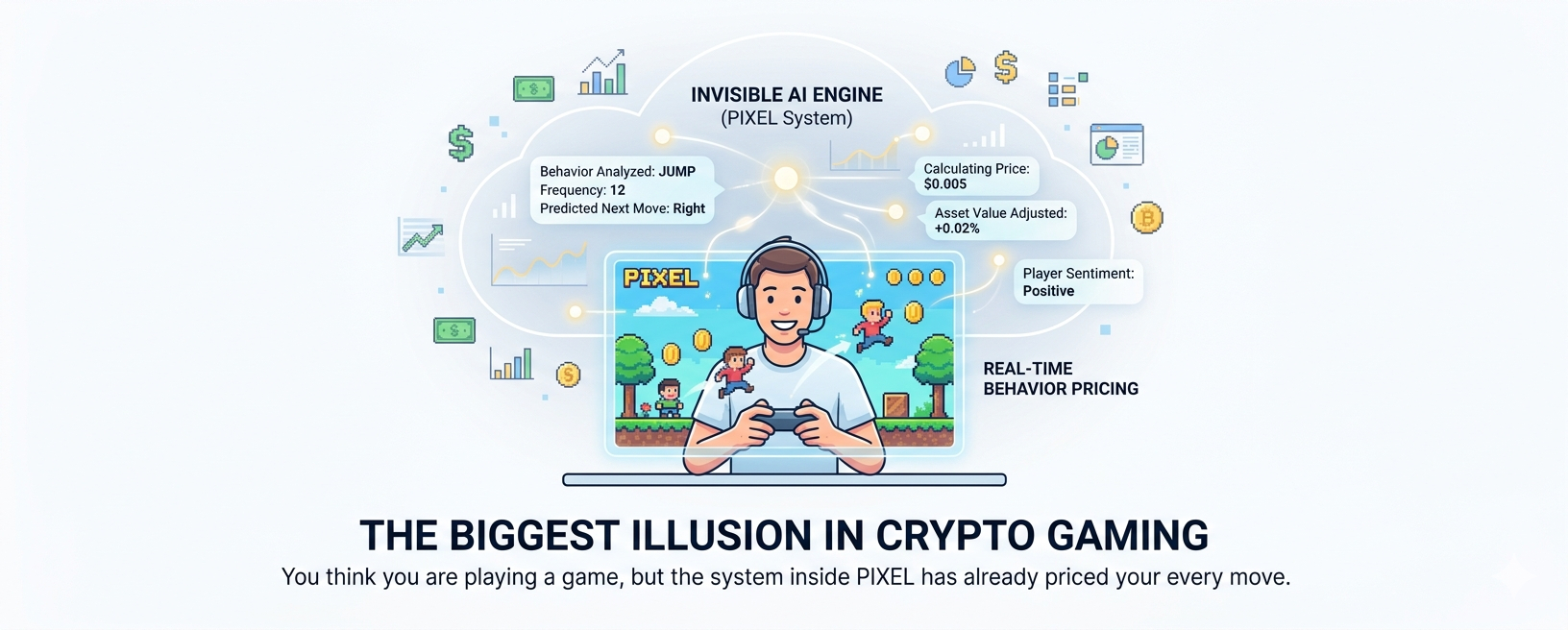
Last month, while I was thinking my chain-game interaction records on Binance, I looked at my recent operating PNL and could not help but feel that familiar pressure. During that same period, I started digging deeper into the core mechanics behind $PIXEL. At first, the label of an “AI game economist” sounded like just another polished phrase designed to attract attention and liquidity. That was my first impression too. But after tracing the project’s early development notes and listening to the founder’s interviews, I slowly understood that this was not a random marketing trick. It was more like a forced adaptation to a market that had already become ruthless.
Anyone who went through the last two years of crypto gaming winter understands how brutal that period was. The pattern repeated itself everywhere. If a project offered token rewards too freely, bots and scripts would rush in immediately and drain everything. If the rewards were tightened too much, real players would lose motivation and leave. It became a trap with no easy exit. In practice, many of us stopped enjoying the game altogether, because normal players simply could not compete with automated farming systems running nonstop on cloud infrastructure. For developers, the hardest part was not building the game itself. It was staring at backend data and trying to figure out who was actually a human and who was just thousands of fake commands pretending to be a player.
In one older podcast, Luke pointed out something that really captured the real pain of the industry. I had always assumed the hardest part of game design was creating a smooth loop between earning and spending. But he explained that the true challenge is deciding who should receive value, when they should receive it, and how to do that in a way that actually improves the system. That hit the center of the problem. Their first attempts involved classifying users by activity and then distributing incentives accordingly. But manual analysis was too slow. By the time the team adjusted the rules for different player groups, farming scripts had already studied the pattern and moved beyond it.
Then came the part that looked risky from the outside. Just as the community was beginning to recover and the migration to on-chain activity was showing signs of life, the team made a move many people probably did not understand at the time. They nearly stopped focusing on visible gameplay upgrades. There were no major new maps, no flashy feature drops, and no dramatic content announcements. Instead, they redirected serious resources toward building a backend distribution system that worked quietly in the background.
At first glance, that decision probably frustrated a lot of users. People came for the game, so why care about hidden tables and invisible logic? But from a survival standpoint, the move made perfect sense. Pouring money into fake growth is one of the fastest ways to kill a project. What matters more is whether every dollar spent can be measured, tested, and used to keep real users engaged in a sustainable way. A system that can tell the difference between genuine retention and empty activity is far more valuable than a temporary burst of hype.
Over time, that internal survival mechanism has become what the market now recognizes as Stacked. I would not call it some magical super-intelligence. It is not a sentient machine, and it is not pretending to be one. But it is a very hard-edged calculation engine built on a huge amount of real interaction data. Its logic is simple in theory, but powerful in practice: it constantly looks for the point where a player is about to leave, measures what it would cost to keep that player engaged, and estimates whether that effort will create meaningful future value.
Once the projected return falls below a safe threshold, the system cuts back. No meetings. No emotional arguments. No endless manual judgment calls. In older projects, decisions like this would take days of debate across multiple teams. Here, the process is automated, cold, and brutally efficient.
That is why, when I looked again at the project’s real protocol-level revenue, the numbers felt far more meaningful than typical token-driven narratives. This was not just a product surviving on hype or speculative dumping. It was generating actual cash flow from land purchases, in-game consumption, and participation inside the ecosystem itself. Underneath the farm-game surface, PIXEL has quietly reshaped its identity. It no longer looks like a simple simulator trying to survive in a crowded market. It looks more like a traffic allocation and user retention engine disguised as a game.
That is also why I have started paying attention to it again from an operational standpoint. I have seen too many teams talk about roadmaps, token utility, and grand visions, while never showing how their anti-bot systems perform under pressure or how efficiently each dollar in circulation actually works. Most of them cannot answer those questions with real data. This project, however, seems to have been battle-tested through the hardest phase of the market.
Still, I would not exaggerate. A strong backend system can raise the floor, but it cannot raise the ceiling forever. If the content layer stops evolving and players no longer feel genuinely interested, even the smartest distribution engine will eventually hit fatigue. The foundation here is stronger than what most projects have built, but the future upside will depend on whether PIXEL can keep creating stories, experiences, and reasons for people to stay, beyond the cold logic of data alone.