

Web3 gaming has spent years trying to answer one uncomfortable question.
What happens when the rewards are no longer exciting?
A lot of blockchain games looked powerful during their loudest moments. Tokens were moving. Communities were posting. New players were joining. Dashboards looked active. But underneath all that noise, many of those games had the same weakness: people were not always playing because the game itself felt good. They were playing because the rewards made the time feel worth it.
That is a fragile foundation.
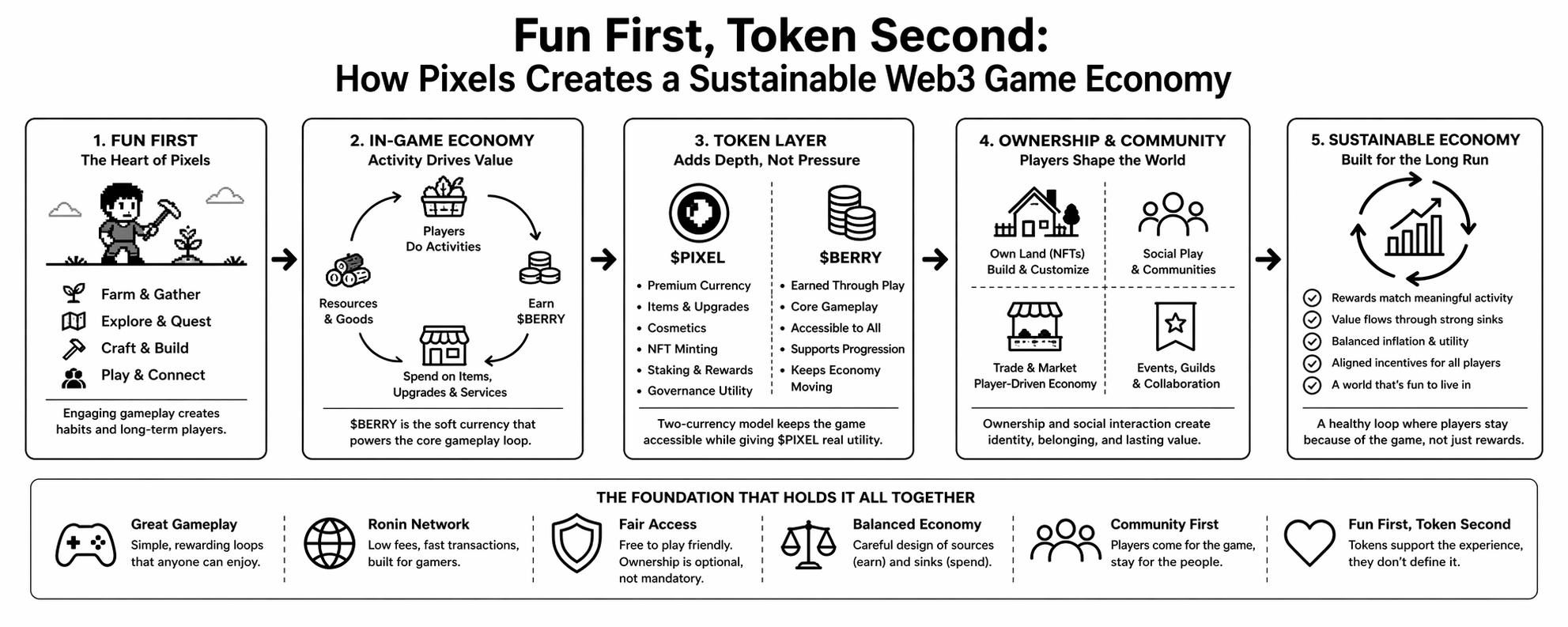
Pixels feels interesting because it does not begin with that mistake. It does not ask players to care about a token before they care about the world. It starts with something much easier to understand: farming, exploring, creating, collecting resources, improving land, and interacting with other players.
That may sound simple, but it is exactly the point.
A sustainable game economy cannot be built only on speculation. It needs habits. It needs routines. It needs small moments that make players return even when the market is quiet. Pixels understands this better than many Web3 games that came before it.
The token matters, of course. PIXEL is part of the ecosystem. It has utility. It supports deeper economic activity. But the more important idea is that Pixels does not rely on the token as the first reason to play.
The game comes first.
The economy grows around it.
A Web3 game should still feel like a game
One of the biggest problems in Web3 gaming is that many projects explain themselves like financial systems.
They talk about ownership, rewards, staking, token utility, marketplace activity, and governance before explaining why the game is enjoyable. That approach may attract investors or airdrop hunters, but it does not always attract real players.
Pixels takes a softer path.
The world is built around familiar actions. Players farm crops, gather materials, complete quests, trade goods, decorate spaces, and move through a social environment. These are not difficult ideas. They do not require a player to understand blockchain before they can begin.
That is important because games work best when the first step feels natural.
A new player should not feel like they are entering a financial dashboard. They should feel like they are entering a place. Pixels gives them that. The farming loop is easy to grasp. The world has color and movement. Progress happens through repeated actions. There is a sense of routine.
Plant something.
Come back later.
Harvest it.
Use it.
Sell it.
Upgrade.
Try again.
This rhythm is simple, but simple does not mean shallow. In casual games, repetition becomes meaningful when the loop feels comfortable and rewarding. Pixels uses that comfort as the base layer of its economy.
The blockchain side then adds extra depth. Ownership, tokens, land, and trading become extensions of play instead of replacing play entirely.
That difference matters.
The economy begins with activity, not hype
A healthy game economy needs more than people buying and selling assets. It needs production. It needs consumption. It needs reasons for items and currencies to move through the world.
Pixels has that structure because players create value by doing things inside the game.
They farm.
They gather.
They craft.
They complete tasks.
They interact with land and resources.
This makes the economy feel more connected to gameplay. It is not just a token floating above the game. It is tied to the actions players take every day.
That is where Pixels becomes more thoughtful than the usual “earn while you play” pitch. The goal is not simply to give players a reward and hope they stay. The goal is to make rewards part of a wider system where resources, upgrades, land, and social activity all connect.
When players earn something, there should also be a reason to use it.
That is one of the hardest parts of Web3 game design. If players only earn and sell, the economy becomes extractive. Value constantly leaves the system. Over time, rewards weaken, prices fall, and the game loses energy.
Pixels tries to avoid that by giving players reasons to keep participating inside the world. Progression, upgrades, land activity, crafting, cosmetics, and social status all create places for value to go.
The economy breathes when value moves in more than one direction.
Why fun must come before the token
The phrase “fun first, token second” sounds obvious, but many Web3 games ignored it.
They treated the token as the main attraction. The game was there to support the asset, not the other way around. That created a strange situation where people talked more about price movement than gameplay. Communities became market-focused. Players became short-term earners. The game itself became secondary.
Pixels has a better chance because its strongest appeal is not only financial.
A farming game gives players a reason to return through routine. A social world gives players a reason to care about who else is there. Land ownership gives committed users a reason to build identity. Tokens add value to those systems, but they do not need to carry the entire experience alone.
That is healthier.
A token can bring attention, but it cannot create lasting enjoyment by itself. A token can reward participation, but it cannot replace good design. A token can support ownership, but it cannot make a world feel alive unless players already want to spend time there.
Pixels works best when PIXEL feels like a tool, not the main character.
The player should not feel pressured to think like a trader every time they open the game. They should feel like they are stepping into a world where their actions matter. Some of those actions may connect to tokens. Some may not. That balance is what makes the economy feel less forced.
The two-currency idea gives the game more control
One reason Pixels has a more flexible economy is that it does not place every responsibility on one token.
In many Web3 games, one token has to do too much. It becomes the reward token, payment token, governance token, marketplace token, and speculation asset all at once. That can create pressure. When the market moves, the whole game feels it. When rewards are too high, the token inflates. When rewards are too low, players lose interest.
Pixels separates parts of the economy more carefully.
BERRY works more like an in-game soft currency. It supports regular gameplay and day-to-day activity. PIXEL plays a more premium role in the ecosystem. This gives the game more room to manage different types of value.
That structure matters because casual players and committed players do not always need the same thing.
A casual player needs the game to feel accessible.
A dedicated player needs deeper goals.
A landowner needs stronger ownership tools.
A token holder needs utility that feels connected to the ecosystem.
Trying to serve all of those people with one economic layer can make a game unstable. Pixels’ split approach gives the system more balance. It allows regular gameplay to remain approachable while still giving PIXEL a meaningful role for premium features, upgrades, and broader participation.
This does not make the economy perfect. No live game economy is ever finished. Inflation, bot activity, reward farming, user drop-off, and speculation are always risks.
But the design gives Pixels more tools to adjust.
That is already a step in the right direction.
Land gives ownership a real purpose
Ownership is one of Web3 gaming’s most repeated ideas, but it often gets explained in a very empty way.
Players are told they can “own their assets.” That sounds good, but ownership only matters when the asset has a real place in the game.
Pixels gives land that role.
Land is not just a collectible sitting in a wallet. It connects to gameplay, social presence, and economic activity. A landowner can build, customize, and participate in the world in a deeper way. Land becomes part of identity. It gives players a stronger connection to the game because they are not just passing through the world. They have a piece of it.
This is where blockchain ownership can actually make sense.
Not every player needs to own land. That is important. If a game requires ownership before enjoyment, it becomes less welcoming. Pixels keeps the door open for free and casual players while giving more invested users additional layers to explore.
That creates a healthier structure.
Some players may simply farm and complete quests.
Some may focus on gathering resources.
Some may care about social spaces.
Some may build around land.
Some may engage with the token economy more seriously.
A good online world should not force everyone into the same role. Pixels benefits from having different paths.
The more varied the motivations, the less fragile the economy becomes.
Social play makes the economy stronger
The social side of Pixels is not just decoration. It is part of the game’s durability.
Players stay longer in worlds where they know people, recognize places, and feel part of something. Farming alone can become repetitive. Farming inside a living community can become a habit.
That is a major difference.
A pure reward system asks, “How much can I earn?”
A social game asks, “What am I building here?”
A good Web3 game should ask both, but not in equal order.
Pixels leans into the idea of a shared world. Players can interact, visit spaces, participate in community activity, and build routines around more than personal earning. This creates emotional weight. It gives the economy a human layer.
That human layer is often missing in token-first games.
Without community, every player becomes a calculator. They measure time against rewards. If rewards drop, they leave. But when a player has friends, habits, land, identity, and unfinished goals, the decision to stay is not based only on short-term earning.
That does not mean rewards stop mattering. They still matter. But they are no longer the only reason to show up.
For a Web3 game, that is a big deal.
Sustainability depends on spending, not just earning
A game economy cannot survive on rewards alone.
This is where many projects fail. They design attractive earning systems but weak spending systems. Players collect rewards, sell them, and move on. The economy slowly drains because there are not enough meaningful reasons to keep value inside the game.
Pixels appears more aware of this problem.
The game gives players multiple reasons to spend, upgrade, craft, improve, customize, and participate. PIXEL can support premium parts of the ecosystem, while BERRY helps power everyday gameplay. This creates a better flow.
Players should not feel like spending is punishment. They should feel like spending helps them express themselves, progress, or unlock better experiences.
That is the difference between a tax and a game sink.
A bad sink feels forced.
A good sink feels useful.
A great sink feels like part of the fun.
Pixels needs strong sinks because any reward-based system faces pressure over time. If too much value is created and not enough is used, inflation becomes a problem. If rewards feel too weak, motivation drops. If spending feels too aggressive, players feel exploited.
The balance is delicate.
Pixels’ advantage is that its spending opportunities are tied to a world people can actually interact with. Farming, land, upgrades, cosmetics, and social participation all give the economy places to absorb value without making the game feel purely financial.
Ronin gives Pixels the right environment
The move to Ronin was important because infrastructure shapes user experience.
For a casual game, blockchain actions need to feel smooth. Players cannot be forced to think about network friction every time they interact with the economy. If transactions are slow, expensive, or confusing, the game loses momentum.
Ronin already had a strong connection to blockchain gaming. It had users familiar with digital assets, wallets, and game economies. That gave Pixels a better home than a general-purpose chain where gaming might feel like an afterthought.
This matters because Web3 games need more than good ideas. They need the right rails underneath them.
A farming game is built on frequent small actions. The experience should feel light. Players should be able to move naturally between gameplay and ownership features without feeling like they are leaving the game and entering a complicated crypto process.
The smoother that connection becomes, the easier it is for the game to reach normal players.
That is where Pixels has a real opportunity. It can use blockchain where blockchain adds value, while keeping the front-end experience familiar enough for casual users.
The real test is long-term behavior
Pixels has many of the right ingredients: a simple core loop, social design, land ownership, layered currencies, Ronin infrastructure, and a token with ecosystem utility.
But the real test is not whether the design looks good on paper.
The real test is what players do over time.
Do they return when rewards are lower?
Do they spend inside the game because they enjoy progression?
Do landowners build useful spaces?
Do new players feel welcomed rather than priced out?
Does PIXEL remain a support layer instead of overwhelming the game’s identity?
These are the questions that matter.
Web3 games often look strongest during growth phases. The harder part comes after the first wave of attention. That is when the economy must prove it can support real habits, not just temporary excitement.
Pixels’ best chance comes from the fact that its world is understandable. Farming is understandable. Crafting is understandable. Land is understandable. Social play is understandable. These simple ideas give the project a stronger base than abstract token mechanics alone.
The more the game builds around those human behaviors, the more durable it can become.
Pixels shows a better direction for Web3 gaming
The most promising thing about Pixels is not that it has a token. Many games have tokens.
The promising thing is that Pixels seems to understand the token should not be the whole product.
A strong Web3 game should be able to stand as a game first. The economy should make the experience deeper, not louder. Ownership should create attachment, not just speculation. Rewards should support participation, not replace enjoyment.
Pixels is not trying to be a complex financial machine with farming graphics on top. At its best, it feels like a casual social world where blockchain adds another layer of meaning.
That is the kind of direction Web3 gaming needs.
Not more games where every player is treated like an investor.
Not more economies that collapse when rewards slow down.
Not more projects that mistake token activity for real engagement.
Pixels points toward something calmer and more practical.
Build a world people want to enter.
Give them things to do.
Let them form habits.
Let ownership matter.
Use tokens carefully.
Protect the fun.
That order is everything.
Because in the long run, players do not stay only because a token exists. They stay because the game gives them a reason to care.
Pixels’ strongest idea is simple: the economy should follow the fun, not replace it.
That is how a Web3 game begins to feel sustainable.
