
If I tell you from my bottom of heart…I keep coming back to a simple question whenever i look at blockchain games: what does it actually mean to own something in a digital world?🤔🤔
Effort is still disposable. I mean, its like the first time I realized I could own my own land in a game… not just look at it, but actually do something with it. That feeling changes everything.
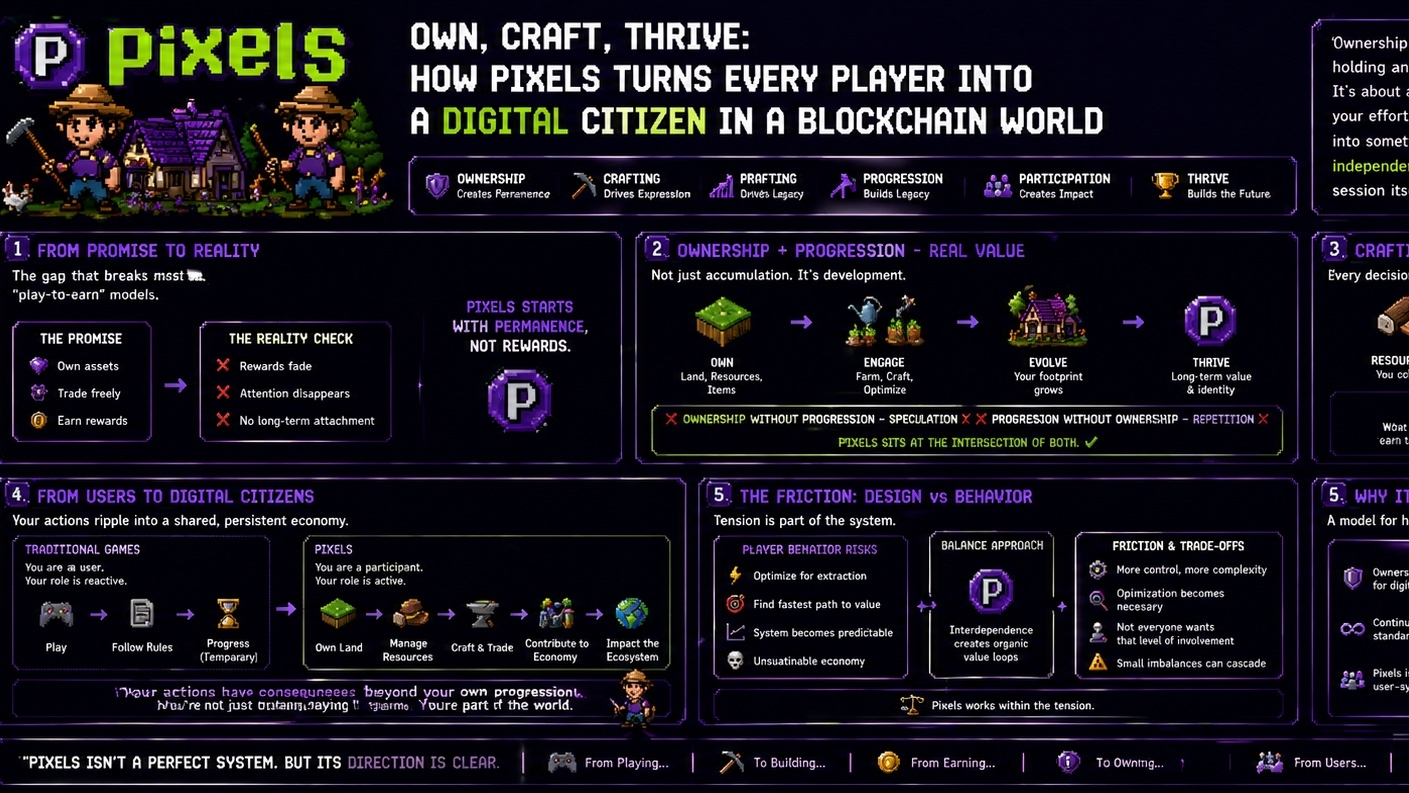
That gap between promise and reality is where most “play-to-earn” models quietly fall apart.
What stands out to me about Pixels is that it doesn’t try to start with rewards. It starts with permanence.
And that changes the entire structure.
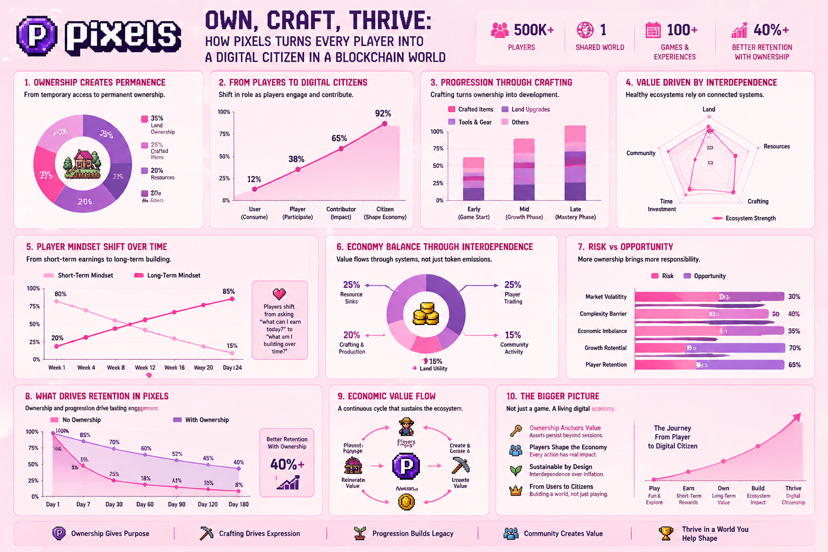
In traditional games, progress is contextual. It lives inside the game, bound to servers, accounts, and rules that can shift at any time. You don’t question it because that’s how games have always worked. Here ownership is not just about holding an asset. It’s about anchoring your time, your effort, and your decisions into something that persists independently of the game session itself. Land, resources, crafted items….these are not just gameplay tools. They are extensions of your identity within the ecosystem.
I’ve seen many projects tokenize items. That’s easy.
What’s harder is making those items matter.
Pixels approaches this by tying ownership directly to progression. The more you engage in farming, crafting, optimizing your land—the more your digital footprint evolves. It’s not just accumulation. It’s development.
That distinction is subtle, but important. Ownership without progression becomes speculation. Progression without ownership becomes repetition. Pixels attempts to sit at the intersection of both.
In Pixels, crafting feels closer to expression.
Because the assets you create are tied to your owned land and your long-term progression, every decision begins to carry weight. What you produce, how you optimize, what you prioritize—these are no longer isolated gameplay choices. They become part of your broader strategy within a persistent economy.
I have noticed that when players feel ownership, they naturally shift from short-term thinking to long-term planning. They stop asking, “What can I earn today?” 🤔and start asking, “What am I building over time?”
That psychological shift is where systems like this either succeed or fail.
Pixels encourages that shift by making crafting less about immediate output and more about sustained growth. It’s not just about producing items. It’s about shaping a personal ecosystem that evolves with you.
There’s a deeper structural change happening beneath the surface here.
In most games, you are a user. You engage with content that is designed for you, but you don’t influence its underlying economy in any meaningful way. Your role is reactive.
Pixels nudges you into a more active position.
By owning land, managing resources, and contributing to the in-game economy, you begin to function less like a player and more like a participant. Almost a digital citizen. Your actions have consequences beyond your own progression. They ripple outward into a shared system. At first, i thought it was just another farming game, but then I realized—this isn’t just about planting crops; it’s about planting the seeds for something that lasts.
But this also introduces complexity.😅
Mistakes are no longer trivial. Optimization becomes a necessity, not a choice.
This is one of the trade-offs that often gets overlooked in discussions around blockchain gaming.
More control sounds empowering—and it is—but it also demands more from the user. Not everyone wants that level of involvement. Not everyone is prepared for it.
Pixels doesn’t eliminate this tension. It works within it.
The Friction Between Design and Behavior
Every system carries an assumption about how users will behave. The challenge is that users rarely follow the script.
In reward-driven ecosystems, behavior tends to collapse into efficiency. Players optimize for extraction. They find the fastest path to value and repeat it. Over time, the system becomes predictable, and eventually, unsustainable.
Pixels tries to counter this by embedding value into progression rather than pure extraction. But the tension still exists.
What i find interesting is that Pixels doesn’t rely solely on scarcity or reward emissions to maintain balance. Instead, it leans on interdependence—between land, resources, crafting, and time investment.
It’s a more organic approach, but also a more delicate one.
Because when systems become interconnected, small imbalances can cascade.a shift in resource value, a change in player incentives, or an influx of new participants can all reshape the economy in unpredictable ways. I get it now. This isn’t just about grinding for rewards, its about making something that actually matters in the game….and beyond it.
Why This Matters Beyond the Game?
It’s easy to view Pixels purely as a game. But I think that misses the broader point.What is
being tested here is not just a gameplay loop. It’s a model for how digital systems can assign and preserve value over time.
If digital ownership becomes meaningful in one environment, it sets expectations for others. Users begin to question why their time and contributions are disposable elsewhere. They start to expect continuity.
Pixels, in that sense, is part of a larger shift.
Not a complete solution. Not a finished model. But a step toward redefining the relationship between users and digital systems.
In my view, the concept of Pixels stands out because it transcends traditional game mechanics by focusing on long-term growth and meaningful ownership. Unlike many games where assets are just temporary rewards, Pixels connects progress to something persistent—your efforts have lasting value.
This is something i have noticed in the design of the game..it allows players to shape their own evolving ecosystem, not just accumulate rewards. For me, it’s refreshing to see a game that pushes players to think beyond short-term gains and encourages strategic thinking. It’s not just about harvesting crops or collecting items; it’s about building something that will grow with you over time. This emphasis on sustainable progression is what makes Pixels feel different….there is a real sense of personal ownership that encourages deeper involvement. #pixel DYOR ALWAYS..