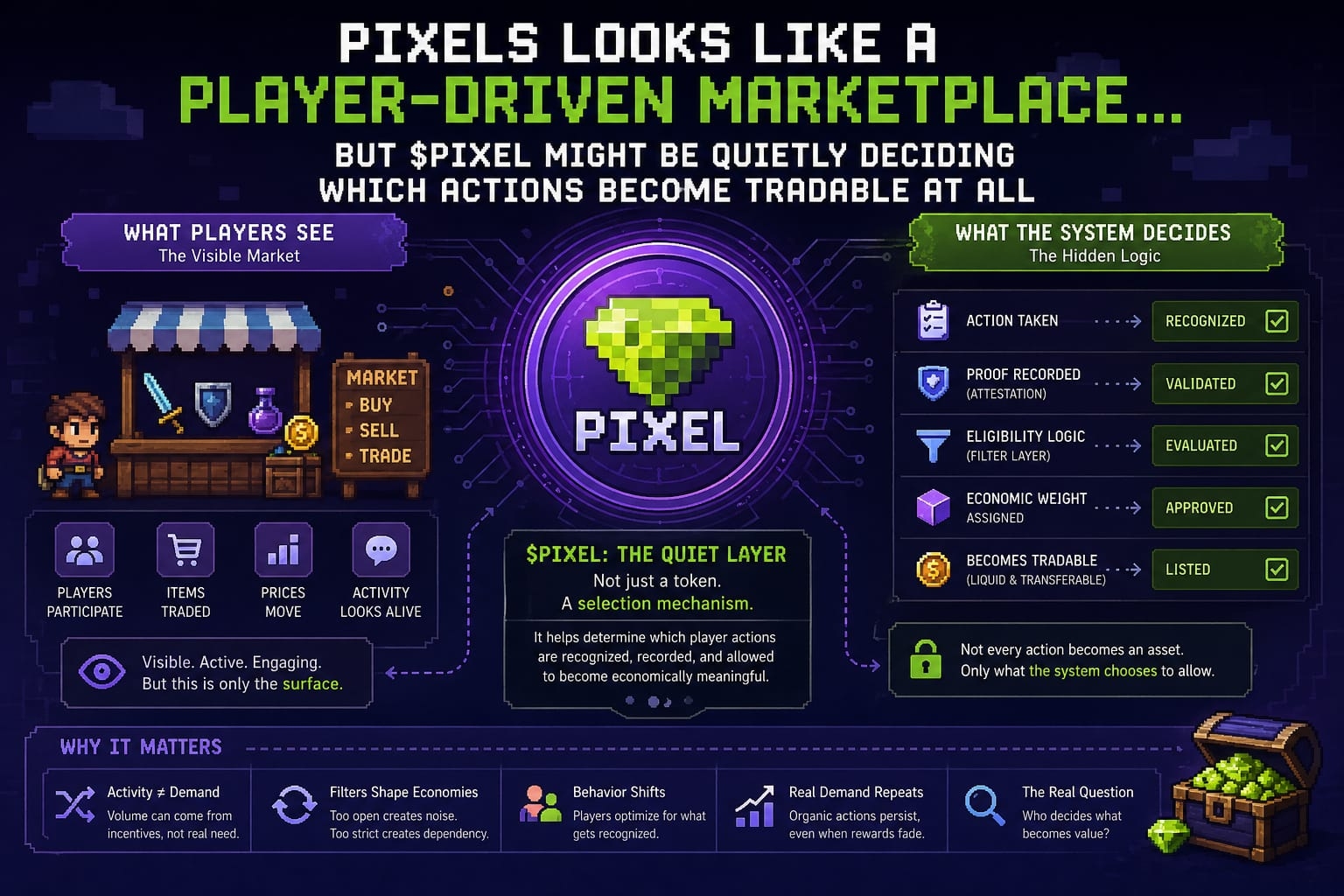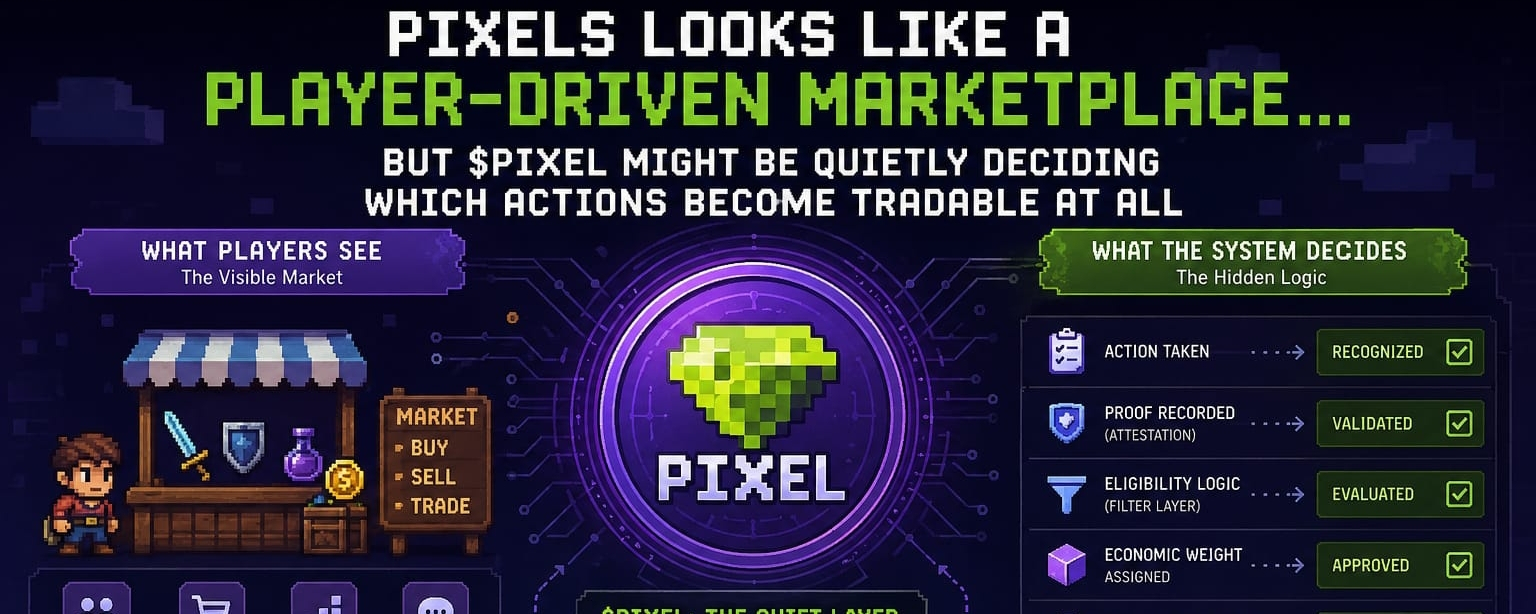
I sometimes catch myself trusting marketplace activity too quickly. A few items move, a few players trade, prices start forming, and the system looks alive. In crypto, we are trained to read that as demand. But after watching enough token economies weaken after the first wave of incentives, I have become more careful with that assumption. Activity can be loud while the real control layer stays quiet. Pixels looks like a player-driven marketplace from the outside, but I keep wondering whether $PIXEL is less about the visible trade itself and more about deciding which player actions are even allowed to become tradable in the first place.
That distinction matters. A marketplace is not just a place where things are exchanged. It is also a filtering system. Some actions become assets. Some effort becomes inventory. Some behavior becomes economically visible. Most of it does not. In a traditional game, this line is usually hidden inside design choices. In a tokenized game economy, the line becomes more sensitive because players start asking whether their time, items, progress, and reputation can move outside the closed loop. $PIXEL may sit near that boundary. Not always loudly, and not always directly, but as part of the logic that decides what earns liquidity and what remains just gameplay.
This is where I think the player-driven narrative gets a little messy. Players may create supply, set prices, farm resources, trade items, and shape short-term behavior, but the system still defines what counts. A player can spend hours doing something, yet that effort only becomes economically meaningful if the game recognizes it in a structured way. That structure is the quiet part. It is not just usage. It is eligibility. In simple words, eligibility logic means the rules that decide who can access something, claim something, trade something, or convert an action into value. The more I look at these economies, the more I think the real power is often sitting there.
$PIXEL, then, is not only a spending token or reward unit. It may become a selection mechanism. The system can use it to separate ordinary activity from activity that deserves economic weight. That sounds abstract, but it is actually practical. Not every click, task, crop, quest, or social action should become tradable. If everything becomes liquid, the economy can get flooded with low-quality output. If too little becomes liquid, players feel trapped inside a decorative loop. The hard part is choosing which behaviors deserve market access without making the whole thing feel controlled from above.
This is why I do not read marketplace volume by itself as proof of healthy demand. Volume can come from incentives, speculation, or short-term farming behavior. Real demand shows up when players repeat actions even after rewards become less obvious. Retention matters more than a one-time spike. If players keep returning because certain actions help them progress, coordinate, trade, or reduce friction, then the economy starts looking more durable. But if the marketplace only works while rewards are fresh, then pixel may be measuring excitement rather than dependency.
There is also a proof layer hiding inside this. Not proof in the dramatic technical sense, but proof as a structured record of behavior. A system needs to know that something happened before it can safely assign value to it. In crypto infrastructure, we often talk about attestations, which are basically signed records that say a claim is true. In a game economy, the same idea can appear more quietly. The system records that a player completed a task, held an asset, earned access, or contributed in a specific way. Once those records become reusable, the economy stops restarting from zero every time a player interacts with it.
That is where pixel could become more interesting than a simple marketplace token. If the token is connected to repeated, recognized, and structured actions, it can help turn player behavior into something the market can price. But this also creates a tension. The more the system filters what becomes tradable, the less purely player-driven it may be. The marketplace may still feel open, but the deeper question becomes who controls the gate between action and asset.
I do not think that is automatically negative. Every economy needs boundaries. Without filters, bots, farmers, and short-term extractors can turn participation into noise. But strong filters also create dependency. Players may begin optimizing not for fun, ownership, or organic strategy, but for whatever the system recognizes as economically valid. That can make behavior more measurable, yet also more narrow.
So when I look at Pixels and $PIXEL, I am less interested in whether players are trading. That part is visible. I am more interested in what the system chooses to make tradable, what it ignores, and whether repeated real behavior slowly becomes more important than surface activity. The marketplace may look player-driven, but the deeper economy might be forming around a quieter question: which actions are allowed to become value at all?