
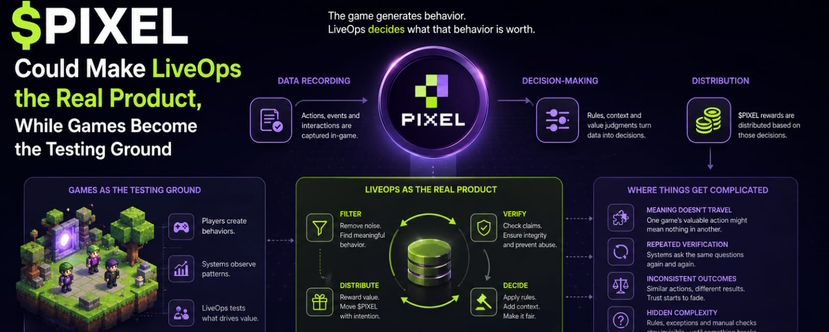
I keep noticing how often games update quietly now. Not big expansions or visible changes, just small adjustments. Reward rates shift. Tasks appear and disappear. Timers get shorter for some players and longer for others. Most of it feels harmless on the surface, almost administrative. But after a while it starts to feel like the game itself is not the main thing being worked on.
It feels like the system around the game is where the real activity is happening.
LiveOps, which is basically the ongoing management of a game after launch, used to feel like support. Events, seasonal rewards, maybe some balancing. Now it looks closer to a continuous decision engine. Not just reacting to players, but quietly sorting them. Deciding who progresses faster, who gets incentives, who is worth retaining. And I think this is where $PIXEL starts to sit, not inside gameplay, but around these decisions.
At first, it still looks like data. Players complete actions. The system records it. Rewards get distributed. Clean loop. But the moment rewards carry real weight, even small ones, the system stops being just a recorder. It has to decide. Who qualifies. Which actions count. What behavior is considered meaningful.
That shift is subtle, but it changes everything.
Because recording data is easy. Deciding based on it is not.
A completed quest is just an event. But when that quest becomes tied to a reward in $PIXEL, it turns into a claim. The player is essentially saying, I did this, I deserve that. And now the system has to verify it, not just technically, but contextually. Was it repeated too often. Was it done in a way that fits the rules. Does it still hold value compared to others doing the same thing.
This is where things start to slow down, even if the interface stays smooth.
Verification, in simple terms, is just checking if something is true. But in practice, it becomes layered. One system confirms the action. Another interprets it. A third decides if it should lead to a reward. And once tokens are involved, that final step carries consequences. Distribution is no longer neutral. It’s a decision with cost.
I think this is where LiveOps stops being support and starts becoming the product itself.
Because what’s actually being built is not just a game loop, but a system that continuously decides how value moves. The game becomes the testing ground where behaviors are generated. But the real work is happening in how those behaviors are filtered, verified, and turned into outcomes.
And it doesn’t stay contained.
The moment another system tries to rely on the same data, things get messy. One game might treat a behavior as valuable. Another might ignore it. A player who looks “high quality” in one environment might not qualify in another. The proof exists, but its meaning doesn’t travel cleanly.
This is the gap people don’t always see. Information existing is not the same as it being usable.
Even something like an attestation, which is just a structured claim that something happened, doesn’t solve this on its own. It can say a player completed a task, or reached a milestone. But it doesn’t carry the full context of why that matters, or whether it should lead to a reward somewhere else.
So the system keeps asking the same questions again. Re-verifying. Re-interpreting. Re-deciding.
From the outside, it still looks smooth. Rewards show up. Players progress. But underneath, there’s a lot of repetition. Manual checks hidden inside automated flows. Rules that get adjusted quietly because edge cases keep appearing.
And this is where trust starts to behave strangely.
Players trust the system when outcomes feel consistent. Not necessarily fair, but predictable. The moment similar actions lead to different results without explanation, that trust weakens. Not loudly, but gradually. People start testing the system instead of playing it.
Which makes the system respond again. More filters. More conditions. More invisible layers.
It becomes heavier.
What’s interesting is that $PIXEL doesn’t seem to remove this complexity. If anything, it makes it more visible, because rewards are no longer abstract points. They carry weight, even if small. That forces the system to be more precise about its decisions. Or at least try to be.
So LiveOps turns into something closer to an administrative layer for value distribution. Quiet, continuous, and slightly tense. Always adjusting. Always deciding.
And the game, almost unintentionally, becomes the environment where all of this gets tested.
I’m not sure if that’s a stable direction.
Because the deeper question isn’t really whether actions can be verified, or whether rewards can be distributed. That part mostly works. The harder question is whether these decisions can hold meaning across different systems, and whether the outcomes they produce remain defensible when someone looks closely.
Right now, it feels like the answers depend heavily on where you’re standing inside the system.
And that doesn’t always travel well.