
Have you ever stopped playing a game and wondered where all that time actually went? Not just the hours, but the small routines you built, the progress you made, the space you slowly shaped. One day you’re active in that world, and the next, it’s like it never really existed outside the screen.
This feeling isn’t new. Most online games are designed as closed systems. You can collect items, build things, even form communities—but everything ultimately belongs to the platform. If the game shuts down or simply loses relevance, all of it fades away. For players, the experience can still be meaningful, but it’s also fragile in a way that doesn’t quite match the time and attention invested.
Over the years, developers have tried to make these worlds feel more lasting. Updates, expansions, and live-service models keep games alive longer, but they don’t change the core reality: players don’t truly own anything. Even features like trading or customization exist within boundaries set by the developers, and those boundaries can shift at any time.
Blockchain gaming entered this space with a different promise—digital ownership that exists outside the control of a single company. In theory, this could make game worlds feel less temporary. But early versions of this idea often leaned too far in another direction. Instead of focusing on the experience of playing, many projects focused heavily on earning. For some players, that worked—for a while. But when the financial side weakened, so did the communities.
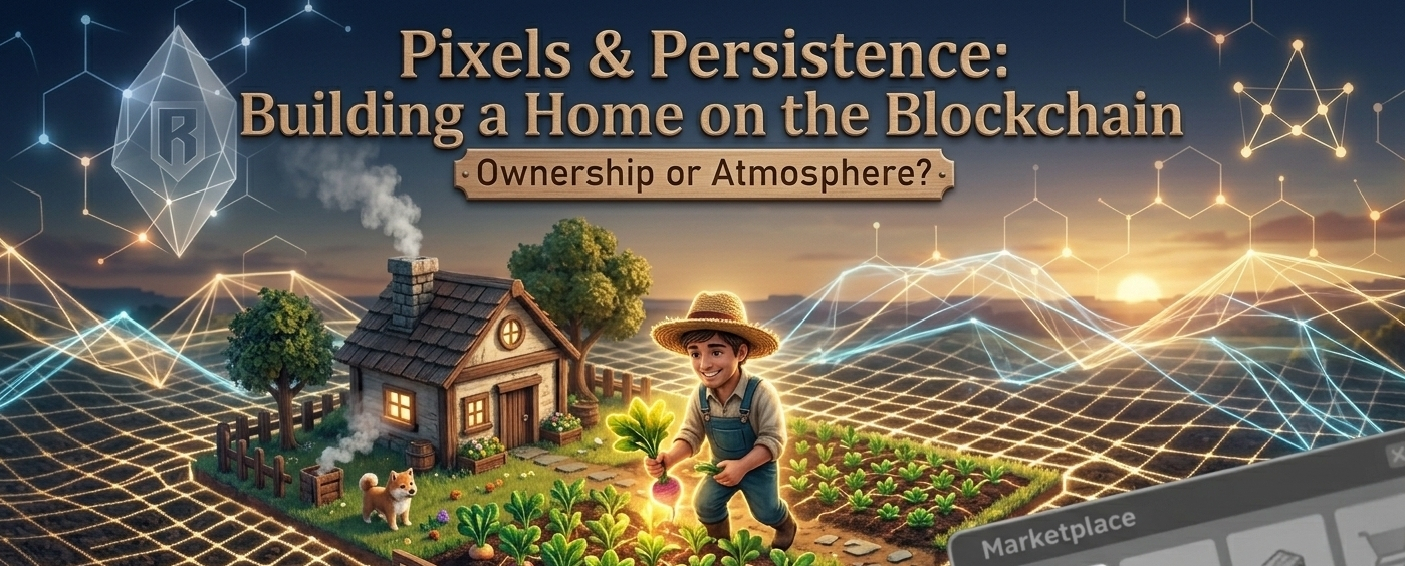
That’s where comes in, built on the . At first glance, it doesn’t feel very different from a typical casual game. You farm, explore, and interact with others in a relaxed, open world. It’s simple, even familiar. The blockchain part isn’t constantly in your face—it mostly sits in the background, shaping how certain things are owned rather than how every moment is played.
That approach feels intentional. Instead of pushing players to think about value all the time, Pixels seems to lean into everyday gameplay—planting crops, building routines, and being part of a shared space. The idea appears to be that if a world feels natural and enjoyable first, then ownership might actually matter in a more meaningful way.
But even this quieter approach comes with open questions. Just because something is recorded on a blockchain doesn’t mean it will always feel valuable. The meaning of in-game land or items still depends on people continuing to play, interact, and care about that world. If the community slows down, the sense of persistence can weaken, even if the assets technically remain.
There’s also the question of who finds it easy to join. Even with efforts to simplify things, blockchain elements can still feel unfamiliar. Setting up wallets, understanding how assets work—it’s not second nature for everyone. So while the game may be open to anyone in theory, in practice it can feel more accessible to those who already have some experience in the space.
And then there’s the issue of balance. If a game becomes too focused on ownership or rewards, it risks feeling transactional. But if those elements are too subtle, players might not see the point of having them at all. Finding that middle ground isn’t easy, and it’s something projects like Pixels are still figuring out in real time.
In the end, Pixels doesn’t fully solve the bigger problem—it just explores it in a different way. It asks whether a game can feel like a place that continues, rather than something temporary, without turning that place into a marketplace.
Maybe the more interesting question is this: can digital worlds ever feel truly lasting because people care about them, or will they always depend on systems of ownership to create that sense of permanence?