
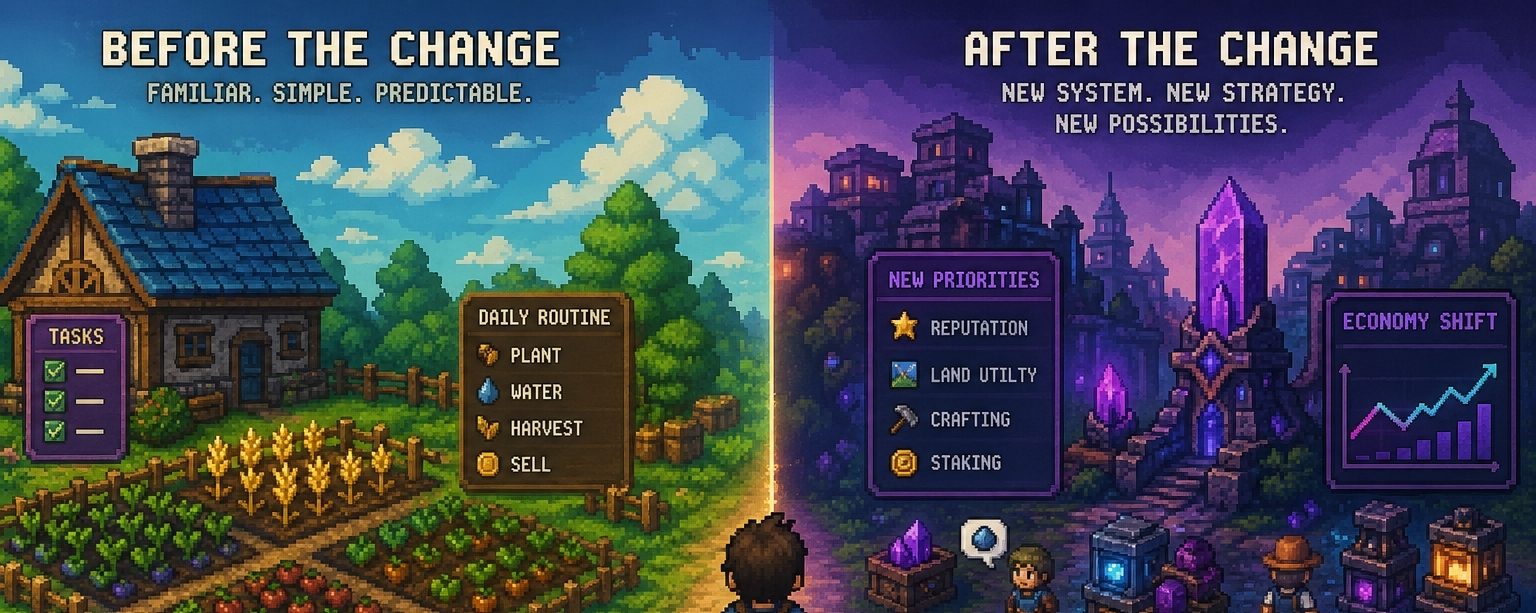
What Happens to Your World in Pixels If the System Changes?
Pixels has a quiet way of pulling you in.
At first, you might open the game just to check things out. You walk around, plant something, collect a few resources, maybe complete a task or two. Nothing feels too serious. It feels simple, almost relaxing. Then after a while, you start to build a routine. You know what you like doing. You know where your time goes. You know which resources feel useful and which ones you usually ignore.
And then one day, something changes.
Maybe the reward system feels different. Maybe a resource suddenly becomes more important. Maybe land starts to matter in a new way. Maybe the game pushes players toward staking, reputation, crafting, or a different type of progress. On the surface, it may look like just another update. But for players who spend time inside Pixels, it can feel bigger than that.
Because when the system changes, your world changes with it.
That’s the part that makes Pixels interesting. It isn’t only a farming game. It’s a living world with an economy under it. Every crop, every resource, every land decision, every token choice, and every small routine connects to something bigger. So when the rules move, even a little, players feel it in different ways.
Some players feel confused.
Some feel frustrated.
Some see an opportunity.
And some just quietly adjust and keep building.
Pixels is built around a simple idea: players enter a social farming world, gather resources, use land, complete tasks, and take part in an economy that keeps growing over time. But the deeper you go, the more you realize that the game is not really about doing one thing forever. It’s about learning how the world works, then learning again when the world changes.
That’s very close to real life.
Think about a small farmer in a real village. For years, maybe he grows the same crop because it always sells well. He knows the soil. He knows the market. He knows the season. Then one year, the weather changes, demand changes, or a new rule comes in. Suddenly, the old plan doesn’t work the same way. He has two choices. He can keep doing what he always did and complain that things are not fair, or he can look around, understand what changed, and adapt.
Pixels works in a similar way.
If you only play by habit, a system change can feel harsh. But if you pay attention, it can teach you where the game is going.
A lot of players make the mistake of thinking their current routine will last forever. They find one farming loop, one way to earn, one resource strategy, or one daily task pattern, and they hold onto it too tightly. For a while, that can work. But Pixels is not a frozen game. It’s a live economy. And live economies never stay still.
When the system changes, the first thing that usually changes is your daily routine.
Maybe the crop you used to focus on is not as useful anymore. Maybe crafting becomes more important than simple farming. Maybe the task board starts rewarding different items. Maybe the game wants you to think more carefully about resources instead of just collecting whatever is easiest. At first, that can feel annoying. Nobody likes having to relearn something they already felt comfortable with.
But that discomfort is also where the game becomes more real.
Because now you have to ask better questions.
What is actually useful now?
Which resources are people going to need?
Is my land still good for the new system?
Should I keep doing the same tasks, or should I change my plan?
Is the game rewarding fast grinding, or is it rewarding smarter participation?
These are the questions that separate casual movement from real understanding.
Resources are a big part of this. In Pixels, resources are not just random items sitting in your inventory. They are the building blocks of the economy. A resource that looks ordinary today can become valuable tomorrow if a new crafting need appears. Something players ignored for weeks can suddenly become important because the system starts using it differently.
This happens in real markets all the time. Something has value because people need it. If demand changes, value changes. Pixels may look cute and colorful, but the same logic is there. If more players need a certain material, the players who can produce or collect it efficiently have an advantage. If fewer players need it, it becomes less exciting.
That’s why serious players don’t only watch token prices. They watch behavior.
They watch what people are crafting.
They watch what resources are being used.
They watch what land types are becoming useful.
They watch which tasks are worth the time.
They watch where players are moving.
The game gives signals. You just have to notice them.
Land is another area where system changes can really matter. For some players, land is just a place to farm. But in Pixels, land can become much more than that. It can shape what you produce, how much you can do, and how valuable your position is inside the world.
A free player may feel a system change in a simple way. Their daily tasks may take longer, or their old routine may not be as strong. A renter may start looking for better land because the new update makes certain land more useful. A landowner may suddenly realize that their plot has become more valuable because it fits the new economy better.
That’s why land in Pixels feels different from land in a normal game. It is not only visual space. It can become productive space.
But there is a delicate balance here.
If land becomes too powerful, new players may feel left behind. If land doesn’t matter enough, owners may feel like their assets have no purpose. Pixels has to keep walking that thin line. Ownership should feel meaningful, but the game still needs to feel open. A new player should be able to enter the world and believe they can grow. If everything feels locked behind early ownership, the world starts to feel smaller.
A healthy game needs both.
It needs people who own and invest.
It also needs people who are just starting.
It needs serious players.
It also needs casual ones.
That mix is what makes a world feel alive.
Then there is the token side, and this is where emotions get stronger. Once a game has a token, players don’t only think like players anymore. They start thinking like earners, holders, traders, builders, and investors. That can bring energy into a game, but it can also bring pressure.
If rewards are too easy, people may farm only to extract value and leave. If rewards are too hard, players may feel like their time is not respected. If the token becomes too necessary, the game can feel unfair. If the token has too little use, people may stop caring about it.
This is one of the hardest problems in Web3 gaming.
A normal game can focus mostly on fun. A Web3 game has to think about fun, economy, ownership, inflation, fairness, and long-term trust at the same time. That is not easy.
So when Pixels changes its reward systems, currencies, fees, or staking features, those changes are usually trying to solve a deeper problem. The team has to stop the economy from becoming too easy to drain. They have to make sure rewards do not lose meaning. They have to encourage players to stay and participate, not just farm and sell.
Some players won’t like that.
And honestly, that’s understandable.
If someone built their whole routine around earning in one way, and that method gets weaker, they will feel disappointed. That is a normal human reaction. But from a long-term view, a game cannot survive if the easiest path is always to take value out and give nothing back.
A strong game needs people who care about the world, not only the payout.
That’s why systems like reputation, staking, land utility, crafting, and resource demand matter. They make the game deeper. They give players more reasons to think. They push the economy away from simple farming and toward something more layered.
But this only works if players understand what is happening.
When a system changes without clear meaning, people lose trust. They feel like the rules are moving against them. But when the change makes sense, players may still complain at first, but many will eventually understand. Good communication matters. Players need to know why a change happened, what problem it is trying to solve, and how they can adapt.
Trust is not built by keeping everything the same.
Trust is built by changing carefully.
One of the most human parts of Pixels is that every player experiences change differently.
Imagine someone who plays after work for peace. They don’t care too much about charts, token movement, or complex strategy. They just like farming, collecting, and slowly improving their small space. If the system changes, they may feel lost for a few days. They may need to learn a new routine. But if the game still feels enjoyable, they will stay.
Now imagine another player who owns land and watches every update closely. For them, a system change is not just a gameplay update. It can affect land value, rental strategy, resource production, and long-term planning. They will read the update differently. They will look for opportunity.
Then there is the grinder. This player cares about efficiency. They want to know the best way to use time. If the old reward path changes, they may get upset first. But if they are smart, they will start testing the new system quickly.
Same update.
Three different reactions.
That’s what makes Pixels feel alive. A change doesn’t land the same way for everyone.
If you are playing Pixels seriously, the best mindset is simple: don’t get too comfortable.
That does not mean you should be stressed all the time. It means you should stay flexible. Don’t depend on one method forever. Don’t assume one crop, one item, one task, or one strategy will always be the best. Learn the game in layers. Understand farming, but also understand crafting. Understand land, but also understand resources. Understand rewards, but also understand why the game might reduce or redirect them.
The best players are not always the ones who grind the longest. Often, they are the ones who notice change early.
They see when the economy is shifting.
They see when players are moving toward a new resource.
They see when a system is pushing people toward reputation or staking.
They see when old habits are becoming weaker.
And instead of only complaining, they adjust.
That does not mean every system change is good. Some changes can be too sudden. Some may feel unfair. Some may confuse players. Some may make the game less fun for a while. A live game still has to respect the people inside it. Players are not numbers on a dashboard. They are people spending real time, and sometimes real money, inside a world they care about.
That is why Pixels has to be careful.
If the team changes too little, the economy can become weak.
If they change too much, players can lose confidence.
The balance is somewhere in the middle. Keep the world fresh, but don’t make people feel like nothing is stable. Protect the economy, but don’t remove the joy. Reward ownership, but don’t close the door on new players. Build token utility, but don’t let the token swallow the game.
That last point is important.
Pixels should still feel like a world first. The economy should support the game, not replace it. When players only think about rewards, the magic becomes smaller. But when the gameplay, social energy, ownership, and economy all work together, Pixels becomes something much more interesting.
It becomes a place where your choices matter.
So what really happens to your world in Pixels if the system changes?
Your world gets tested.
Your old routine may not work the same way.
Your resources may gain or lose importance.
Your land may become more useful, or maybe less useful.
Your rewards may require more strategy.
Your habits may need to change.
But your world does not end.
It evolves.
That is the honest answer. Pixels is not meant to stay still. No serious digital economy can stay still. The players who expect everything to remain exactly the same will always feel uncomfortable. The players who understand change will have a better chance of growing with the game.
When the system changes, don’t only ask, “What did I lose?”
Ask, “What is the game trying to reward now?”
That question can help you see the next path.
Maybe the new system rewards patience.
Maybe it rewards better land use.
Maybe it rewards reputation.
Maybe it rewards cooperation.
Maybe it rewards people who actually play instead of only extract.
Whatever the answer is, the signal is there.
Pixels is a farming game on the surface, but underneath, it is a lesson in adaptation. You build, the rules shift, the economy reacts, and then you decide what kind of player you are going to be.
Some players will leave when the old path disappears.
Some will complain and keep doing the same thing.
Some will slow down, watch carefully, and find the new opportunity.
That is usually where the smarter players are.
Because in Pixels, your real world is not only the farm, the land, or the items in your inventory.
Your real world is the system connecting all of it.
And when that system changes, the best thing you can do is not panic.
Look around
Learn the new rhythm.Then start building again.
