wait — the Ronin deploy that changed the whole framing
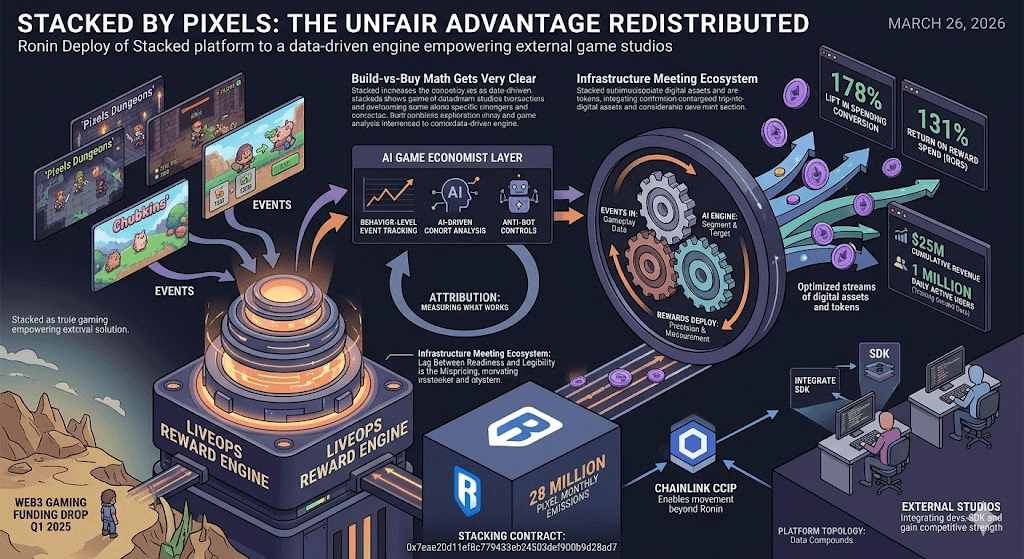
March 26, 2026. Stacked by Pixels went live on Ronin — formally announced by the Ronin network blog, app accessible and open. I wasn't even paying close attention that week. Then the numbers from the internal test campaign surfaced: 178% lift in spending conversion. 131% return on reward spend. I had to read that twice.
Because those aren't speculative metrics. That's a system that was already running live inside the Pixels ecosystem — across Pixels, Pixel Dungeons, Chubkins — generating the data before anyone else got access to it. Four years of iteration. $25 million in cumulative revenue. A million daily active users as the training ground. And now they're handing the SDK to external studios.
That's not a launch. That's an unfair advantage being redistributed.
the part the market hasn't fully priced in yet
Most people still look at Stacked as a Pixels product. A loyalty app. A quest board that doesn't suck.
That reading is too small.
What Pixels actually built — quietly, internally — is a LiveOps reward engine with behavior-level event tracking, AI-driven cohort analysis, automated payout logic, and anti-bot controls. And critically: a system that measures whether rewards are actually working. Not just whether quests were completed. Whether the behavior you incentivized translated into real retention, real revenue, real LTV movement. There's a word for that in traditional software infrastructure. It's called attribution.
Game studios have been flying blind on reward spend for years. You drop tokens into a quest, hope players stick around, watch your RORS collapse, wonder what broke. Stacked closes that loop. The AI game economist layer lets a small team ask in plain language — what separates my Day 30 retained users from my Day 7 churners? — and get an actionable answer, not a dashboard full of noise.
That's the conceptual model that matters here: three quiet gears running together. Events flow in from gameplay. The AI engine segments and targets. Rewards deploy with precision and measurement. Each rotation of that flywheel improves the next. And now any studio can bolt this onto their own game via SDK.
honestly the part that still bugs me
The slow rollout. Pixels is being deliberately careful about B2B partner expansion. They said so directly: "as confidence in the system builds, we'll accelerate." Which is the right call. But it means the infrastructure thesis is not fully legible yet on-chain. You can track the 28 million $PIXEL distributed monthly to stakers, watch daily reward indexing happen transparently on-chain. The economic spine is visible. The B2B pipeline isn't — yet.
That lag between infrastructure readiness and market legibility is where I think the mispricing lives.
hmm… and maybe that's intentional. If you open B2B too fast and onboard a studio that fails publicly, you've damaged the infrastructure narrative before it had a chance to compound. Better to run quietly, prove the system works, then scale the intake.
I've watched enough Web3 gaming cycles to know the difference between a platform and a product. Products serve one audience. Platforms create gravity — they become more valuable as more participants join, because data compounds, behaviors sharpen, targeting improves. What Pixels is building with Stacked has platform topology. Every external studio that integrates adds signal. Every cohort analyzed refines the model.
3 AM and this is what I keep coming back to
The backdrop matters here too. Web3 gaming funding dropped 71% in Q1 2025. Games are shutting down. The Blockchain Gaming Alliance found 32% of studios cited cash shortages as their primary survival threat. In that environment, a studio spending budget on a full internal data science team to manage reward logic is burning runway on a problem Stacked already solved.
The build-vs-buy math gets very clear very fast.
And the distribution channel is already established. Stacked runs on Ronin — the same chain handling Pixel staking, running Pixel Dungeons, The Forgotten Runiverse, multiple Ronin-native titles. Studios looking at Ronin as a deployment target now have a LiveOps infrastructure layer sitting there waiting. The B2B motion isn't cold outreach into the void. It's infrastructure meeting ecosystem.
Two timely signals worth tracking: one, the Pixel staking pool now caps monthly emissions at 28 million tokens — a deliberate constraint to maintain RORS discipline. That's Pixels signaling they will not sacrifice economic coherence to chase growth. Two, the cross-chain architecture — built with Chainlink CCIP — means Stacked's reward infrastructure isn't permanently Ronin-locked. That's a detail that matters when you're pitching B2B to studios on other chains.
The forward question I'm sitting with isn't whether Stacked works — the internal data already answered that. It's whether the B2B partner expansion compounds fast enough to establish infrastructure moat before a well-funded competitor copies the model. Platform advantages are real, but they're not automatic.
What would it take for a studio on a different chain to justify integrating Stacked versus building their own version — and has Pixels thought hard enough about that specific objection?