
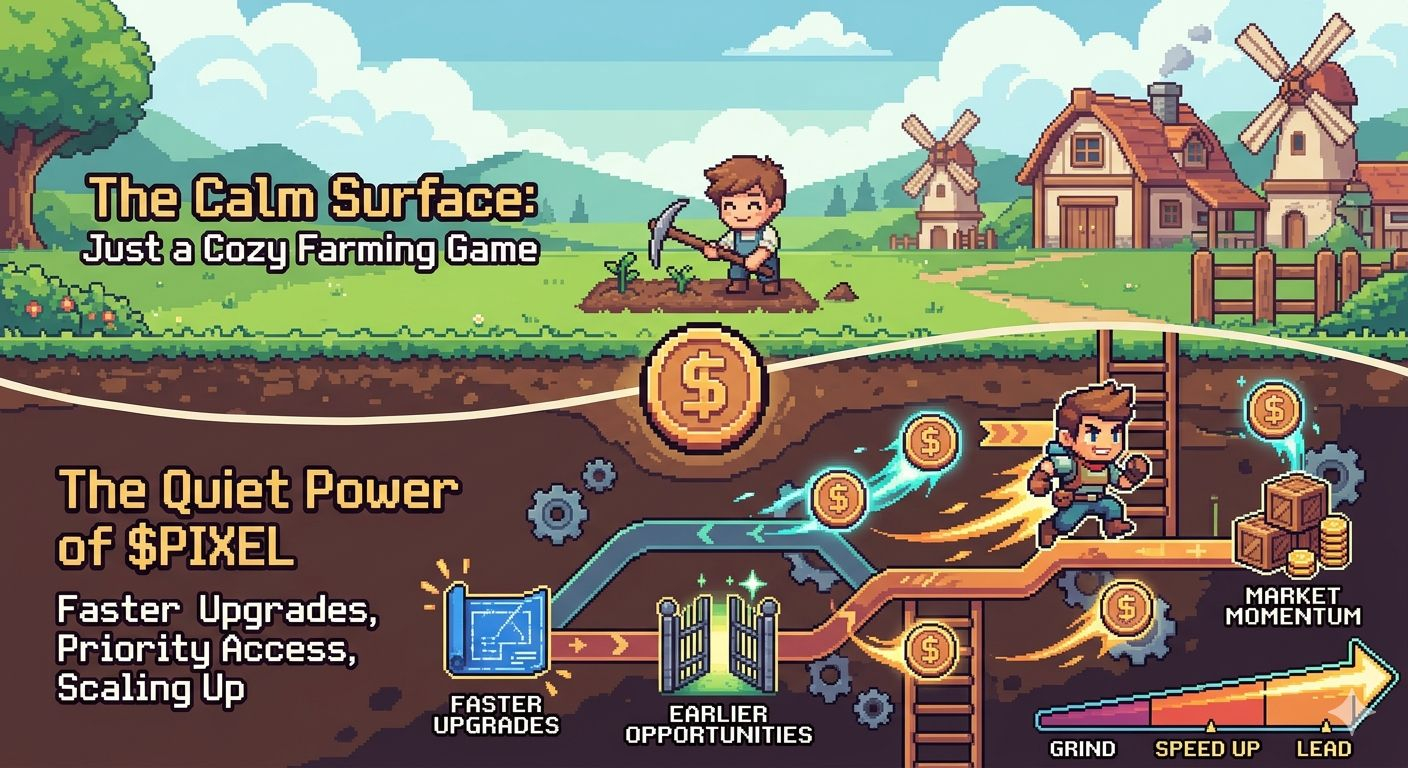
 Pixels looks like the kind of game you open to unwind: cozy visuals, simple farming loops, friendly quests, and a pace that doesn’t scream “competitive.” But under that calm surface, a new reality is taking shape—one where $PIXEL can subtly influence how quickly a player grows, upgrades, and unlocks meaningful progress.
This isn’t about “pay-to-win” in the loud, obvious sense. It’s more about pay-to-accelerate—and in Web3 games, acceleration often becomes the real advantage.
The Calm Surface: Why Pixels Feels So Chill
Pixels is designed to feel light and approachable. The tasks are familiar, the world is colorful, and the learning curve is not aggressive. That’s exactly why it attracts a broad crowd: not just hardcore gamers, but casual players, collectors, and even people who never touched crypto before.
But relaxed gameplay doesn’t mean relaxed economics. In fact, games that feel slow and cozy often create the strongest demand for speed—because progression becomes the main “status symbol.”
The Quiet Power of $PIXEL: Speed, Access, and Efficiency
In many blockchain games, the token doesn’t necessarily buy power directly. Instead, it buys time. And time is the one resource every player competes over—even in a peaceful farming game.
Here’s how PIXEL can quietly become a progression lever:
1) Faster Upgrades = Earlier Access to Better Loops
Upgrades usually unlock better tools, better production, or better quest rewards. If pixel helps a player upgrade earlier (directly or indirectly), they enter efficient earning loops sooner—meaning they can compound progress while others are still grinding basics.
2) Reduced Friction in Trading and Crafting
Web3 game economies often punish slow decision-making. Prices move, items get scarce, and popular resources become competitive. If pixel improves a player’s ability to trade, craft, or secure inputs faster, they can avoid the “stuck phase” many free players hit.
3) Priority in Progression-Based Opportunities
Even when a game is fair, progression creates tiers. Players who reach milestones sooner can access:
limited-time events
better farming routes
rare drops
guild or community roles
economy opportunities (flipping, supplying, crafting)
If PIXEL acts as a bridge to those milestones, it becomes a quiet gatekeeper.
Not Pay-to-Win… But Pay-to-Lead
The difference matters.
Pay-to-win means money buys unbeatable strength.
Pay-to-lead means money buys momentum, and momentum often decides who dominates early markets.
In game economies, the first movers often become suppliers. Suppliers set the pace. They control availability. And in a player-driven economy, control over supply is a form of power—even if no one is “fighting.”
The Psychology: Why Speed Becomes Social Currency
Pixels doesn’t need PvP to create competition. Players naturally compare:
who unlocked what first
who owns rare assets
who scaled faster
who looks “established” in the world
In a relaxed game, that comparison becomes even more noticeable—because there’s no intense combat to distract you. Progress becomes the scoreboard.
And if $PIXEL can compress weeks of grinding into days, it becomes the invisible engine behind that scoreboard.
The Bigger Question: Is That Bad?
Not necessarily.
A token-powered acceleration system can be healthy if:
free players can still reach everything with time
paying players don’t permanently block the economy
the game rewards skill and planning, not just spending
token sinks are balanced so inflation doesn’t ruin rewards
The danger appears when acceleration becomes mandatory—when the “free route” feels like walking while everyone else is driving.
What Smart Players Should Watch Next
If you’re trying to understand where PIXEL truly sits in the power structure, watch these signals:
1) How often does the game create time-limited opportunities?
More limited events = more advantage for fast progressors.
2) Are key upgrades locked behind token-based systems?
Even partial locks can shift the balance.
3) Does early progression lead to better earning or better market control?
If yes, acceleration becomes a financial edge.
4) Is there a strong path for free-to-play progression?
If the gap keeps widening, the economy becomes top-heavy.
Final Take
Pixels may look like a peaceful farming adventure, but the economy underneath can still reward the fastest builders. And in that kind of environment, PIXEL doesn’t need to “break” the game to shape the leaderboard—it only needs to influence who gets there first.
In Web3, the quietest advantage is rarely raw strength.
It’s starting sooner, scaling faster, and compounding longer.
If you want, I can write the same article in:
1) More viral Twitter-thread style
2) A news-style blog post (SEO optimized)
3) A deep-dive analysis with token utility breakdown