
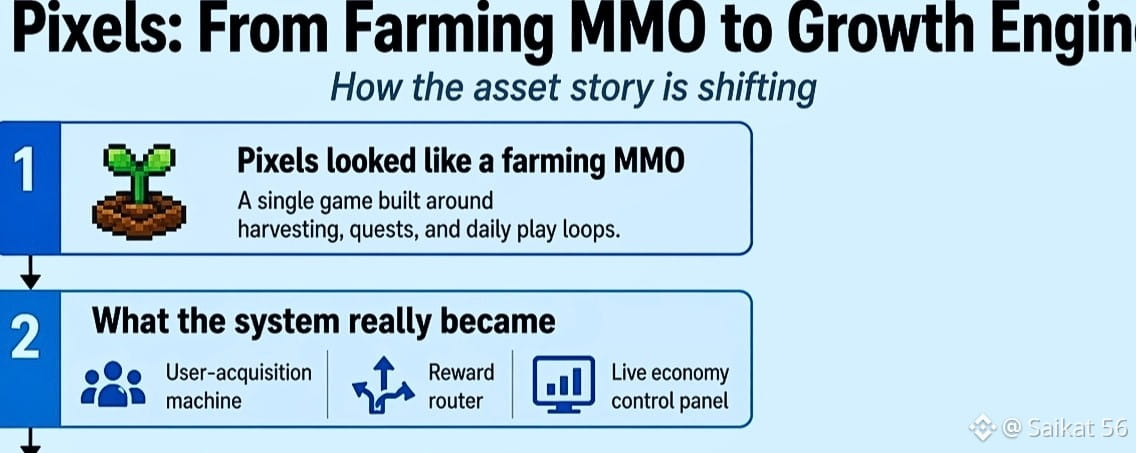
For a long time, I didn’t really take Pixels seriously. It looked like the usual type of Web3 farming game plant some crops, complete tasks, collect rewards, and then slowly lose momentum once the hype fades. I’ve seen many projects follow that path, so at first Pixels didn’t seem different.😴
Later, I realized I was looking at the wrong thing.
Because the real story of Pixels is not farming. It is the system hidden inside the farming layer. From the outside, it looks like a casual game. But underneath, there is a structure designed to track player activity, manage reward flows, and build an economy layer that goes beyond simple gameplay.
That was the moment I stopped viewing Pixels as just a game. I started seeing it as a platform that understands how to bring users in, keep them active, reward them, and circulate them throughout its ecosystem. That may be where the project’s real strength lies.
This is why the Stacked launch feels important to me. It shows Pixels is no longer thinking only about its own game. They are connecting $PIXEL staking to a broader ecosystem. If other projects begin using the same reward structure, then Pixels may no longer be just a single game it could become a shared economy layer.
Put simply, the old narrative was: “Come play our game.”
The new narrative could become: “Use our system.”
For investors and traders, that difference matters a lot. A game token usually rises when the game is popular and falls when interest fades. But if the token becomes part of a larger ecosystem reward network, its utility becomes much bigger.
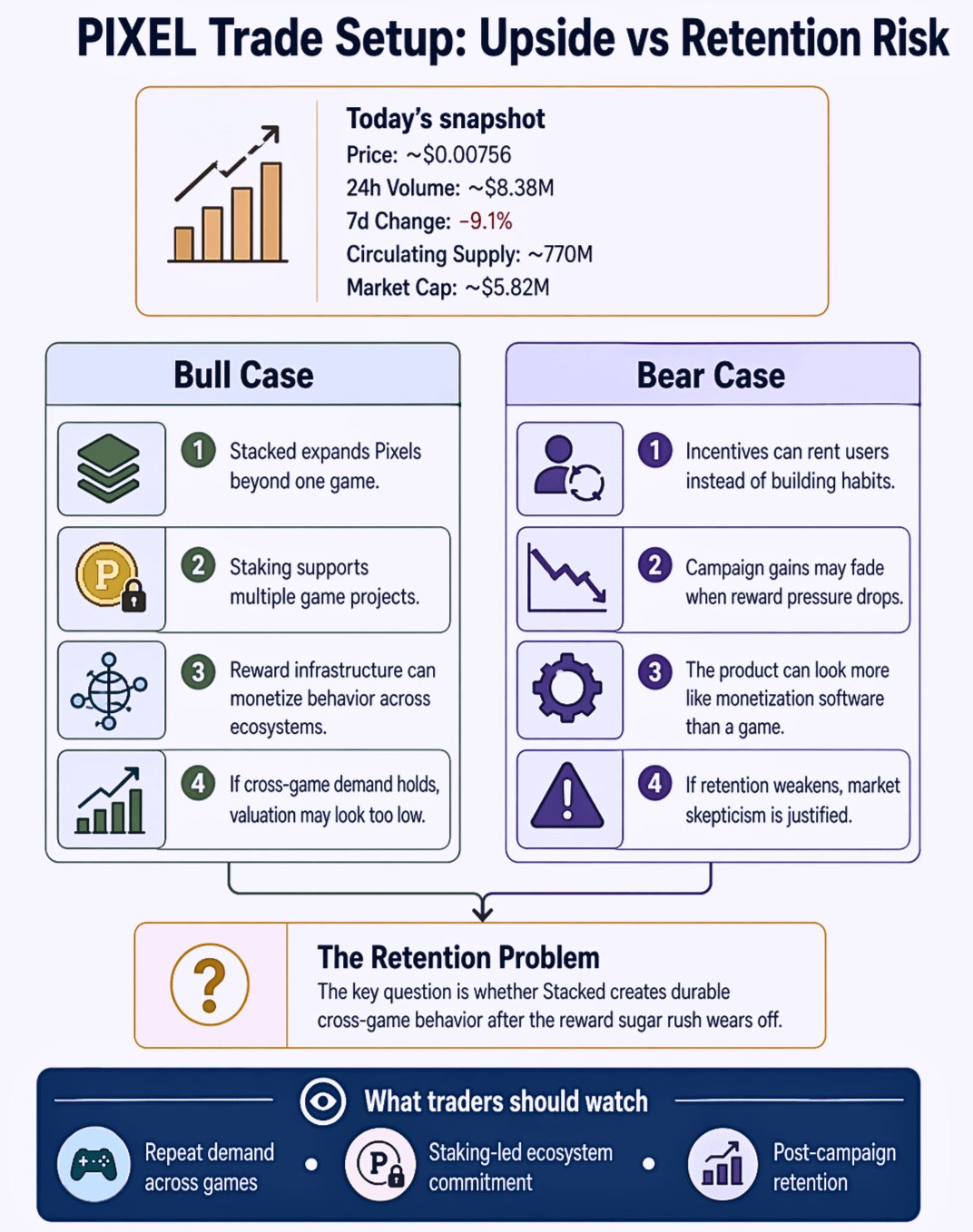
Even so, the market still does not seem fully convinced. PIXEL’s market cap remains small, and price behavior suggests many traders are still thinking short term. There is liquidity, there is attention, but conviction looks limited. People are watching it, but not fully trusting it yet.
The bull case is clear. If Pixels can truly build a multi-game rewards network, if staking increases ecosystem demand, and if players stay connected across different games through one economy, then today’s valuation could look very small in hindsight.
But the bear case is also real. Bringing users in and keeping users engaged are not the same thing. Rewards can attract people. Incentives can increase activity. But when rewards slow down, how many people stay? That is the real test. Many projects showed strong growth early, then collapsed once incentives disappeared.
PIXEL faces the same question.
Is it building habits, or simply buying activity with rewards?
There is another issue too. The more Pixels optimizes systems like reputation scores, thresholds, events, and gated rewards, the more it may feel less like a game and more like monetization software. From a business perspective, that could be smart. But emotionally, not every user will respond the same way.
So in my view, Pixels is in an interesting stage right now. It is not dead, but it is not guaranteed success either. It is in transition.
If Pixels can prove Stacked is more than a campaign tool if it becomes a real cross-game demand engine then the $PIXEL story can change quickly.
If most activity still depends on incentives and organic loyalty remains weak, then the market’s skepticism was justified.
The conclusion is simple:
Don’t watch the branding. Watch behavior.
Don’t watch announcements. Watch retention.
Don’t watch hype. Watch real demand.
If Pixels can do more than attract people if it can truly keep them then that is where the real win begins.😎