
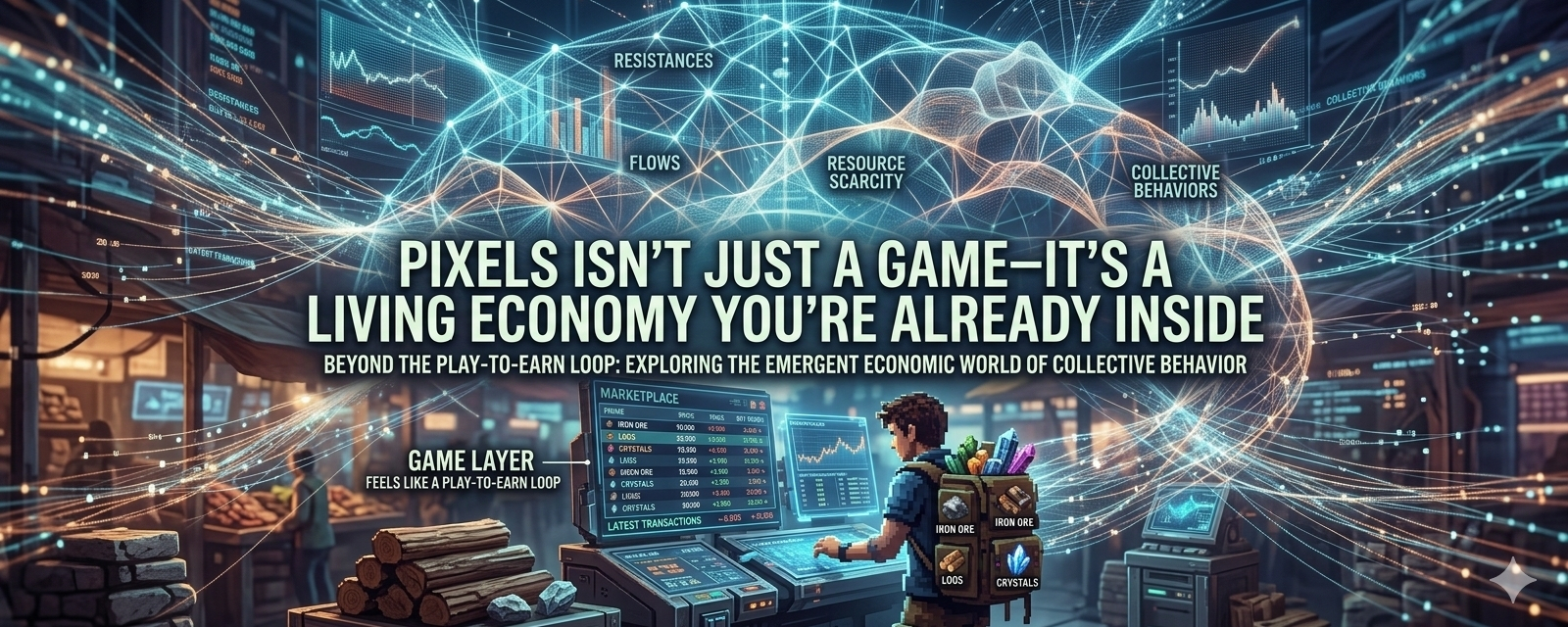
@Pixels There was a moment this weekend when I told myself I’d stay away from Pixels, take a proper break, reset a bit. But out of habit more than intention, I opened it anyway—just to quickly check the prices of a few resources. I had farmed a decent amount of wood and stone the day before, so it felt like a harmless glance. But the longer I stayed on the marketplace screen, the more something felt… off. Not in a bad way, just different. It didn’t feel like I was checking progress in a game. It felt like I was watching something already in motion, something that didn’t really need me but still reacted to me.
At first, I used to see Pixels the way most people do—a typical play-to-earn loop. You farm, you craft, you sell, and you try to optimize every step so you come out ahead. It’s a familiar mindset, especially if you’ve spent time in crypto. Everything becomes about efficiency, timing, and squeezing the most value out of each action. On the surface, it all feels predictable, almost mechanical. But the more time I spent actually observing what was happening instead of just playing, the more I realized that this explanation only scratches the surface.
What’s really happening inside Pixels doesn’t feel like a game layered with an economy. It feels more like an economy that just happens to look like a game. And that shift in perspective changes everything. Because suddenly, you’re not just optimizing for profit anymore—you’re responding to dozens of small signals at once. Prices shift slightly, crafting takes a bit longer than expected, movement feels slower in certain areas, or resources become just scarce enough to make you hesitate. None of these things alone seem important, but together they quietly shape your decisions.
I started paying more attention to how I actually play. Not just what I do, but what happens in between. The pauses. The moments where I stop, check the market again, rethink a plan, or just stand still for a few seconds before deciding what to do next. And I noticed something interesting—those in-between moments were happening more often than the actions themselves. It wasn’t that I didn’t have a plan. It was that the plan kept changing while I was trying to execute it.
In most GameFi systems I’ve experienced, everything revolves around clear numbers—reward rates, returns, efficiency curves. You follow the math, and the math tells you what to do. But Pixels doesn’t behave like that. There isn’t one dominant factor guiding your behavior. Instead, it’s a collection of small frictions—tiny delays, minor inefficiencies, subtle shifts—that stack on top of each other until they start influencing you in ways that are hard to notice directly.
And then another thought hit me. What if the system isn’t really controlling behavior at all? What if it only feels that way because thousands of players are making similar decisions at the same time? Maybe what I’m seeing isn’t a designed structure, but something that has emerged from repeated patterns. Players optimize, adapt, react—and over time, those repeated behaviors start forming something stable, something that looks intentional even if it wasn’t fully planned.
That idea changes how Pixels feels entirely. It stops being a game you play and starts becoming an environment you participate in. Every action you take—every resource you gather, every item you craft, every decision you delay—feeds into a larger system that’s constantly adjusting itself. You’re not just following the system; you’re quietly helping shape it.
What makes it even more fascinating is how blurred the line becomes between the system and the players. It’s hard to say where one ends and the other begins. The system influences behavior, but behavior also builds the system in real time. What we call “structure” might just be patterns that have repeated long enough to feel permanent. And what we call “choice” is often already being guided by that structure before we even realize it.
In that sense, Pixels isn’t just something you log into and play for rewards. It’s closer to a small, evolving economic world—one that doesn’t have a clear center, where direction comes from collective movement rather than top-down design. Value flows not where it’s told to go, but where resistance is lowest. And players, knowingly or not, become part of that flow.
The most surprising realization for me wasn’t about profit or strategy. It was recognizing that sometimes, in systems like this, what matters isn’t what you own—but what kind of logic you’ve already stepped into. Because by the time you start questioning it, you’re already part of it.
