

From Simple Farm to Living World: Why Pixels Feels Special in 2026
What truly hooks me in a crypto game isn’t a flashy launch or early hype.
It’s watching it evolve into something far deeper than its original spark.That rare transformation is what most projects never achieve.
Pixels began as a charming, retro style social farming experience on Ronin simple, accessible, and delightfully fun. Plant, harvest, vibe with friends. For a while, that light-hearted loop was enough to pull in crowds and create genuine buzz.
But in 2026, something exciting has shifted.
It’s breaking free from being “just another farming sim.” The team is thoughtfully expanding it into a rich, multi layered ecosystem a living world with meaningful depth, progression, and real on-chain utility.
There was a time when Pixels was judged mainly on daily active users and surface level engagement. Those numbers still matter, and the game has shown impressive staying power with strong player counts even in 2026. But what’s more telling is how the experience inside has matured.
Some might see the slower, more deliberate pace as less exciting.
I don’t,To me, it signals a move from broad, casual activity toward deeper, more rewarding engagement. A game that keeps adding layers new mechanics, economic utility for $PIXEL, and reasons to stay invested creates something that can actually last.
And that’s where Pixels feels more compelling in 2026.It’s no longer just chasing short play sessions. It feels focused on building a living system where players can progress meaningfully, whether through farming, animal care, crafting, or emerging social and competitive elements. In any sustainable on-chain economy, depth like this matters far more than initial hype.
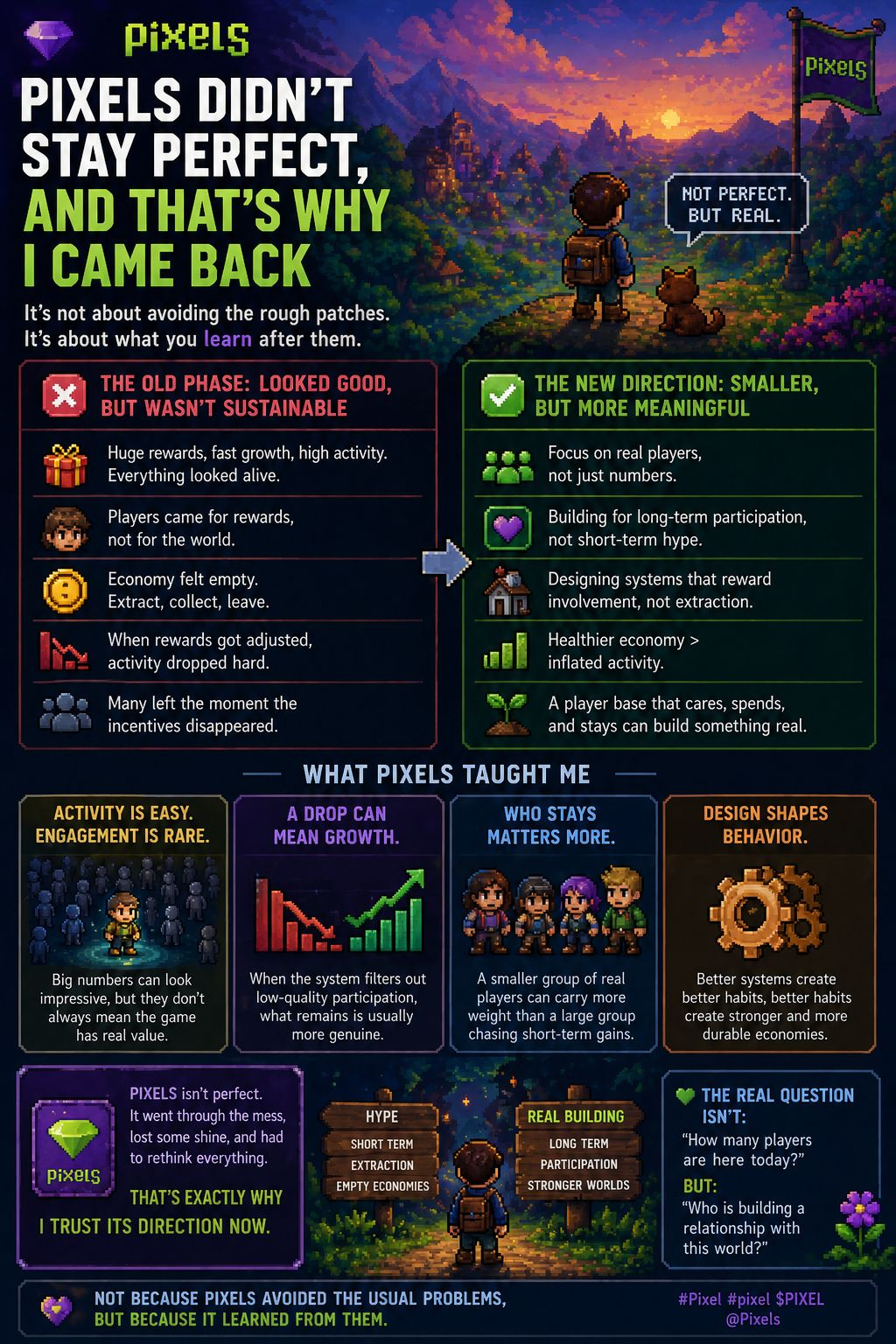
What keeps me coming back to a game isn’t whether it stayed smooth the whole time. It’s whether it changed after things stopped being smooth. That’s the part most projects never really get right.
But instead of trying to hide it or maintain the same approach, it feels like the system adjusted because of it. That’s what makes it stand out to me now. It no longer feels like everything is built around appearance or short-term growth.
It feels like there’s more attention on what actually matters who is playing, how they’re participating, and whether the system can hold up without relying on constant excitement.
Because once a project goes through the difficult phase when incentives don’t align, when excitement fades, when behavior gets messy it either ignores it or learns from it.
Pixels feels like it learned something.
The tone is different now. Less about selling an ideal version of the future, more about working through the reality of what actually happens inside these systems.
It doesn’t feel like a project trying to maintain an image. It feels like one that got pushed into reality and had to rethink what actually matters. The focus doesn’t seem to be on how many players show up anymore it’s on who stays, who participates, and who actually adds value inside the game.
That shift is subtle, but it changes everything.
There was a time when the numbers looked impressive from the outside. High activity, strong engagement, constant movement. But when reward structures changed and low effort participation became less viable, the drop was noticeable.
To me, it signals a move from broad, casual activity toward deeper, more rewarding engagement. A game that keeps adding layers new mechanics, economic utility for $PIXEL, and reasons to stay invested creates something that can actually last.