
For years, the promise of Web3 gaming has been overshadowed by a recurring cycle of hype and collapse. Most "play-to-earn" projects struggled because they lacked a sustainable economic model, often becoming victims of bot farms and aggressive value extraction that eventually drained their liquidity. However, the landscape is shifting in 2026, and @Pixels (https://www.binance.com/en/square/profile/pixels) is at the forefront of this transformation.
The secret behind this resilience is the Stacked ecosystem.
Beyond Simple Farming: A Data-Driven Approach
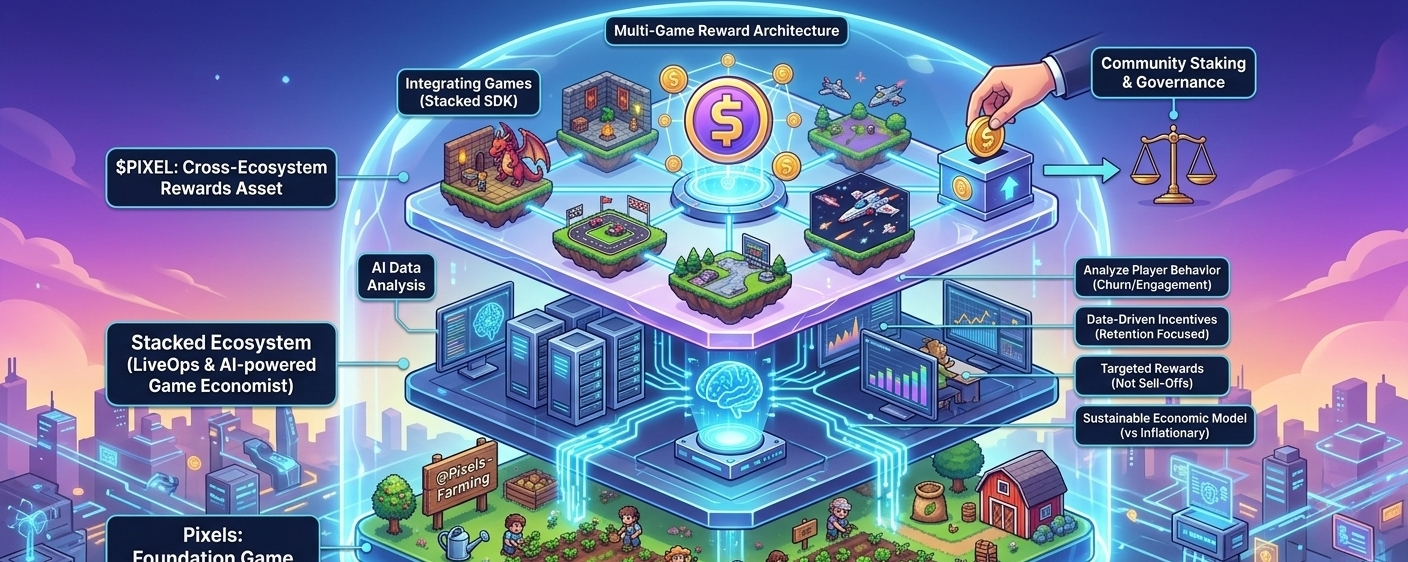
At its core, Pixels has moved far beyond the concept of a simple farming simulator. Stacked is a sophisticated, AI-powered LiveOps and rewards engine that functions like a "game economist." Instead of blindly distributing tokens—which often leads to inflationary pressure and token price volatility—Stacked analyzes player behavior in real-time.
By utilizing data science models, the system identifies segments of players who are churning, those who are highly engaged, and those who need specific incentives to continue playing. It then targets these users with precise rewards that foster retention rather than just facilitating quick "sell-offs." This shift from "play-to-earn" to "reward-to-play" is the holy grail of game development, balancing developer profitability with an enjoyable player experience.
$PIXEL : The Thread Weaving the Ecosystem Together
The $PIXEL token has evolved alongside this infrastructure. It is no longer just a single-game currency; it is becoming a cross-ecosystem rewards asset. As more games integrate the Stacked SDK, the utility of $PIXEL expands, moving from a standard utility token to the foundational layer for a multi-game reward architecture.
This infrastructure doesn't just benefit the developers; it benefits the players who participate in the ecosystem. By staking $PIXEL, players aren't just locking up tokens—they are effectively participating in a governance mechanism that supports the titles they believe in. High-performing games, supported by community stakes, receive more platform exposure and rewards, creating a meritocratic environment where game quality and community engagement are directly tied to financial success.
Why This Matters for the Future
The beauty of the Stacked model is its scalability. Whether it is Pixels, Pixel Dungeons, or other partner games, the infrastructure remains seamless. It creates a "silent account" for users in the background, allowing the experience to remain intuitive without the friction of complex blockchain interactions for the casual player, while providing deep-chain utility for those who want it.
We are witnessing a maturation of the Web3 space. Projects that prioritize sustainability, player retention, and genuine utility are beginning to outlast the short-term experiments of the past. By building infrastructure that actually solves the "leaky bucket" problem of previous economic models, Pixels is proving that Web3 gaming can be both sustainable and fun.
If you are looking for a project that is building for the long term—one that treats its economy like a living, breathing town rather than a temporary theme park—the development of this ecosystem is something you cannot ignore.