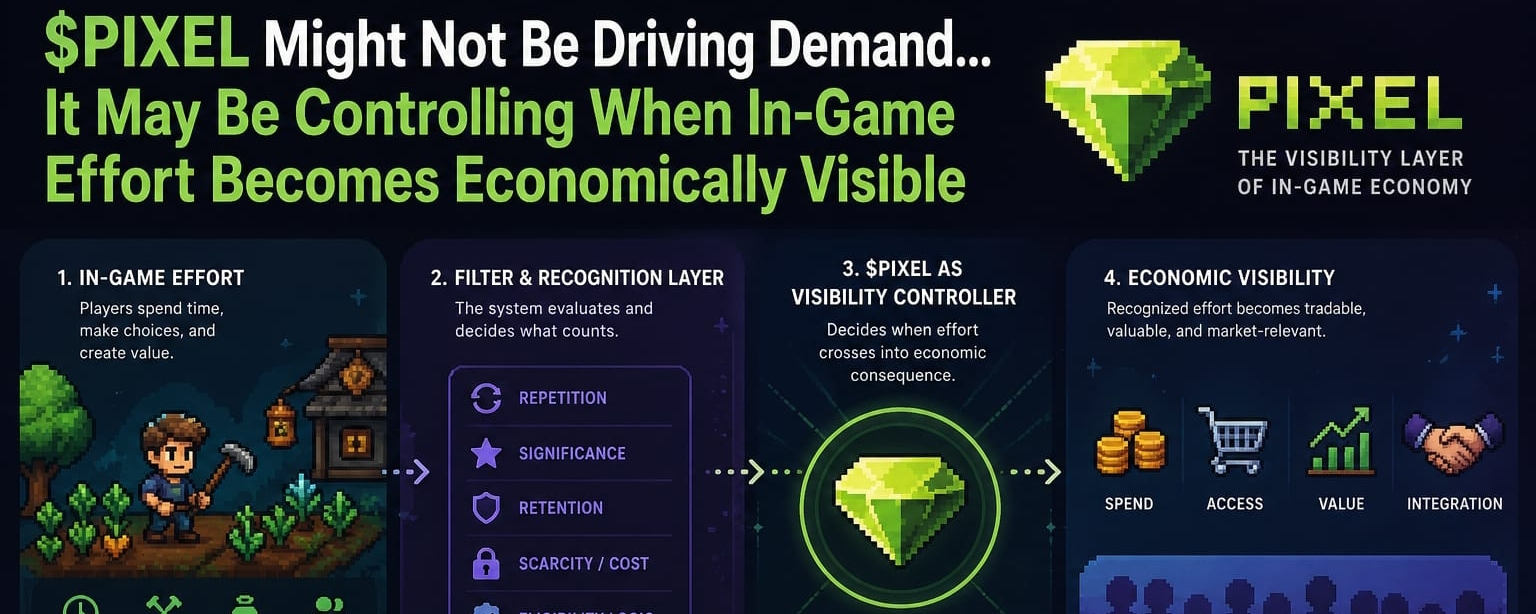
I used to think game tokens were mostly about spending. You earn something, you buy something, maybe you sell something later if the market gives you a chance. Simple loop. But the more I watch systems like Pixels, the less comfortable I am with that view. The more interesting question is not whether players are active. They clearly are. The quieter question is when that activity becomes visible in economic terms, and who decides that moment.
That is where pixel starts to look different to me. Not necessarily as a demand engine in the obvious sense. It may not be “driving demand” the way traders usually describe it, with clean charts, volume spikes, and a simple story of more users needing more token. It feels more like a control layer around recognition. A player can farm, craft, complete tasks, build habits, join the social loop, and still most of that effort can remain inside the game’s softer economy. It exists. It matters to the player. But it may not matter economically until the system decides it is worth converting into something more visible.
That distinction feels small at first. Then it becomes uncomfortable. Usage is not the same as demand. A player clicking every day is not automatically creating durable token pressure. Activity can be noisy, subsidized, seasonal, or just habit. Demand begins to look more serious when repeated behavior needs a scarce settlement layer, a premium access point, or a recognized record that other parts of the system care about. Pixel may be sitting around that threshold, not replacing gameplay, but deciding when gameplay crosses from private effort into measurable economic weight.
In normal games, effort often disappears into progress bars. You spend time, the game updates your state, and that is mostly the end of it. In crypto games, people expect more, sometimes too quickly. They assume on-chain visibility should follow participation naturally. But that creates another problem. If every small action becomes economically visible, the system gets noisy and easy to exploit. If too little becomes visible, the token feels disconnected from the game. So the real design problem is not just rewarding players. It is filtering which actions deserve to become part of the market-facing record.
I keep coming back to this idea of visibility. A player may feel rich in effort before the market can see anything valuable. The market does not price sweat directly. It prices structured signals. Repeated purchases, scarce upgrades, meaningful access, proven retention, maybe behavior that studios or ecosystems can reuse later. Raw activity is messy. Structured activity is different. It says, this player did not just pass through. They returned, chose, spent, waited, upgraded, or proved something through behavior.
This is why incentives are tricky. Incentives can create motion without creating dependency. A campaign can bring users in, but once the reward fades, the system finds out what was real. Did players return because the game had gravity, or because the payout was visible? Did pixel become part of the player’s routine, or was it only touched during reward moments? That is the line I would watch. Not just transactions. Repetition. Not just spending. Recurring need. A token economy becomes more believable when players keep meeting the same friction and the token remains the cleanest way through it.
There is also a strange proof layer here, even if Pixels is not always discussed in that language. Proof does not have to mean a complex zero-knowledge proof, where someone verifies something without exposing all the details. In a practical sense, proof can simply mean a structured record that the system trusts. The player has done enough, returned enough, bought enough, or reached a state that matters. The question is whether pixel helps turn that record into economic consequence. Not every effort needs to be disclosed raw. Some effort just needs to be recognized at the right moment.
That makes pixel less like a loud reward token and more like a timing mechanism. It can shape when effort becomes liquid, when progress becomes premium, when patience becomes optional, and when a player’s internal history starts to carry market meaning. I do not want to overstate it. These systems can still become too extractive, too dependent on incentives, or too unclear for regular players. But the structure is interesting because it does not ask whether players are doing things. It asks which actions should count outside the game.
And maybe that is the harder part for the market to price. Charts can show demand after it appears. They are worse at showing the moment before recognition, when thousands of small actions are still invisible, waiting to be filtered into value. If $PIXEL matters, it may be because it controls that border. Not the whole economy. Not the whole game. Just the point where effort stops being only effort and starts becoming economically legible. That border is still blurry, and maybe that is exactly where the real question sits.