
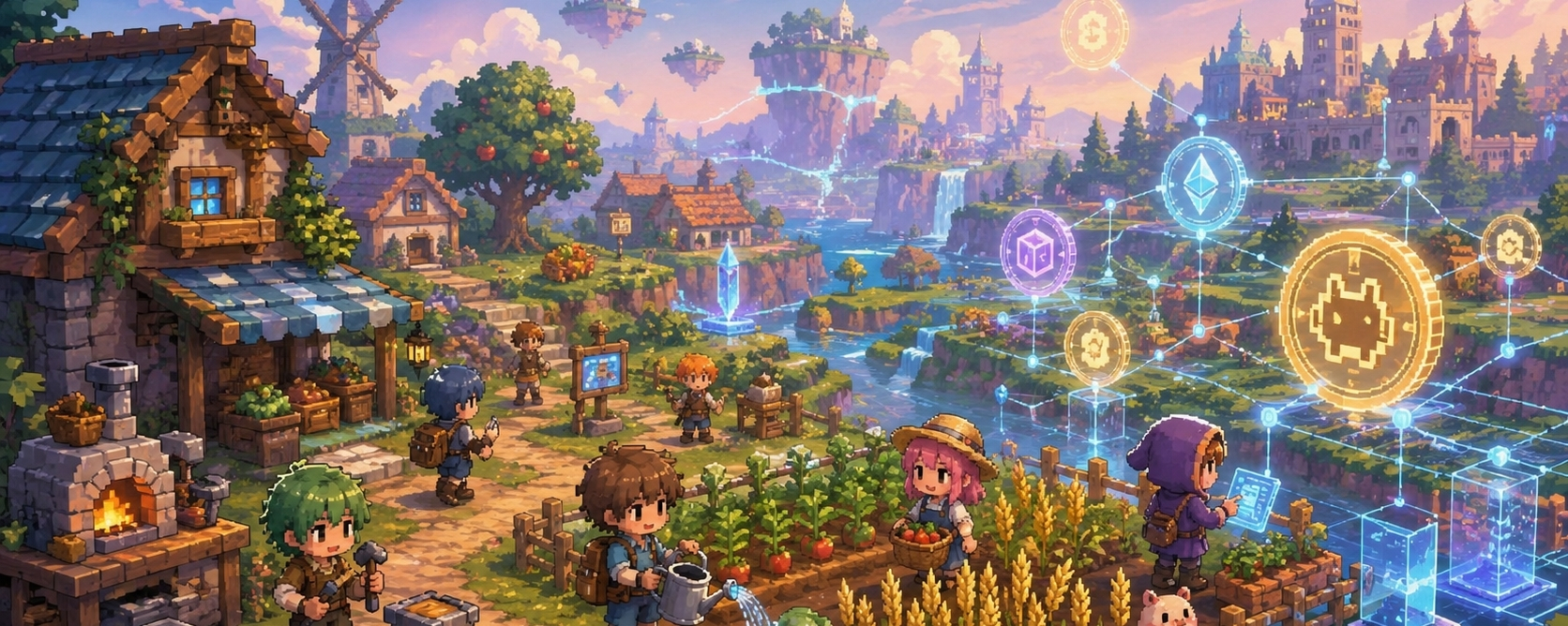
A tiny farming game shouldn’t have this much pressure on it.
That’s the funny thing about Pixels. At first glance, it looks simple. Almost too simple. A little pixel character walks around, crops grow in small fields, resources appear here and there, and players complete basic tasks. It feels soft, casual, and harmless.
But behind that small farming world is a much bigger question:
Can a blockchain game actually feel like a real game?
That question matters because blockchain gaming has had a rough reputation. A few years ago, the space was full of big promises. Players were told they would own their items, earn from their time, and become part of open gaming economies. It sounded exciting.
But then reality hit.
Many games didn’t feel like games. They felt like token dashboards. Players were not always playing because they loved the world. They were playing because they hoped the rewards would be worth something. And when the rewards dropped, the excitement disappeared too.
That is the problem Pixels is trying to move away from.
Pixels doesn’t walk in shouting about being the future. It starts with something very normal: a farm, a few jobs to do, a world to explore, and other players around you. You plant, gather, craft, trade, complete quests, and come back again later.
It’s not a new idea, but it’s a smart one.
Farming games work because they give people a simple feeling of progress. You start with very little. You do small tasks. Slowly, your space improves. It feels calm. It feels personal. It gives you a reason to return.
That’s why Pixels feels different from many Web3 games. The blockchain part is there, but the game does not depend on explaining crypto to you before you can understand what you’re doing. You don’t need to know every detail about wallets, tokens, or NFTs just to understand the basic loop.
That is a big deal.
A lot of blockchain games made the mistake of putting the economy first and the game second. Pixels feels closer to the opposite. It gives players something to do first, then builds the Web3 layer around that experience.
The move to Ronin also helped Pixels grow. Ronin is already known in blockchain gaming because of Axie Infinity. That history matters. Axie showed how big a crypto game could become, but it also showed how risky play-to-earn economies can be when too much depends on rewards.
Pixels entered the market at a more careful time. Players were no longer blindly excited about every crypto game. Many had already seen projects rise fast and fall even faster. So Pixels had to prove itself in a harder environment.
And in some ways, that makes its progress more meaningful.
The PIXEL token is part of the game’s wider system. It can be used for different in-game features, upgrades, memberships, guild-related activity, and other parts of the ecosystem. But this is also where the pressure begins.
A token can help a game, but it can also hurt it.
If players care only about earning and selling the token, the game starts to feel like work. People stop asking, “Is this fun?” and start asking, “Is this profitable?” Once that happens, the heart of the game gets weaker.
Pixels has to avoid that trap.
The token needs to feel useful, but it cannot become the whole reason people play. The strongest version of Pixels is not “a token with a farming game attached.” It is a farming and social game where the token adds extra value for players who want that layer.
That balance is not easy.
The game needs real players, not only reward hunters. It needs people who enjoy the world, talk to others, improve their land, join communities, and return even when the token price is not exciting.
That is where Pixels has a chance.
Its world is simple and friendly. It does not scare people away with too much complexity at the start. The game gives players a rhythm. You check in, do a few things, improve something, and leave with the feeling that you made progress.
That kind of loop can be powerful.
But Pixels still has a lot to prove.
The wider gaming market is not easy to impress. Most normal gamers are not sitting around waiting for the next blockchain game. They are playing Fortnite, Roblox, Minecraft, Stardew Valley, mobile games, shooters, and whatever their friends are playing.
For those players, the question is very simple:
Is Pixels fun enough to care about?
That question is more important than any token chart or Web3 promise.
Inside the crypto gaming world, Pixels already has attention. People know the name. They talk about it as one of the stronger examples of what blockchain gaming could become. It has a community, a live game, a known ecosystem, and a token with real usage inside the project.
But outside that world, things are less certain.
Many traditional gamers still don’t trust blockchain games. Some hear words like “NFT” or “token” and immediately lose interest. And honestly, that reaction did not come from nowhere. The industry has disappointed people too many times.
So Pixels has to earn trust slowly.
It cannot just say it is different. It has to show it.
The best way to do that is by making the game better and better until the blockchain part feels natural instead of forced. The dream is that someone plays Pixels because they enjoy it, and only later realizes that ownership, trading, and digital assets add something extra.
That is how Web3 gaming has a real chance.
Not by pushing crypto into players’ faces.
By making games where crypto quietly supports the experience.
Pixels is closer to that than many projects because it understands the value of a shared world. Farming alone can be relaxing, but farming inside a social space feels more alive. Other players make the world feel real. Markets feel better when people are actually using them. Land feels more meaningful when others can visit or notice it. Guilds feel stronger when people work together.
This is where blockchain can make sense.
Digital ownership is not exciting if nobody cares about the game. Owning an item in an empty world means almost nothing. But owning something inside a living community can feel different. It can have history, identity, status, and usefulness.
That is the version of blockchain gaming people actually want to see.
Still, Pixels has to keep its world active. A game like this cannot survive only on early excitement. Players need new goals, events, updates, better systems, and reasons to keep coming back. If the game becomes too repetitive, comfort can quickly turn into boredom.
That is one of the biggest challenges for Pixels.
It has to keep the simple charm without becoming stale.
It also has to manage the pressure from token holders. In Web3 games, every update gets judged through the market. If the token price goes up, people are happy. If it goes down, even normal problems start looking much worse.
That creates a strange tension.
Players want a better game.
Token holders want stronger demand.
The team has to serve both, but it cannot let the market control every creative decision. If it does, Pixels could lose the thing that made it interesting in the first place.
That is why Pixels matters beyond itself.
It is not just about one farming game. It is about whether blockchain gaming can finally grow up.
The first wave of play-to-earn games made earning the main attraction. That worked for a while, but it was fragile. When money became the main reason to play, the game could not stand on its own.
The better future is different.
Players should play because they enjoy the world. Ownership and rewards should add depth, not replace the fun. Earning can be part of the experience, but it should not be the whole experience.
Pixels seems to understand that.
That does not mean it is guaranteed to succeed. It still has to grow beyond the Web3 bubble. It still has to prove its economy can last. It still has to keep players engaged. It still has to show that its bigger platform vision is more than just a nice idea.
But compared with many blockchain games, Pixels feels more grounded.
It is not trying to look like a fake AAA game with a token attached. It is not selling some impossible dream. It is building around a simple world that people can understand.
And sometimes simple is exactly what this space needs.
The question is whether the market is listening.
Right now, the answer feels mixed.
The Web3 gaming crowd is listening. They see Pixels as one of the better examples in the space. But the wider gaming market is still cautious. It has heard too many promises before. It wants proof.
That is fair.
Pixels does not need louder marketing. It needs stronger staying power. It needs to keep improving the game, protecting the economy, supporting the community, and making the experience feel natural for people who don’t care about crypto.
If it can do that, Pixels could become more than another blockchain game.
It could become proof that Web3 gaming works best when the game comes first.
And after all the hype, mistakes, and broken promises this industry has seen, that would actually mean something.
