
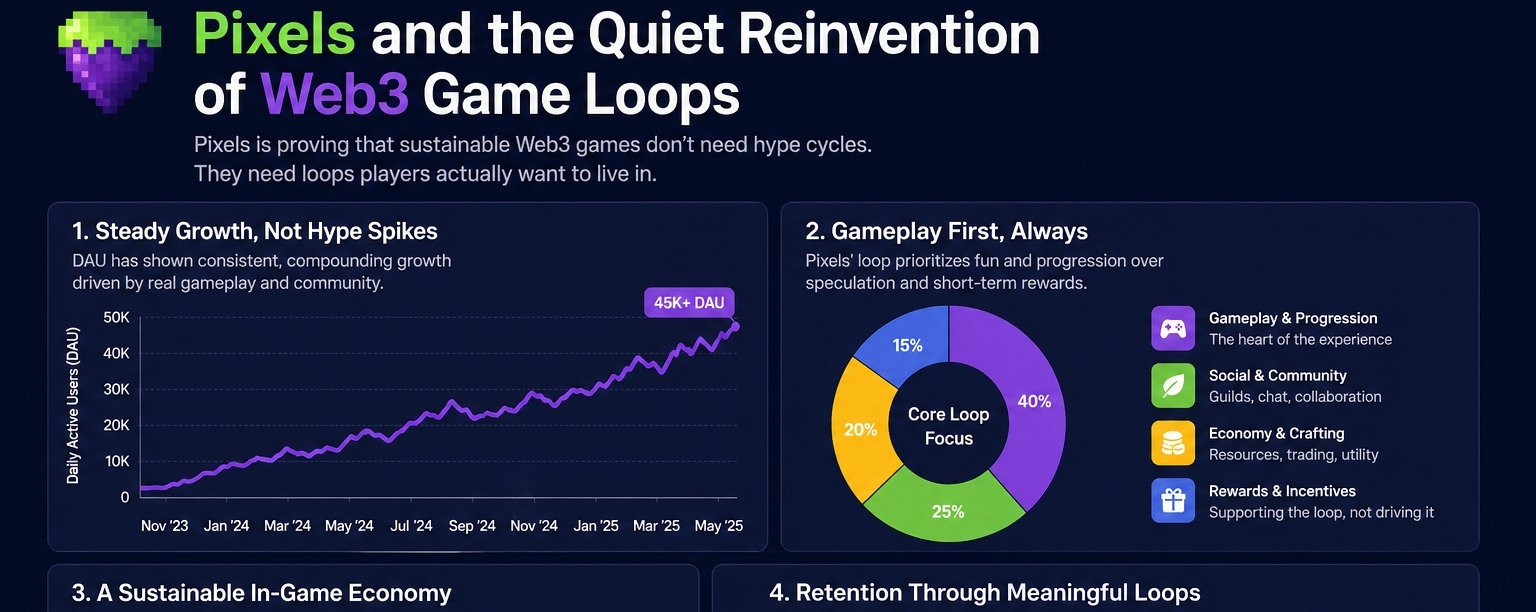
Pixels is the kind of project I don’t approach directly anymore. I sort of drift toward it over time, noticing it in pieces rather than all at once. It presents itself simply—farming, exploring, creating—but those words feel more like a surface than an explanation. I’ve seen too many systems use the same language to smooth over something more mechanical underneath. Still, there’s something about how Pixels carries itself that makes me pause instead of dismiss it.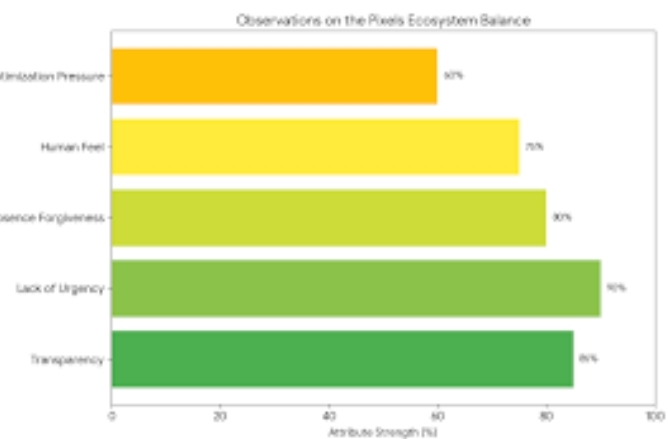
It doesn’t rush you. That’s the first thing that stands out. You enter, you move around, you plant something, maybe you come back later. Nothing feels urgent, and that lack of urgency almost feels intentional, like it’s trying to resist the usual pressure most Web3 spaces create. But the longer I watch, the more I notice how quickly that calm turns into routine. Not forced, just quietly forming. You start checking things without thinking too much about why. That’s where the shift begins.
I’ve learned to pay attention to that moment, because it’s where these systems reveal themselves. When something becomes part of your day without asking permission, it stops being just a game mechanic. It becomes a pattern. And patterns, especially in token-driven environments, tend to tighten over time. What starts as something light can slowly turn into something you feel responsible for maintaining.
The interesting part is how Pixels doesn’t try to hide this too much. It keeps everything relatively transparent, almost like it knows people will figure it out anyway. There’s no heavy illusion of complexity. What you see is mostly what you get. But that also means every imbalance, every shortcut, every optimized loop becomes easier to spot. There’s less distraction, so the system itself becomes more visible.
And once people start seeing the system clearly, they start testing it. That always happens. Someone figures out a faster way to progress. Someone else scales it. Then the tone shifts, just slightly. Conversations move from casual exploration to efficiency. You can feel it even if no one says it outright. The space starts leaning toward utility instead of experience.
That’s where I usually start feeling a bit skeptical. Not because Pixels is doing something wrong, but because I’ve seen how predictable this phase can be. The social layer starts thinning out as optimization takes over. The world is still there, still functioning, but it feels different. Less like a place, more like a structure people are navigating carefully.
Ownership plays into that too. It always does. The idea sounds appealing—having something that’s yours, something that holds value—but it changes behavior. People become more cautious, more calculated. They stop experimenting as freely. They start thinking in terms of preservation and return. That shift can be subtle, but it affects everything.
What keeps me watching Pixels is that it hasn’t fully tipped in one direction yet. It’s still holding onto that softer side, where things feel a bit slower, a bit more open. You can step away and come back without feeling completely disconnected. That matters more than people realize. Most systems don’t allow that. They punish absence in small, persistent ways.
But I also wonder how long that balance can hold. Systems like this tend to get pulled toward efficiency over time. It’s not even intentional. It’s just what happens when enough people interact with the same mechanics. The question is whether Pixels can keep that sense of ease while everything around it starts tightening.
I don’t think it needs to become something bigger or louder to matter. If anything, its strength is in staying small enough to feel manageable, to feel human. But that also makes it vulnerable. The moment it starts leaning too heavily into extraction or optimization, it risks losing the very thing that makes it worth returning to.
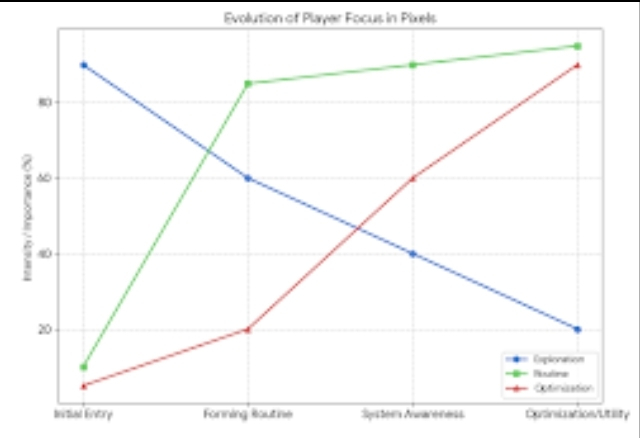
So I keep observing it from a distance, not expecting it to solve anything, just watching how it responds as more people settle into it. Because that’s when the real shape of a project appears—not in its design, but in how it holds up when people stop treating it like something new and start treating it like part of their routine.