

There’s a subtle but critical misunderstanding most players carry into Pixels.
They assume effort converts to reward.
Time in → tokens out.
More grinding → more earning.
That logic feels intuitive because it’s how almost every GameFi system trained users to think. But Pixels doesn’t actually operate on that model anymore. And the longer you stay inside the system, the more obvious the mismatch becomes.
You can repeat the same loop—same crops, same timing, same routes—and still land in completely different reward outcomes.
At first, that feels inconsistent.
Over time, you realize it’s intentional.
The Shift: From Action-Based Rewards to System-Based Evaluation
Pixels isn’t rewarding isolated actions. It’s evaluating context.
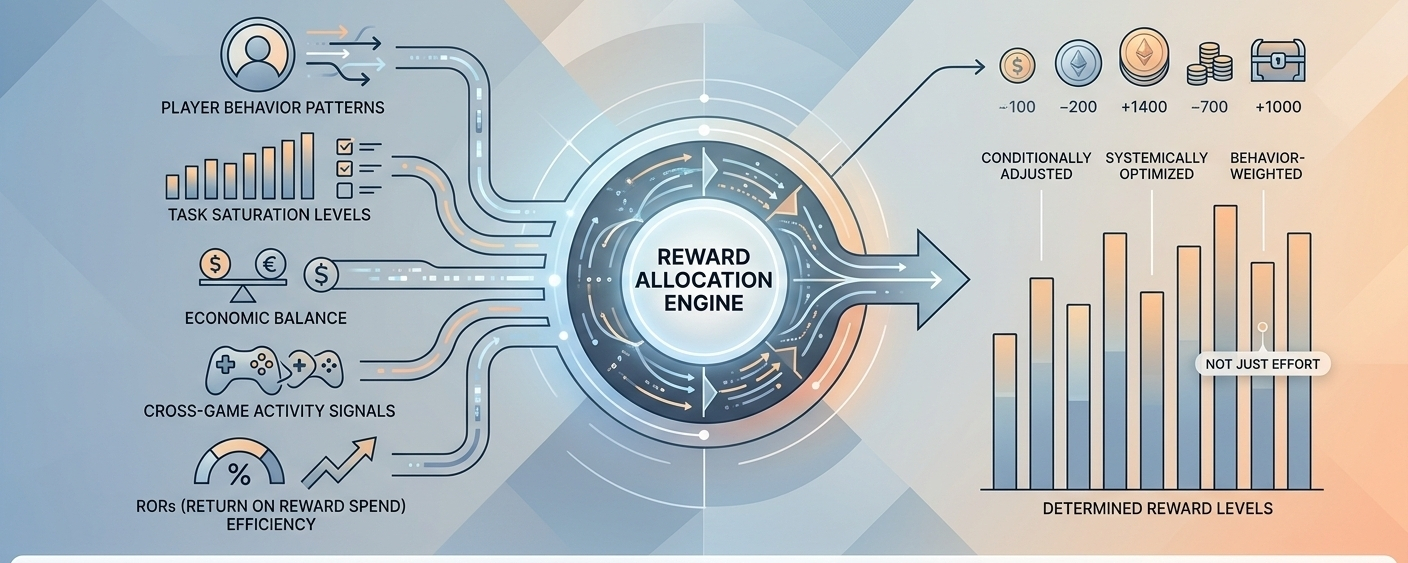
Every input you make—movement, farming, task completion—doesn’t exist as a standalone event. It feeds into a broader scoring layer shaped by Stacked, where rewards are no longer tied to what you did, but how that action fits into the system’s current state.
This is where most players lose clarity.
Because the system doesn’t explicitly tell you what it’s optimizing for at any given moment.
And that’s the point.
Stacked Isn’t a Feature — It’s the Control Layer
Stacked changes the role of rewards from something reactive to something conditional.
Instead of distributing tokens evenly across visible effort, it adjusts emission based on:
Player behavior patterns
Task saturation levels
Economic balance requirements
Cross-game activity signals
RORS (Return on Reward Spend) efficiency
That last part matters more than anything.
Pixels isn’t trying to reward players equally. It’s trying to spend rewards efficiently.
If two players perform the same action, but one contributes more to system health—through timing, diversity, or behavior—the reward allocation shifts.
Not randomly. Systemically.
Why Your Gameplay Feels “Inconsistent”
Because you’re interacting with a system that’s adapting faster than your strategy.
You might think:
> “I did the same thing, so I should get the same result.”
But the system is asking a different question:
> “Is this action valuable right now?”
And “right now” is constantly changing.
That’s why repetition breaks down as a strategy.
Efficiency in Pixels doesn’t come from doing more.
It comes from aligning with what the system currently values.
Cross-Game Continuity: The Invisible Layer Most Players Miss
When Pixels expanded beyond a single game, it didn’t just add more content.
It added memory.
Your activity isn’t isolated anymore. It travels.
The system tracks behavior across experiences, which means:
You’re not evaluated as a “new player” in each game
Your past actions influence future reward potential
Engagement becomes cumulative, not reset-based
This is where Pixels separates itself structurally from traditional GameFi ecosystems.
Most systems fragment users across games.
Pixels compounds them.
RORS: The Constraint That Shapes Everything
Return on Reward Spend (RORS) is the hidden governor behind Pixels’ economy.
It forces the system to ask:
> “Is this reward generating meaningful engagement, or just being extracted?”
If the answer leans toward extraction, rewards get suppressed.
Not globally—but selectively.
That’s why:
High-volume grinders don’t always earn more
Low-visibility players sometimes outperform expectations
Reward flows feel uneven but intentional
The system isn’t failing to be fair.
It’s refusing to be naive.
The Psychological Adjustment Players Have to Make
To function effectively inside Pixels, you have to drop a deeply ingrained assumption:
That effort guarantees output.
In this system:
Effort is just input
Behavior is interpretation
Alignment is what gets paid
That shift is uncomfortable because it removes predictability at the surface level.
But underneath, it introduces something more important:
Sustainability.
Why This Model Actually Holds
Previous play-to-earn systems collapsed because they overpaid for undifferentiated activity.
They treated every action as equally valuable.
Bots exploited that instantly. Real players followed. Economies drained.
Pixels flips that entirely.
It doesn’t try to stop extraction directly.
It makes extraction inefficient.
And once extraction becomes inefficient, behavior naturally shifts toward contribution.
What Pixels Is Really Building
Not a game that pays players.
A system that decides when players should be paid.
That distinction changes everything.
Because it turns the economy into something closer to:
A live operational system
A responsive reward engine
A behavior-weighted distribution model
Rather than a static emission schedule.
Final Thought
If Pixels feels unpredictable, it’s because you’re still approaching it like a fixed system.
It isn’t.
It’s adaptive, conditional, and constantly recalibrating around one goal:
Maximizing the value of every reward it distributes.
And once you understand that, the question stops being:
> “Why didn’t I earn more?”
It becomes:
> “What is the system actually trying to reward right now?”