
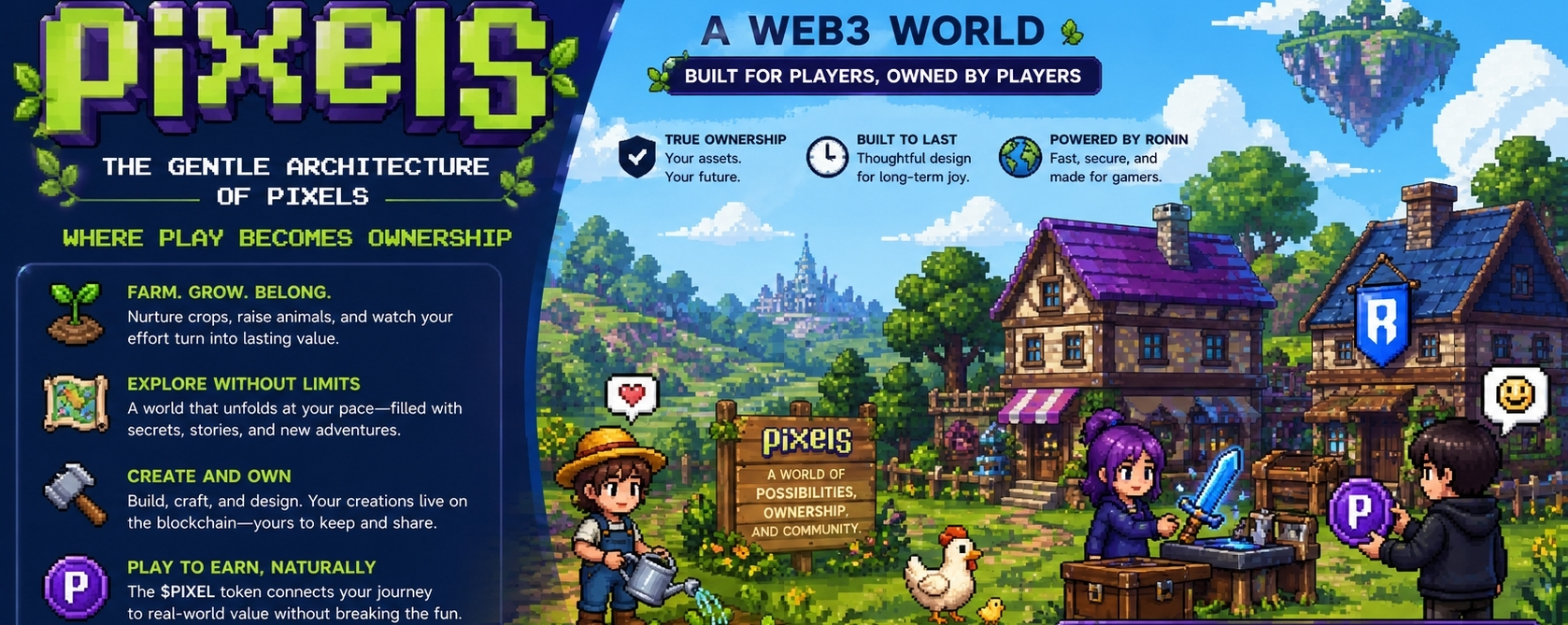
There is a certain quietness to Pixels that feels almost deliberate, as if it understands the difference between attention that is taken and attention that is earned. In a landscape where many crypto projects compete through urgency and spectacle, Pixels moves with a softer rhythm, offering something that feels less like a product and more like a place.
At its surface, it is a social casual Web3 game built on the Ronin Network, shaped around farming, exploration, and creation. Yet this description only captures its mechanics, not its essence. What makes Pixels compelling is not simply what players do, but how they feel while doing it. The world unfolds slowly, inviting curiosity instead of demanding it, allowing each interaction to carry a sense of presence that is often missing in blockchain-based experiences.
The farming is not just a task loop designed for optimization. It carries a quiet satisfaction, a sense of continuity that mirrors something real and familiar. Crops grow, time passes, and effort compounds into something visible and tangible. This pacing creates a subtle emotional connection, where progression does not feel rushed but earned through gentle persistence. It is in this space that Pixels begins to separate itself from the noise, replacing intensity with immersion.
Exploration extends this feeling further. The open world does not overwhelm with complexity, but instead reveals itself gradually, encouraging players to wander rather than chase objectives. There is an intentional simplicity in its design, one that makes room for imagination. Each corner of the world feels like it exists to be discovered at the player’s own pace, reinforcing the idea that value in this ecosystem is not only financial, but experiential.
Creation, perhaps, is where the philosophy of Pixels becomes most visible. Players are not just participants but contributors to the world itself. This aligns naturally with the promise of Web3, where ownership and creativity intersect. Assets are not merely items held in a wallet; they become extensions of time, effort, and identity. In this sense, Pixels does not force the concept of ownership into the experience, but rather lets it emerge organically from play.
Underneath this calm exterior lies a carefully structured economic layer. The PIXEL token connects activity to value, translating engagement into something that exists beyond the boundaries of the game. Yet even here, the design avoids feeling transactional. The economy supports the world rather than dominating it, creating a balance that many projects struggle to achieve. It allows players to benefit from their time without reducing every action to a calculation.
What is most striking is how Pixels reframes the relationship between users and blockchain technology. Instead of presenting Web3 as a technical leap that must be understood, it integrates it quietly into the background. Players do not need to think about infrastructure or protocols; they simply play, create, and return. This subtle integration may be its most powerful feature, as it lowers the barrier between curiosity and participation.
There is also a social undercurrent that runs through the experience. The world feels shared, not just populated. Interactions carry a sense of light community, where presence matters even in small ways. It reflects a broader shift in how digital spaces are evolving, moving away from isolated engagement toward something more collective and human.
Pixels does not promise to redefine crypto through disruption alone. Instead, it suggests a different path, one built on consistency, atmosphere, and trust in slower growth. It understands that longevity often comes from experiences that people want to return to, not just assets they want to trade.
In the end, Pixels feels less like a game competing for attention and more like a world quietly waiting to be lived in. Its strength lies not in loud innovation, but in thoughtful design that respects both the player and the technology beneath it. And in a space often driven by extremes, that kind of restraint may be exactly what makes it endure.