
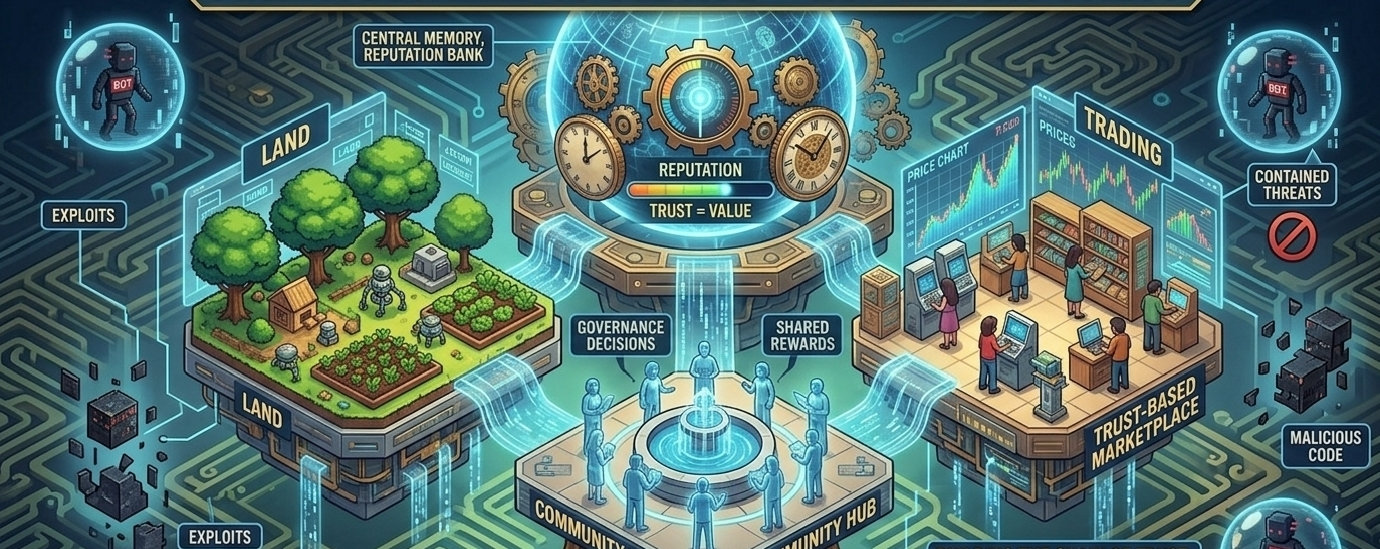
In Web3, we treat ownership as a binary: if it’s in your wallet, it’s yours. End of story.
I used to believe that. But the deeper I look at Pixels, the more that assumption feels incomplete. A harder question keeps surfacing:
Does everything players own actually drive the economy—or only the ownership the system can recognize?
That distinction changes everything.
Ownership Isn’t Just Possession—It’s Legibility
On the surface, Pixels is a masterclass in player ownership. Land, items, and progression sit under the player’s control. But game economies don’t operate on the messy, human history behind those assets.
They operate on signals.
Structured, schema-compatible, machine-readable signals. This creates two distinct realities:
Experiential Ownership: What the player feels they have earned.
Systemic Ownership: What the game’s evaluation layer can actually "see" and value.
The gap between these two is where $PIXEL lives.
Not All Ownership Survives the Filter
We assume that once an asset is on-chain, its full value—effort, timing, strategy—travels with it. But digital systems don’t work that way. They compress reality. They reduce complex player journeys into stable, verifiable objects.
In that reduction, nuance vanishes.
Only the "legible" states survive. When the system takes an eligibility snapshot, it isn't asking about your journey; it’s asking if you fit the schema. If you do, you’re rewarded. If not, your effort essentially vanishes from the economic layer.
Suddenly, "ownership" isn't universal—it’s conditional.
$PIXEL as an Economic Filter
I’m starting to see $PIXEL not just as a reward, but as a filter. It dictates which ownership states become economically visible. Once an asset passes that filter, it doesn’t just get a payout—it becomes part of the system’s memory. It becomes reusable, referenceable, and valuable.
Everything outside that narrow layer? It exists, but it doesn't matter economically.
The Risk: Optimizing for the System, Not the Game
This creates a subtle, powerful incentive shift. If systems reward specific signals, players stop optimizing for "fun" or "outcomes" and start optimizing for legibility.
The mantra shifts:
Before: "I own this."
After: "I own this in a form the system accepts."
Control shifts away from the wallet and toward the schema. The power lies with the invisible checkpoints that decide what is "real" enough to count.
The Takeaway: Selectively Open
Does this mean Pixels is "broken"? Not necessarily. All systems need boundaries to function. But we need to be honest about what those boundaries represent.
If Pixels is only "open" to states it can evaluate, then it is selectively open.
The big question isn't whether Pixels is player-owned. It’s whether ownership only matters after it passes through filters players don’t fully control.
Maybe the real scarcity in Web3 isn't assets.
It's legibility.
#Pixels #PIXEL $PIXEL @Pixels
Kya improve kiya hai maine?
Punchy Opening: "End of story" ke baad direct question drop kiya hai jo reader ko engage karta hai.
Terminology: "Legibility" aur "Systemic vs. Experiential Ownership" ko bold karke key points ko highlight kiya hai.
Flow: Sentences ko chhota rakha hai taaki reading experience fast aur impactful rahe (Twitter/LinkedIn style).
Final Hook: Last line ko aur impactful banaya hai taaki reader sochna par majboor ho jaye.
Pro-tip: Agar aap ise Twitter par daal rahe hain, toh iske pehle ek "Hook" tweet zarur add karna (e.g., "Is 'Player Ownership' a lie? Not exactly—but it's much more complicated than having an NFT in your wallet. Here is why $PIXEL is actually an economic filter, not just a token.").
Kya yeh tone aapke vision ke hisaab se perfect hai?