
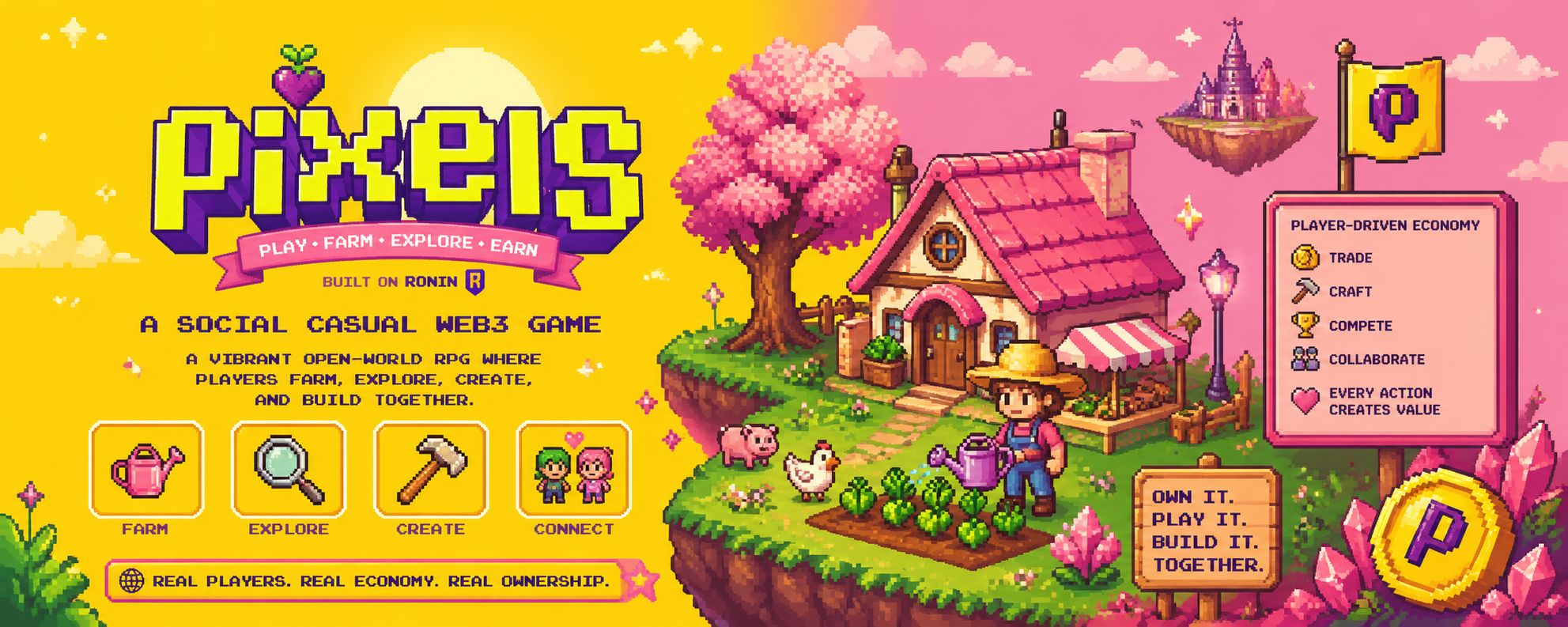

I’ve been thinking and if I’m honest, I used to approach projects like Pixels (PIXEL) the same way I approached most of Web3 gaming as a concept, not a system. Oh yeah the narrative was easy: ownership, open-world economies, players earning while playing. It sounded complete. It felt like the future. But it was surface-level thinking.
I assumed that once something is created inside a system a token, an item, a piece of land value naturally follows. That creation alone was enough. Okay… that was the naive part.
What changed wasn’t the idea itself, but how I started looking at what happens after creation.
Because creation is just the beginning. The real question is: does that thing move?
If I plant a seed in a game like Pixels, does it just sit there as an asset, or does it enter a loop? Does it get traded, consumed, reinvested, referenced by other players, or used as input for something else? Or does it quietly become static — existing, but not participating?
That’s where most systems break. Not in design, but in what happens next.
A lot of Web3 games remind me of building a factory with beautiful machines… but no supply chain. Everything works in isolation, but nothing flows. Items are created, tokens are distributed, but there’s no continuous motion tying it all together. Without that motion, value doesn’t compound — it stalls.
So I started looking at Pixels differently. Not as a game, but as a system of interactions.
At a structural level, what matters is how participants connect. In Pixels, players farm, gather, craft, and trade. On paper, that creates a loop — resources become goods, goods move between players, and the economy circulates. But the key isn’t whether this loop exists. It’s whether it’s necessary.
If players can bypass each other, the system weakens. If interaction becomes optional instead of essential, activity fragments. Real systems force interaction — like a city where no one can survive alone. The question is whether Pixels creates that kind of dependency or just simulates it.
Then there’s the output. What I produce in the game — crops, items, NFTs — can it be reused in meaningful ways? Or is it a dead-end product? A strong system turns outputs into inputs for someone else. Like wheat becoming bread, bread feeding workers, workers producing more goods. If outputs don’t re-enter the system, they lose relevance quickly.
Network effects come from that reuse. Not just more players joining, but more connections forming between what already exists. Oh, that’s the difference. Growth isn’t just expansion — it’s density. Are players increasingly relying on each other, or just coexisting?
From a market perspective, Pixels sits in an interesting position. It’s visible, relatively early, and tied to the Ronin Network, which already has a user base from past ecosystems. But visibility isn’t maturity.
Activity still feels partially event-driven — spikes around updates, incentives, or new features. The real test is what happens in between those moments. Does the system sustain itself when there’s nothing new being pushed?
Participation also matters. Is it broad and expanding, or concentrated among a core group optimizing rewards? Because those are two very different dynamics. One is organic growth. The other is temporary extraction.
Potential is clear — an open-world, player-driven economy always sounds powerful. But proven adoption is quieter. It shows up as consistent behavior, not headlines. Are players logging in because they need the system, or because they’re being incentivized to?
That’s the core risk here. Whether usage is continuous and self-sustaining… or temporary and reward-driven.
Because if the moment incentives drop and activity fades, then the system wasn’t functioning — it was being supported.
Real strength looks boring. It’s repetition. Daily usage. Small transactions that keep happening without attention.
So I bring it back to reality. Would actual users — not just players chasing yield — keep using this system? Would developers build on top of it because it solves something real? Would businesses or communities find a reason to integrate it into their operations?
Or does it remain contained within its own loop?
For me, confidence increases when I see activity that isn’t tied to announcements. When outputs are clearly feeding back into the system. When interactions between users feel necessary, not optional. When new participants aren’t just arriving — they’re staying and integrating.
Caution starts when usage clusters around incentives. When outputs pile up without clear reuse. When the system needs constant updates to maintain engagement. That’s not an economy — that’s maintenance.
Okay… so I don’t look at Pixels the same way anymore.
I don’t ask what it creates.
I ask what keeps moving.
Because systems that matter aren’t the ones that produce assets — they’re the ones where those assets don’t stop. They circulate, they connect, they integrate into behavior so naturally that no one questions their presence.
That’s when something stops being a product… and starts becoming infrastructure.