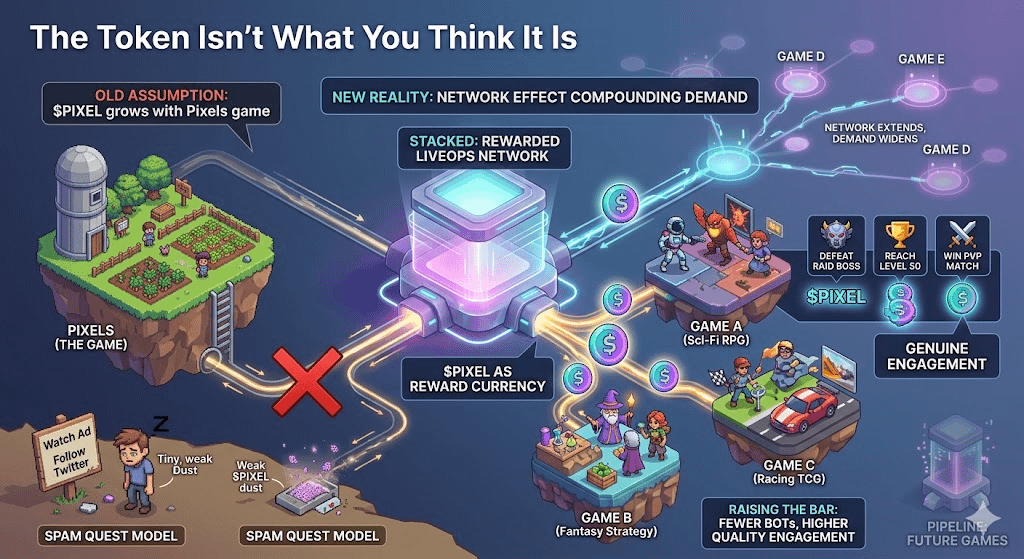
The Token Isn't What You Think It Is
Market felt sluggish today. Not the panicked kind of slow — just the kind where nothing's really moving and you end up clicking through things you normally wouldn't bother with.
I ended up looking at Pixels. Not because anything happened, just… it came up. And I started going down a rabbit hole that I'm still not fully out of.
Here's what I thought going in: Pixel is a gaming token. You play Pixels, you earn Pixel, you spend Pixel in Pixels. Clean loop. Nothing unusual.
Then I looked at what Stacked is actually doing with it.
Stacked runs something called a Rewarded LiveOps Network — basically, it handles the quest and engagement layer for web3 games. When a game joins, Stacked deploys tasks, tracks completions, distributes rewards. The game gets retention infrastructure without building it themselves. Players get paid for doing things that matter.
That part I understood. What I missed was the Pixel angle.
As more games plug into Stacked's network, they're not just adding quests. They're adding Pixel as a reward currency. Not their own token. Not USDC. Pixel.
So I sat with that for a minute.
If Game A, Game B, Game C all start rewarding players in Pixel — players who have never touched Pixels the game, never farmed land, never cared about Ron's farm — those players now need to know what Pixel is. They now hold it. They now look for places to use it or trade it.
And Pixels didn't do anything. Stacked did.
That's the thing that clicked. Pixel's demand isn't being built by one game getting more popular. It's being built by a network that has nothing to do with Pixels getting bigger. Every new game that joins Stacked is a new demand surface for a token that most people still mentally file under "Pixels ecosystem."
That framing is already wrong, and I don't think many people have updated it yet.
The old assumption: $PIXEL goes up if Pixels the game grows.
What's actually happening: Pixel gains new holders every time a completely unrelated game decides to plug into Stacked's infrastructure.
These are different mechanisms. One is dependent on a single team executing. The other is dependent on a network effect that compounds with every new participant.
Now — and this is the part I'm still chewing on — Stacked also made a real shift in how rewards work. They moved away from the spam model. You know what I mean. The typical crypto quest loop: watch an ad, follow a Twitter account, answer a quiz with obvious answers, collect dust. It became such a meme that "quest farming" basically means "doing nothing for almost nothing."
Stacked apparently said no to that.
The rewarded tasks they're running are structured around actual engagement. Real time spent, real actions inside games, real skill or progression gated requirements. Which sounds nice in theory. But here's what I keep turning over: when you raise the bar on what earns rewards, you reduce the number of people who complete them.
Is that a feature or a bug?
I think they'd say it's a feature — fewer but higher quality engagements, players who actually stick, metrics that aren't inflated by bots clicking through quest forms. And maybe that's right. Advertisers and game studios should prefer genuine engagement over empty numbers.
But I'm not fully convinced this holds under pressure. When a new game onboards and wants to show big user numbers to their investors, does Stacked stay firm? Or does "real engagement" quietly start stretching toward "engagement-ish"? That tension is real, and I haven't seen anyone really address it.
What makes this interesting beyond the token mechanics is who it actually affects.
There's a whole class of player — call them the web3 natives who are already in five different game ecosystems, already completing quests, already holding a messy portfolio of small gaming tokens. These players are fatigued. The spam quest model burned them. If Stacked is actually building something where effort maps to reward in a way that doesn't feel insulting, that player cohort might actually re-engage.
And when they do, they're not just engaging with one game. They're engaging with a network. And the common thread across that network is $PIXEL.
That's the demand surface that's new. Not "Pixels gets bigger." It's "the network gets wider, and Pixel is the connective tissue."
I thought this was a Pixels story. It's not really a Pixels story.
But here's the part that bothers me a little. Network effects sound great until the network is thin. Right now, how many games are actually live on Stacked's network? How much of this is present tense versus pipeline? Because the thesis depends entirely on the second and third and tenth game joining — and "more games will join" is a projection, not a fact.
I keep coming back to that.
The mechanism makes sense. The incentives are aligned. But I've seen enough "network effect" narratives in this space that turned out to be two participants and a roadmap.
Anyway. Nothing's really moved yet. Maybe it will, maybe it won't. I'll probably just keep watching where the quest completions actually go and whether the new game integrations are real or just announcements.
Market still looks like it's deciding something. I'm not sure what.