
I noticed something small first.
A Telegram chat that used to move like a crowded station at rush hour had started to feel like a waiting room. The same names were still there, but the rhythm had changed. Fewer grand claims. Fewer people typing in all caps after a successful run. More half-finished sentences. More “I tried that too” replies. And a strange number of messages that were really just admissions of fatigue, written in the language of jokes.
At first I did not know what to do with that.
I used to think market attention was loud when something was healthy. More noise, more confidence, more motion. That seemed intuitive enough. But then I kept seeing the opposite in places that mattered. The people who were most active were not always the ones staying the longest. The ones who spoke most confidently were often the first to disappear after the easy phase was gone. And the strange part was that the silence did not always mean death. Sometimes it meant the system had become harder to enter, and the casual crowd had quietly stepped out.
Maybe I am misreading it, but that is what Pixels started to feel like to me.
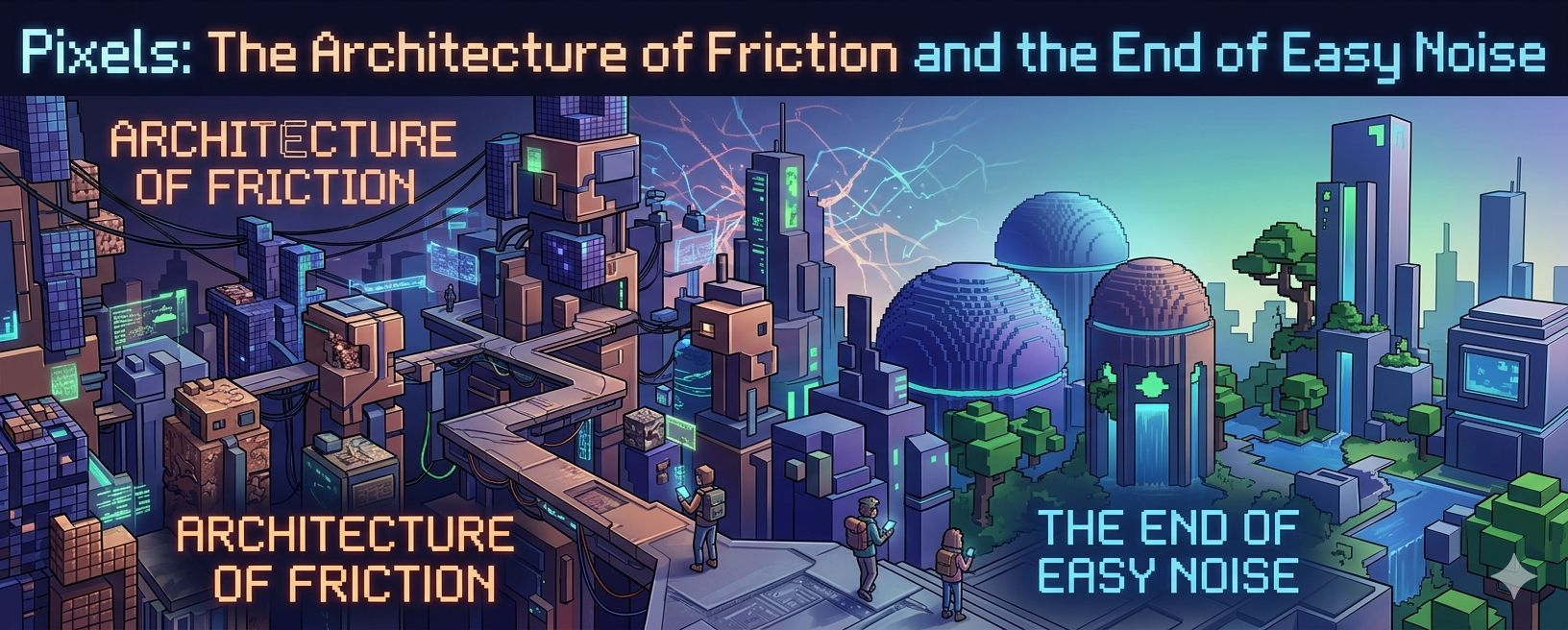
Not as a product announcement. Not as a campaign. More like a case study in how systems survive once the first wave of attention has already spent itself. Pixels, in the way it has evolved, looks less like a game trying to be broadly comfortable and more like an environment learning how to keep only the people who can tolerate its friction. That sounds almost unfriendly until you sit with it for a while.
Because friction is not always a flaw.
I used to think good design mostly meant removing resistance. Make the path shorter. Reduce the steps. Cut the waiting. Smooth the experience. That still matters, of course. No one wants needless pain. But there is another side to it that people only seem to notice after a system has already become expensive to maintain: too much comfort can attract attention faster than it can build loyalty.
In a GameFi setting, comfort can behave like a floodgate. If the system is too easy, it invites users who are there for convenience, not commitment. They arrive for the visible gain, not the invisible discipline. They stay while the rewards feel immediate. They leave the moment the routine starts asking for more than attention. And because they all arrive at once, they create the illusion of vitality. On-chain activity looks busy. Chat looks busy. Sentiment looks busy. But busy is not the same thing as durable.
This is where the logic of friction starts to make sense.
When a system becomes slower, more segmented, more procedural, it begins to do something important that people usually mistake for inefficiency. It filters. It asks for patience, and patience is expensive. It asks for repeated judgment, and repeated judgment is exhausting. It asks users to make daily decisions rather than one-time emotional commitments. That changes the type of person who remains. Not the loudest person. Not necessarily the smartest person either. Often just the person who can tolerate being less entertained in exchange for being more embedded.
And that changes everything.
I keep coming back to the idea that liquidity is not only about money. It is also about mood, status, and social momentum. In a fast-moving GameFi setup, liquidity does not just flow through pools or tokens. It flows through behavior. It moves through what feels prestigious, what feels easy, what feels worth posting. When the system is generous and simple, status belongs to the early crowd that can capture attention before everyone else. But as the design tightens, status begins to shift. It is no longer about who entered first. It is about who can still operate after the novelty wears off.
That is a different kind of hierarchy.
Pixels, at least from where I am standing, seems to understand this better than many projects do. Or maybe it stumbled into it and then learned to work with it. I cannot tell the difference yet, and maybe the difference does not even matter. What matters is the effect. The design pressure is not just on gameplay; it is on behavior. A user has to decide whether a small task is worth the energy, whether the next loop is worth the time, whether the daily grind is acceptable in exchange for staying inside the system. That is not merely a product choice. It is a filter for temperament.
And temperament is what people keep underestimating in crypto.
We talk about efficiency all the time. We praise automation, low cost, smooth onboarding, scalable loops. We assume that the best system is the one that removes as many points of resistance as possible. But in practice, systems that are too efficient can become fragile in ways that are hard to see at first. They can grow quickly and still have weak roots. They can look strong because activity is high, while the underlying commitment is shallow. The moment the incentive structure shifts, the floor disappears.
That is the hidden tension I keep noticing.
People say they want simplicity, but they often behave as if they value edge. They say they want fair access, but they gravitate toward whatever feels socially validated. They say they want long-term opportunity, but they react most strongly to short-term visibility. And when a system begins to reward discipline instead of excitement, many of those same people decide it has become too difficult. Not necessarily because it is worse, but because it no longer flatters the habits that brought them in.
That is why the silence matters.
A silent chat can mean boredom, yes. It can also mean selection. A quieter feed can mean interest is fading, or it can mean the crowd that lived off noise has been priced out by structure. A complicated task board can be called clumsy, and sometimes it is clumsy, but it can also function as a seriousness test. The daily drag of repeated effort turns casual enthusiasm into a cost. And once cost enters the picture, behavior becomes more honest.
People stop pretending.
They either do the thing, or they do not. They either adapt to the rhythm, or they leave. They either accept the system’s hidden demands, or they spend their energy complaining that the old easy version is gone. That complaint is not meaningless. It is actually a signal. It tells you where the friction begins to separate real users from temporary spectators.
I think that is what makes Pixels interesting to watch in real time. Not because it proves some grand theory, but because it makes a familiar pattern visible. It turns survival into a design language. It suggests that a project can move from extraction by excitement to retention by difficulty. That is not a moral victory. It is not automatically noble. But it is instructive.
Because once you see that, you start noticing similar patterns everywhere.
You notice which communities are held together by actual participation and which are held together by the memory of earlier gains. You notice which systems can still function when the easy money is gone. You notice how quickly status changes when the flow of resources slows down. You notice that a lot of “organic growth” is really just borrowed momentum. And you begin to understand that the most dangerous thing in crypto is not volatility itself. It is mistaking temporary intensity for structure.
That realization is still settling for me.
Maybe that is the real lesson here. Not that hard systems are good and easy systems are bad. Not that friction is always wise. It is simpler, and stranger, than that. Small design changes can reveal what kind of participant a market is actually made of. They expose whether people are attached to the asset, the narrative, the status, or just the convenience. They show you who leaves when the easy path closes. They show you what the system loses when it becomes harder to fake commitment.
And once you start noticing that, you stop reading noise the same way.
You become slower yourself. Less eager to call every crowded room healthy. Less impressed by activity that does not survive resistance. More alert to the moments when a system is quietly teaching its users how much effort it really expects from them. In crypto, that kind of noticing is not a luxury. It is part of staying alive long enough to understand what you are actually holding.#pixel