
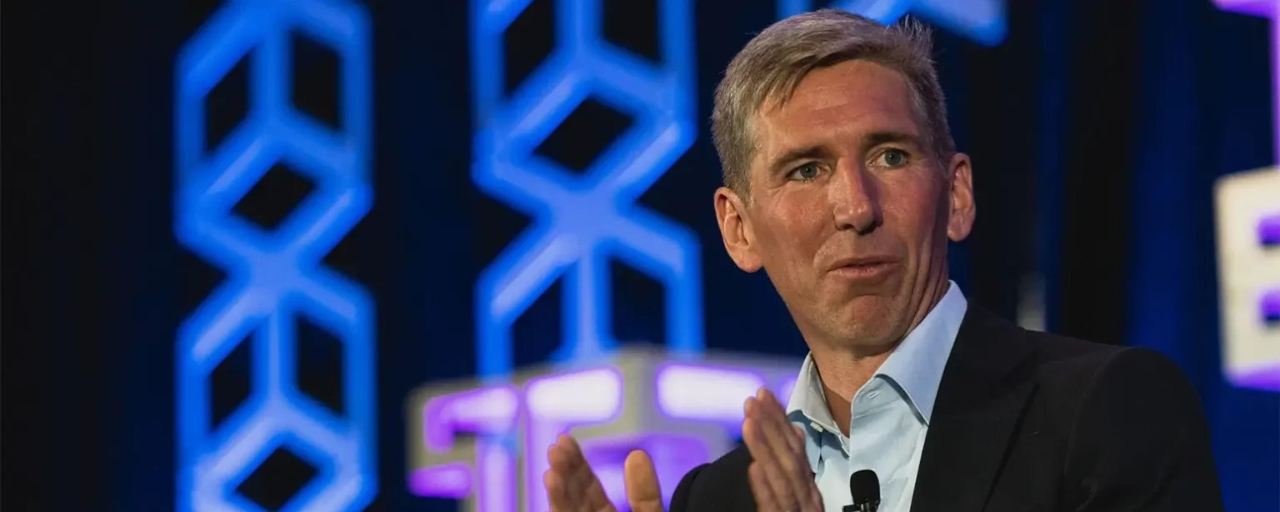
Bitwise Chief Investment Officer Matt Hougan spoke to Cointelegraph at Bitcoin Las Vegas 2026, declaring the era of broad altcoin seasons over, naming Aave as dramatically undervalued.
Key Takeaways
Altcoin season: "Those eras are over".
Aave market cap: $1.42B, same as Papa John's pizza.
Financial advisors: 150 of 170 at a non-crypto conference personally hold crypto..
BTC channel: $60K-$80K short term, "much higher" a year from now.
BTC price target: north of $1M by 2030, Solana triple digits by year end.
Clarity Act: more important to get past it than whether it passes or fails.
The Room That Changed Hougan's Outlook
Hougan arrived at a standard financial advisor conference, 170 people, nothing crypto-related, average age approximately 55. He asked how many personally held Bitcoin or crypto. He expected 20, maybe 30. The answer was 150.
"It shows you how much we've normalized crypto," Hougan told Cointelegraph. Morgan Stanley launching a Bitcoin ETF. Goldman Sachs launching a Bitcoin ETF. Charles Schwab recommending 2% to 7% crypto allocations. And then 150 out of 170 financial advisors, none of whom were there for a crypto event, already holding it personally. The bullish signal Hougan drew from this is correct. The more precise implication he did not name is that financial advisor personal adoption has already happened. The next wave is not advisors buying for themselves. It is advisors putting client money into crypto through regulated products. Personal conviction preceded professional allocation. The gap between those two things is the wave Hougan is describing when he says institutional capital is coming. It is not coming from people who are still skeptical. It is coming from people who are already personally convinced and are now building the compliance infrastructure to act professionally on that conviction.
Why Institutional Capital Is Different This Time
Hougan made the most structurally important claim of the interview almost as an aside. Bitwise had essentially no outflows in 2018. No outflows in 2022. Both years saw Bitcoin fall 80%+. The institutional money that came in stayed in through conditions that would have driven retail capital to the exits.
His explanation is structural: "If you're an institution allocating to Bitcoin, you're still an outlier. So you're not going to allocate if you're 51% confident. You're going to wait till you're 80 or 90% confident." The selection effect matters enormously. Institutional allocators who entered crypto did so only after building conviction that withstands an 80% drawdown, because they anticipated one. Retail allocators entered at peak excitement and exited at peak fear. A market with more institutional holders is by definition a market with stickier capital. Hougan's prediction of "less volatility and a strong march up" is not optimism. It is a logical consequence of who is holding. When the marginal holder is an institution that allocated at 90% confidence and plans to hold for years, the volatility profile of the asset changes structurally.
The counter is regulatory risk. Institutional allocators who entered at 90% confidence built that confidence on a regulatory environment that was improving. A sustained deterioration, a Clarity Act failure followed by hostile SEC action, could force institutions to reduce allocations not because of price but because of compliance requirements. Hougan's response to this is indirect: Bitwise had no outflows in 2018 or 2022. Both predated the current regulatory clarity. If institutions stayed through those conditions, the threshold for forced selling is higher than most assume.
Aave vs. Papa John's
The most analytically precise moment in the interview lasted about thirty seconds and Hougan moved past it without developing it. Aave has the same market cap as Papa John's pizza.
Papa John's generates approximately $500M in annual revenue from selling pizza. Aave processes billions in lending volume, generates protocol fees that accrue to token holders, and operates as what Hougan calls "a really important financial primitive," the underlying lending infrastructure for a significant portion of DeFi. At $1.42B, Aave is valued at the same level as a mid-tier pizza chain. "Is that right in the world?" Hougan asked.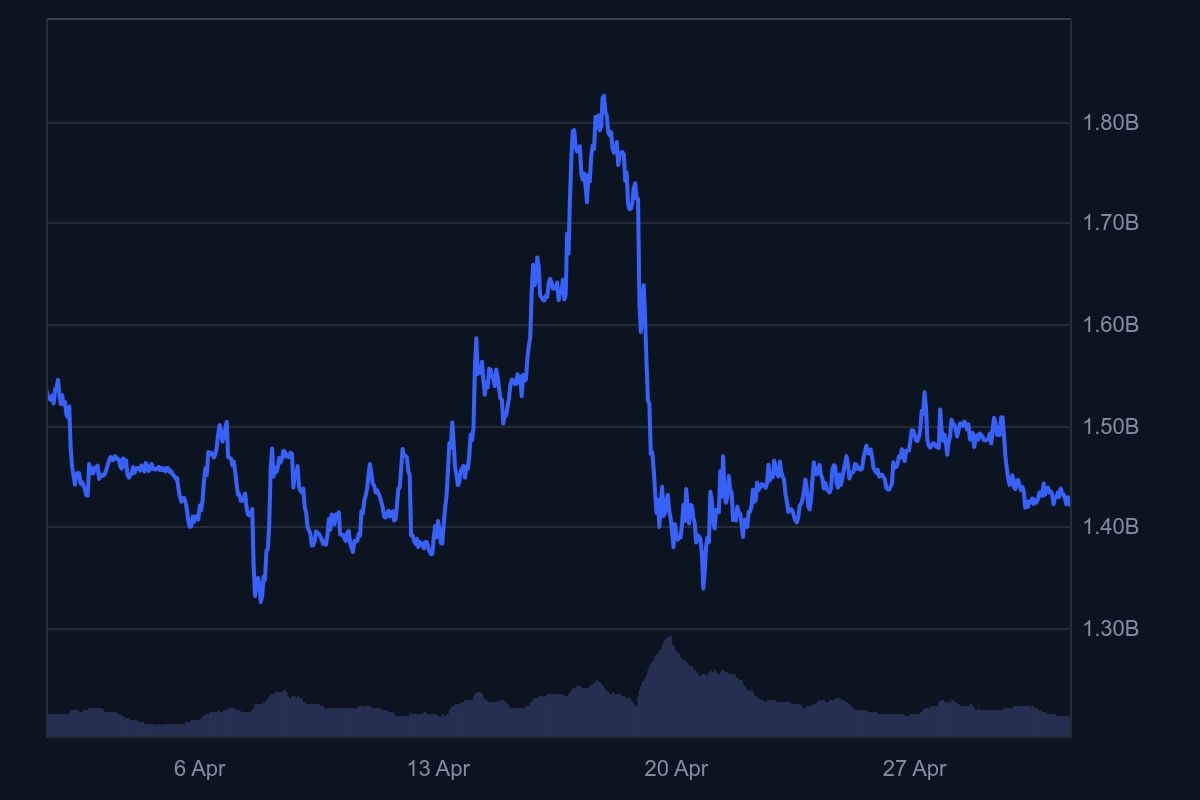 Source: CoinMarketcap[/caption]
"I'm not sure that's right in the world." His answer is that it is not right, and that the mispricing exists because Aave faces real challenges. Tokenomics issues. An ongoing difficult period. Existential risk he acknowledges explicitly. "High risk, high reward," he said. "If you're looking for something that could 5x or 10x quickly, some of those OG DeFi apps fit that bill." It is that a financial primitive valued at the same level as a fast-food chain is either wrong about its market opportunity or wrong about its problems. Hougan is betting on the former.
No More Altcoin Seasons, Some Altcoins Will 10x Anyway
"There's no altcoin season ever again that includes all altcoins going up. Those eras are over." Hougan's statement is provocative and his reasoning is structural. Altcoin seasons historically worked because retail capital was undiscriminating. It flowed into everything when sentiment was positive. With institutional capital replacing retail as the marginal buyer, the evaluation standard changes completely. An institutional allocator cannot put client money into a meme coin. They can put it into a DeFi protocol with audited contracts, real revenue, and a defensible business model. That standard creates a bifurcation: assets that pass institutional due diligence will get institutional capital. Assets that do not will lose retail capital as retail gets replaced by institutions and receive nothing from the new buyer base.
Hyperliquid is Hougan's example of what survives: well-designed tokenomics, genuine utility, institutional-grade architecture. The assets that do not survive he describes with unusual directness: "many other altcoins will make their slow march to zero, which is what they deserve." The mechanism is clear. Without retail to buy them and without institutional interest to replace retail, those assets have no marginal buyer. No marginal buyer means no price support at any level. The era of everything going up together ended when the buyer base changed. What replaced it is a market that rewards genuine utility and punishes everything else.
The counter is that a retail-driven meme cycle could emerge independently of institutional flows. Hougan's structural argument assumes institutional capital replaces retail as the marginal buyer, but if retail returns in force before institutional adoption is complete, the old dynamics could reassert themselves temporarily. The altcoin season he is declaring dead may simply be dormant.
https://www.youtube.com/watch?v=56jMmF5rASg
Bitcoin by 2030
Hougan's most direct price prediction came in response to a simple question: if someone had $10,000 and wanted $100,000 by 2030, where should they start? His answer was unambiguous. 'I would start with Bitcoin. I think it's dramatically undervalued versus the scalable market it's going after. I think you could see Bitcoin north of a million dollars in five years.' A 10x move from current levels in five years requires no exotic assumptions, it requires Bitcoin's historical four-to-five year compound growth rate to continue at a pace already demonstrated multiple times. The $1M target is not a moonshot prediction from Hougan. It is the base case.
The Gap Between Market Share And Market Cap
Hougan's position on the Clarity Act is that getting past it matters more than whether it passes or fails. The uncertainty removal is the value, not the outcome itself. Kevin Warsh as Fed chair named as a positive catalyst. The Iran conflict resolution named. But his actual conviction is independent of all of these: "Even if none of those things happen quickly, the second half of the year is shaping up extraordinarily well. There's just too much institutional capital that wants to come into this market to keep it down."
The catalysts are not the thesis. The thesis is the institutional capital wave. The catalysts are things that could accelerate or delay a move Hougan believes is coming regardless. For BTC, he sees the $60K-$80K channel holding short term before a move that takes it much higher within a year and potentially north of $1M within five years. For Solana, he sees triple digits by year end as institutional flows catch up to a market share that already exceeds its market cap. "Its market share is larger than its market cap. That's often a good comparison to make," he said. The gap between market share and market cap is Hougan's valuation framework applied consistently: wherever that gap is widest, the asset is cheapest. By that measure, Solana looks cheap. Aave looks cheaper. And the asset he is most excited about is the one currently trading at the same price as a pizza chain.