
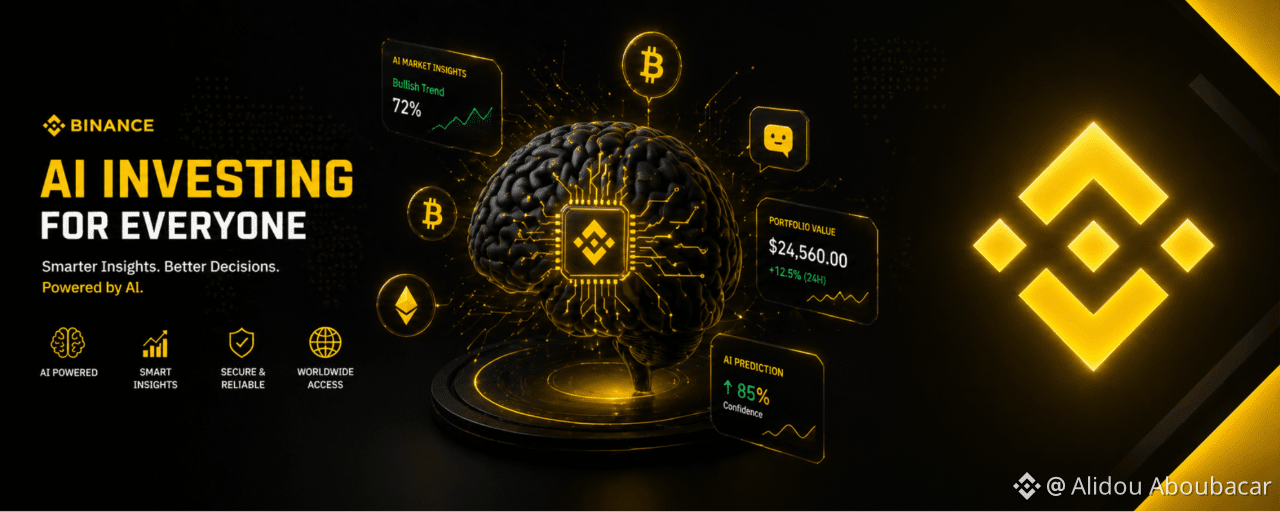

What if the tools used by hedge funds 24/7 execution, macro signals, smart portfolio management were available to anyone with a smartphone?
That shift is already happening.
Summary
• Binance is integrating AI-powered financial tools directly into its platform.
• Capabilities once reserved for institutions are becoming accessible to retail investors globally.
• This shift could redefine financial inclusion by lowering barriers to advanced investing.
Market Context
For years, the advantage in financial markets has been asymmetric.
Institutional players hedge funds, proprietary trading firms, asset managers have traditionally operated with:
Advanced data infrastructure
Automated execution systems
Real-time macro analysis
Algorithmic portfolio strategies
Retail investors, by contrast, relied on:
Manual execution
Delayed information
Limited analytical tools
This gap has defined market structure for decades.
But with the rise of AI and digital platforms, that gap is starting to close
The Shift: From Institutional Exclusivity to Mass Accessibility
AI is changing how financial decisions are made.
Instead of requiring deep technical expertise, modern systems can:
Process large datasets instantly
Identify market patterns
Automate trading decisions
Optimize portfolio allocation
By embedding these capabilities into a single platform, Binance is making advanced financial tools accessible at scale.
This marks a transition from:
Exclusive infrastructure → Open financial access
What AI-Powered Investing Looks Like on Binance
1. 24/7 Automated Execution
Crypto markets never close.
AI-driven systems allow users to:
Execute strategies continuously
React instantly to market movements
Reduce emotional decision-making
This mirrors institutional trading desks — now available to retail users.
2. Macro Signal Analysis
Markets are increasingly driven by macro factors:
Interest rates
Liquidity conditions
Geopolitical events
AI tools can analyze these variables in real time and translate them into actionable insights.
This allows users to make more informed decisions without needing deep macro expertise.
3. Smart Portfolio Management
Portfolio construction is one of the most complex aspects of investing.
AI can help:
Diversify assets
Adjust risk exposure
Optimize allocations dynamically
Instead of static portfolios, users gain access to adaptive strategies.
Why This Matters for Retail Investors
The implications are significant.
For the first time, individuals can access:
Institutional-grade tools
Real-time decision support
Automated execution systems
This reduces three major barriers:
Complexity
AI simplifies advanced strategies.
Time
Automation removes the need for constant monitoring.
Knowledge Gap
Users no longer need to master every technical detail.
Financial Inclusion Through Technology
AI-powered investing is not just about efficiency.
It’s about access.
Globally, millions of people lack:
Financial education
Access to advisory services
Exposure to diversified investment tools
By embedding intelligence into the platform, Binance enables users to:
Participate in global markets
Make informed decisions
Build financial strategies
All from a mobile device.
This represents a major step toward democratizing finance.
Structural Implications
The rise of AI in investing signals a broader transformation:
Human-driven → Data-driven decision making
Manual trading → Automated strategies
Institutional advantage → Retail empowerment
As AI becomes more integrated into financial platforms, the distinction between professional and retail capabilities will continue to narrow.
Looking Ahead
The next phase of AI-driven finance will likely focus on:
Personalization of financial strategies
Deeper automation
Integration with multi-asset ecosystems
Real-time adaptive decision-making
Platforms that successfully combine AI + accessibility + usability will define the future of investing.
Conclusion
AI-powered investing is no longer limited to Wall Street.
With platforms like Binance integrating intelligent tools directly into the user experience, advanced financial capabilities are becoming widely accessible.
This is more than a technological upgrade.
It is a structural shift toward a more inclusive financial system — where anyone, anywhere, can access tools once reserved for the few.


