
The price and the fundamentals are pointing in opposite directions right now. That tension resolves soon. Here's what the data actually shows.
April's Hidden Story
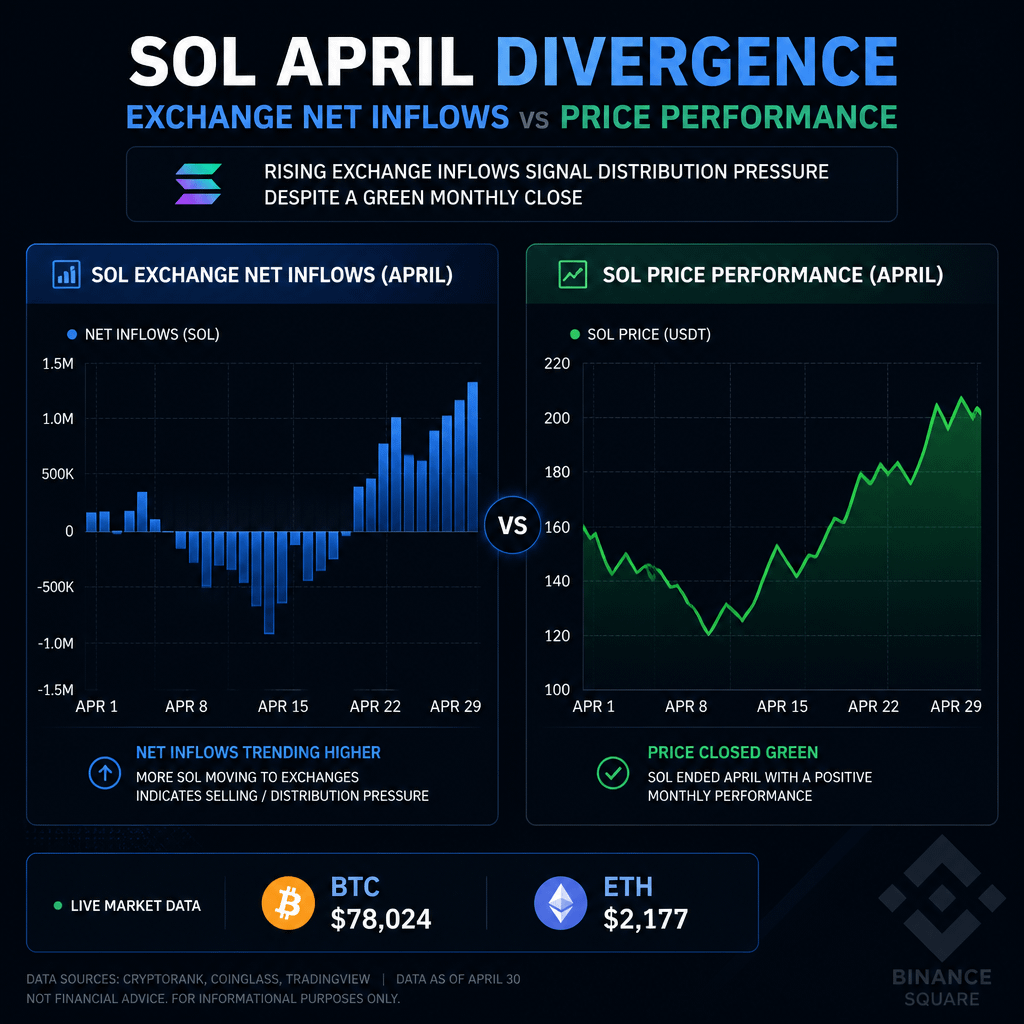
Every single session in April, more SOL moved onto exchanges than off them. Every. Single. Day. Net inflows peaked at 1.8M SOL on April 7 alone. That's textbook distribution pressure. That's the kind of data that usually precedes a flush.
But April closed green. Up 1.18%. First green month after three straight monthly losses.
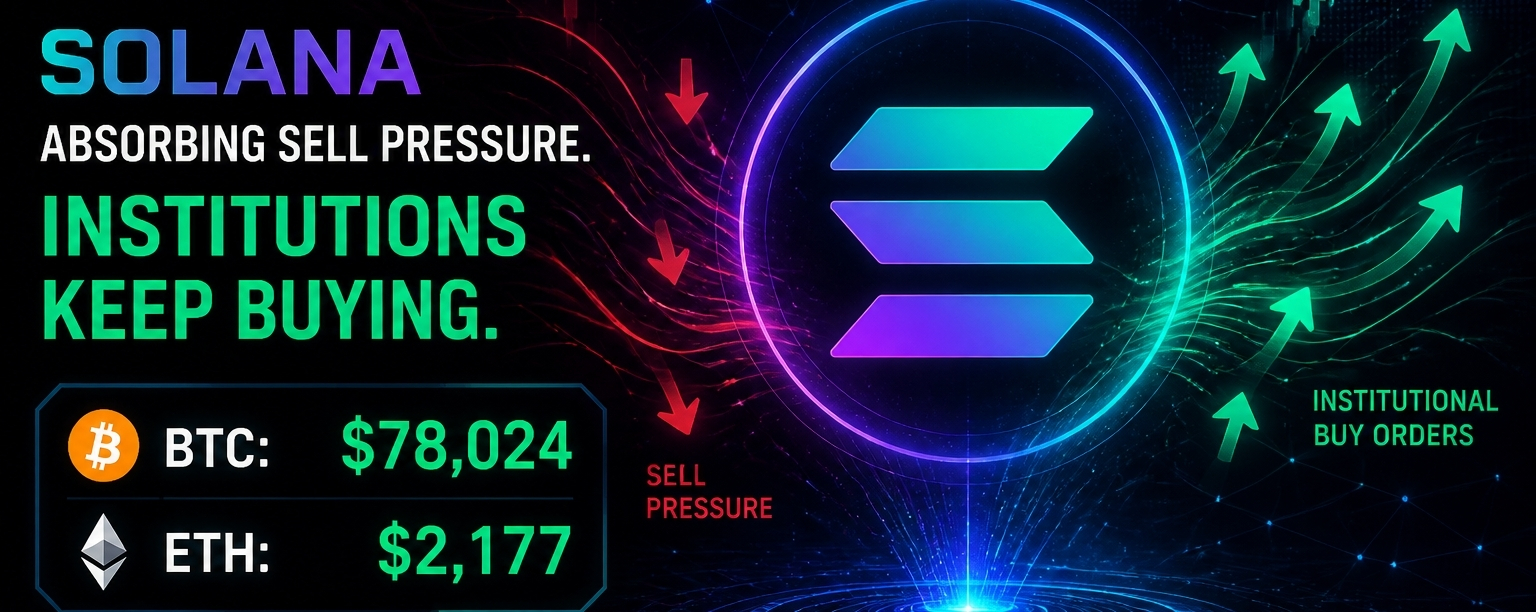
So who was on the other side of all that selling? Someone absorbed that pressure without flinching, without moving price into the red. That's not chart structure holding the floor. That's institutional buying, quiet and patient. Most traders were watching moving averages while the real action was happening in the net flow data.
The Institutional Picture Nobody Priced In
This week got loud on the fundamental side. May 14 was a busy day for $SOL.
Dartmouth University's endowment, an actual Ivy League institution, took a $14.5M direct stake in a Solana ETF. Not a token purchase. Not a fund allocation. A direct, deliberate bet on SOL exposure from people whose entire job is to protect generational wealth. Weekly spot ETF inflows are sitting at $39.23M, about 0.071% of SOL's market cap. Modest, yes. But the trend of who is buying matters as much as how much.
Same day, Western Union launched USDPT, a dollar-backed stablecoin built on Solana, issued by Anchorage Digital Bank. 24/7 settlement. Institutional-grade infrastructure. Western Union moving 150 years of payment legacy onto your chain is not a small thing. That's a regulated payment rail endorsement from one of the most recognizable money-movement brands on earth.
And the CLARITY Act cleared the U.S. Senate Banking Committee, moving toward a full Senate vote. The provisions in that bill could formally qualify Solana as a mature blockchain, and create safe harbors for its DeFi developers and validators. That's regulatory clarity that the entire ecosystem has been waiting years for.
Three separate fundamental catalysts, one day. And SOL is down 3.31% today trading at $86.27.
Where Price Is Actually Sitting
The technicals here are honest. SOL is caught in a tight spot. The immediate ceiling is the Fibonacci 0.236 level at $86.09, which it keeps bumping into. Lose the 0.382 Fib at $83.01 and the door opens to the $78 zone, which is the critical level traders have been watching.
24-hour range has been $85.69 to $89.96 with $2.40B in volume. The volume is real, the range is compressed. That kind of coiling usually breaks in one direction fast.
The setup for fam watching the chart is clear: either the institutional demand that silently held April's floor shows up again and SOL reclaims above $89 with momentum, or ETF inflows continue their seven-month decline and the fundamentals don't translate into bid pressure in time.
The Real Question for May
It's not whether SOL can bounce. Of course it can. The question is whether the buyers who quietly absorbed 1.8M SOL in a single April session are still positioned and ready to absorb the next wave of distribution.
BTC is at $78,024. ETH Is at $2,177. The whole market is in a risk-off posture. That macro weight sits on SOL regardless of what Dartmouth does or what Western Union launches.
But here's what I keep coming back to. When was the last time a coin had an Ivy League endowment buy in, a legacy payments giant launch on its network, and a landmark regulatory bill clear committee all in the same week, while trading below $90?
The fundamentals are screaming one thing. The price is saying another. That kind of divergence doesn't last forever. It resolves, one way or the other, usually faster than people expect.
Watch the $83 level. Watch whether ETF inflows accelerate or fade over the next two weeks. And watch the exchange net flow data because that told the real story in April when everyone else was reading the candles wrong.