
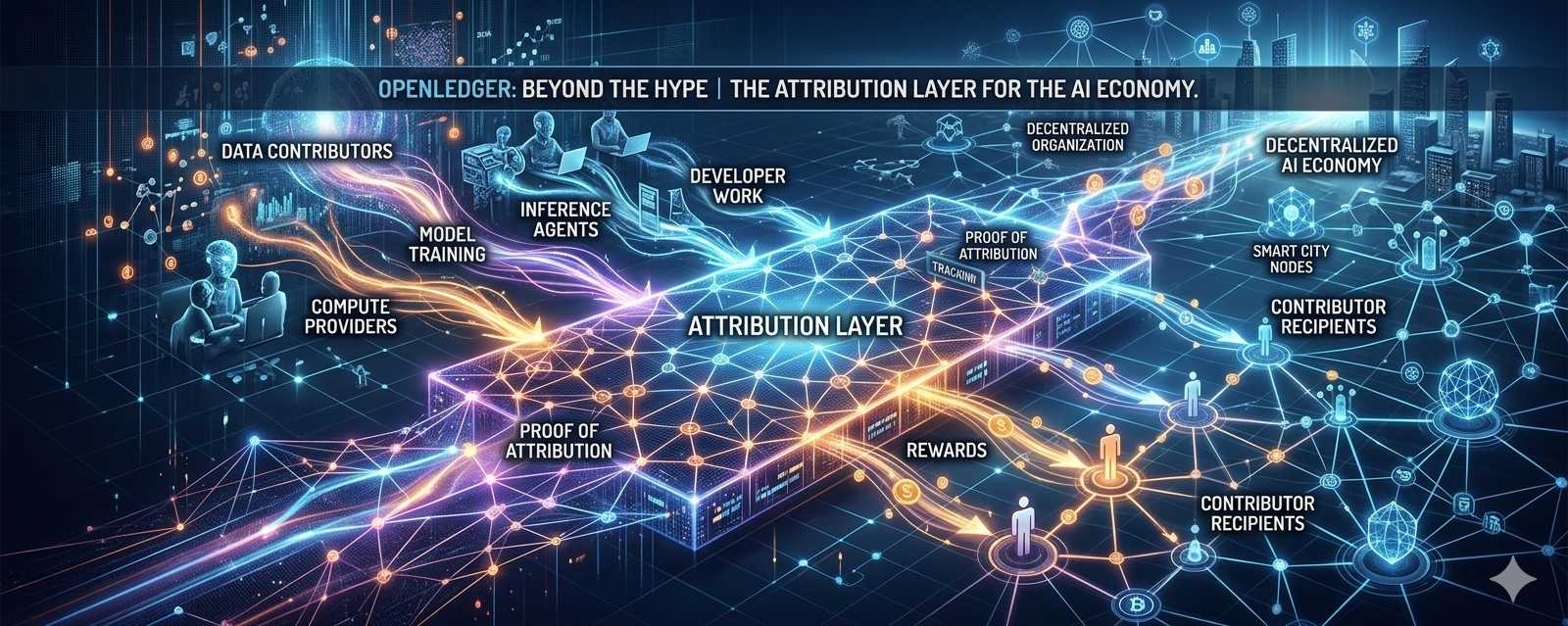
I think a lot of people still misunderstand what OpenLedger is actually trying to build. The moment anything in crypto gets connected to AI, the market instantly throws it into the same bucket as every other trending narrative project. People start talking about hype cycles, AI agents, token pumps, and speculative attention before they even look at the structure underneath. But after spending time digging deeper into OpenLedger, it honestly feels like something different is quietly forming here. This does not look like a project built only around AI excitement. It feels more like an attempt to solve one of the biggest unanswered problems in artificial intelligence itself, which is figuring out who deserves value when AI systems create something useful. That question sounds simple on the surface, but the deeper you think about it, the more important it becomes. AI does not appear out of nowhere. It is built from data, infrastructure, training, refinement, computation, and people contributing at different layers. Yet most systems today still reward value in a very centralized and unclear way. OpenLedger seems to be focusing directly on that imbalance, and that is why Proof of Attribution stands out to me more than the usual AI marketing narratives floating around crypto.
What makes this interesting is that OpenLedger is treating attribution almost like economic infrastructure instead of just a transparency feature. In most AI ecosystems today, the people or systems contributing to intelligence creation are rarely compensated fairly because there is no efficient way to measure contribution across the full process. Data contributors often disappear into the background, model improvements become difficult to trace, and inference participants are usually invisible in the final value chain. OpenLedger is trying to structure this differently by creating a framework where contributions can actually be tracked and verified as AI systems operate. Data enters the network, models learn from it, agents generate outputs, and attribution mechanisms help determine where rewards should flow based on measurable impact. That changes the entire dynamic because verification is no longer just something happening after the work is done. It becomes part of the system itself. The more I think about it, the more it feels like OpenLedger is less focused on building another AI product and more focused on building the accounting layer behind decentralized AI economies.
I also think people underestimate how important transparent incentive systems become once ecosystems start growing. When contributors trust that their work can be measured and rewarded properly, participation naturally becomes stronger. Developers are more willing to contribute, data providers have clearer incentives, and systems become easier to coordinate because the economic logic is visible instead of hidden behind centralized decision-making. Once that kind of infrastructure becomes integrated into workflows, it usually becomes difficult to replace because going back to opaque systems creates friction for everyone involved. That is why attribution systems can become surprisingly sticky over time. In traditional AI environments, the distribution of value is often unclear and politically messy. OpenLedger is trying to remove some of that uncertainty by making contribution itself part of the settlement process. If that approach actually scales, then OPEN starts looking less like a speculative AI token and more like infrastructure that routes value through machine intelligence networks.
The market right now still mostly values AI crypto projects based on attention. If something captures enough hype, people assume the token has value. But hype fades quickly, and most narratives eventually rotate into the next thing. Infrastructure is different because infrastructure gains strength when ecosystems start depending on it. That is the part I think many people are missing with OpenLedger. The long-term opportunity may not come from competing for attention with every new AI project entering the market. It may come from becoming part of the system that determines how value gets distributed as decentralized AI grows larger and more complex. As AI networks continue evolving, the need for attribution and compensation layers will probably become unavoidable because intelligence creation is becoming increasingly collaborative. Multiple systems, datasets, agents, and contributors will all interact together, and without proper attribution frameworks, reward distribution becomes inefficient very quickly. OpenLedger seems to be positioning itself exactly in that gap before the rest of the market fully realizes how necessary those systems could become.
I am not saying everything is already guaranteed or fully priced wrong today, but I do think the market still views OpenLedger too heavily through a short-term narrative lens. Most people are still asking whether AI tokens will stay relevant this cycle, while OpenLedger appears to be asking a much deeper question about how AI economies themselves should function. Historically, once industries mature, the real value often shifts away from the flashy applications and toward the infrastructure quietly coordinating everything underneath. And when that transition happens, the repricing is usually fast because people suddenly realize the system has become dependent on tools they previously ignored. That is why OpenLedger feels important to watch. It is not only trying to participate in the AI conversation. It is trying to define how contribution, ownership, and compensation work inside decentralized machine intelligence systems. And if attribution eventually becomes a requirement rather than an option, then the role OpenLedger is building toward could end up being far more significant than most people currently expect.
